



SHARE:

Workforce Readiness
Florida's educational system is committed to growing a prepared workforce at every level.
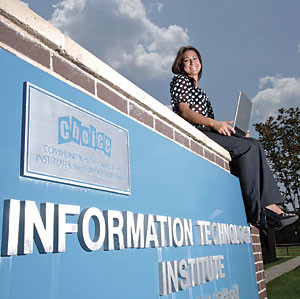 At the CHOICE Information Technology Institute, high schoolers earn college credits and professional certifications [Photo: Ray Stanyard] |
Getting the Jump on Careers
Florida lawmakers have given the green light to making sure that all Florida high school students receive the kind of rigorous, relevant education that is most responsive to business needs and which will translate into jobs following graduation.Signed into law by Gov. Charlie Crist in July 2007, the Florida Career and Professional Education Act requires every school district in Florida to:
- Develop a five-year strategic plan to address emerging labor market needs with appropriate coursework and industry certifications by June 2008
- Have at least one career and professional academy operational by the beginning of the 2008-2009 school year
| At A Glance: Florida Education |
Public Schools (K-12) | 3,687 |
| Average Teacher Salary (K-12) | $45,296 |
| Pre-K-12 Enrollment | 2,662,701 |
| Pre-K-12 Per-Student State & Local Funding | $6,850 |
| State Universities | 11 |
| Community Colleges | 28 |
| Independent Colleges & Universities of Florida (ICUF) | 28 |
| Non-Public Postsecondary Schools (including technical & trade schools) | 786 |
| Public Technical & Trade Schools | 47 |
In addition, high school students must earn at least four of their eight elective credits in a Major Area of Interest such as a career and technical program or academic content area. Beginning in 2011, Florida high school diplomas will show a specific major, not as a certificate of mastery but as a visible indication of a higher-than-average level of expertise in a particular subject or skill such as culinary arts or computer programming.
And many Florida high schools already offer career academies — small-group learning opportunities in which students receive firsthand exposure to a particular career field.
Taking it up a notch
The Florida Career and Professional Education Act takes workforce preparation to a new level by ensuring that core courses are specifically designed to address emerging academic and labor market needs and to meet the requirements for industry standards. In addition, career and professional academies have new muscle. The curriculum they offer must now be industry-specific and aligned directly to a priority workforce need as identified by the regional workforce board. Students who complete the rigorous academic curriculum offered at career and professional academies receive a standard high school diploma, the highest available industry certification and opportunities to earn postsecondary credit.