


According to data from U.S. Citizenship and Immigration Services, Florida's public universities with the largest research operations appear to dominate H-1B hiring:
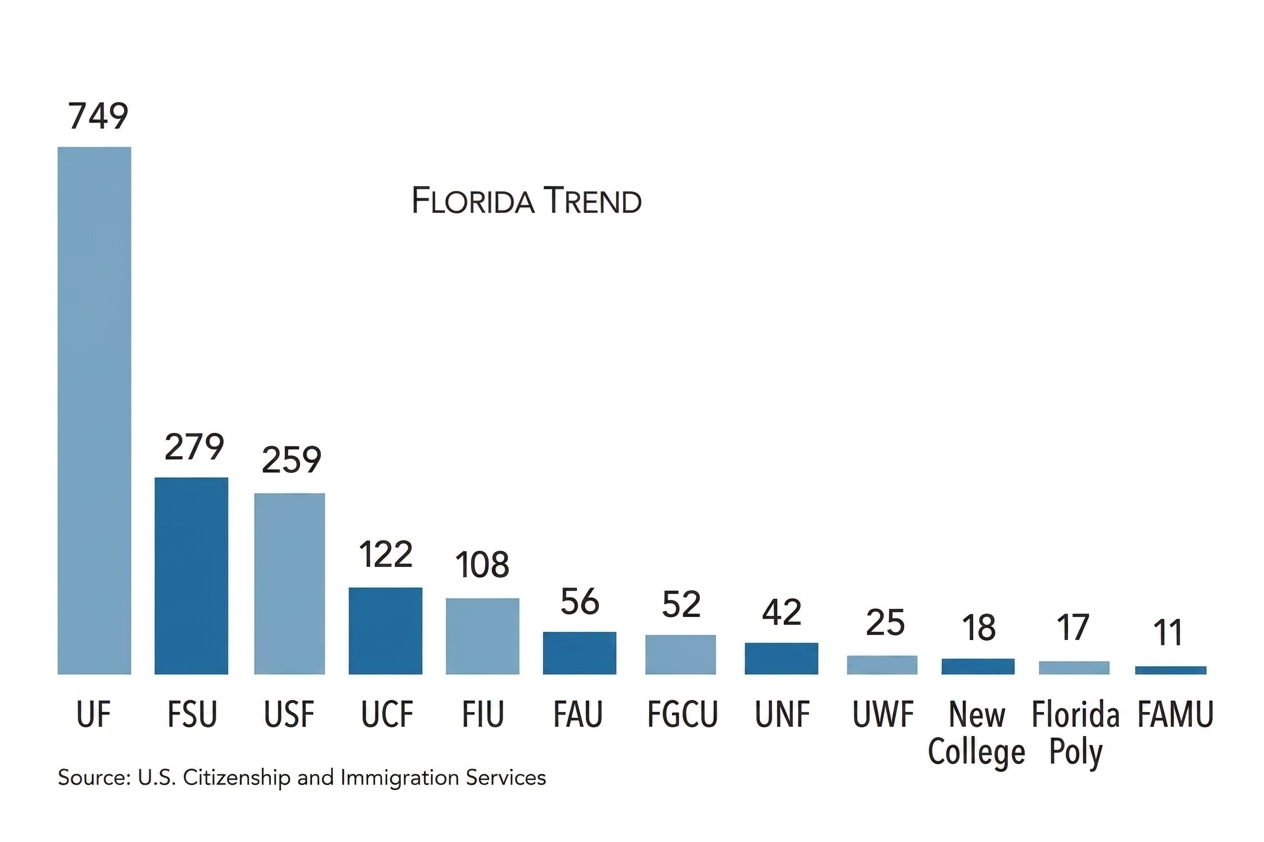
The University of Florida, with its $1.33 billion in research last year, is home to the most H-1B visa holders among Florida's educational institutions. Its three-year count — 749 approved applicants — was the third largest among any Florida employer.
Florida State University had 279 H-1B visa holders — the second most of Florida's public universities. Its research budget last year reached $487 million.
The University of South Florida, with its $531 million in research last year, followed with 259 successful H-1B visa applications from fiscal years 2023 to 2025.
Notably, several private universities are heavy users of the H-1B program. Over the last three fiscal years, the University of Miami had 388 approved H-1B petitions, ranking No. 6 among all Florida employers. Embry-Riddle Aeronautical University had 226 H-1B petitions. The private schools are not subject to the BOG's H-1B hiring pause.
Estimated H-1B Headcounts at Florida's Public Universities (2023-25)
While public data on how Florida universities use H-1B visas is limited, federal data reveals the count of approved petitions for initial and continuing H-1B employment per school per fiscal year. To get an idea of current H-1B headcounts, Florida Trend compiled approved petitions at each of the state's 12 public universities from fiscal years 2023 to 2025. (The H-1B visa is valid for up to three years and renewable for another three years.) It's unclear what percentage of the approved petitioners are actively working at the universities.