

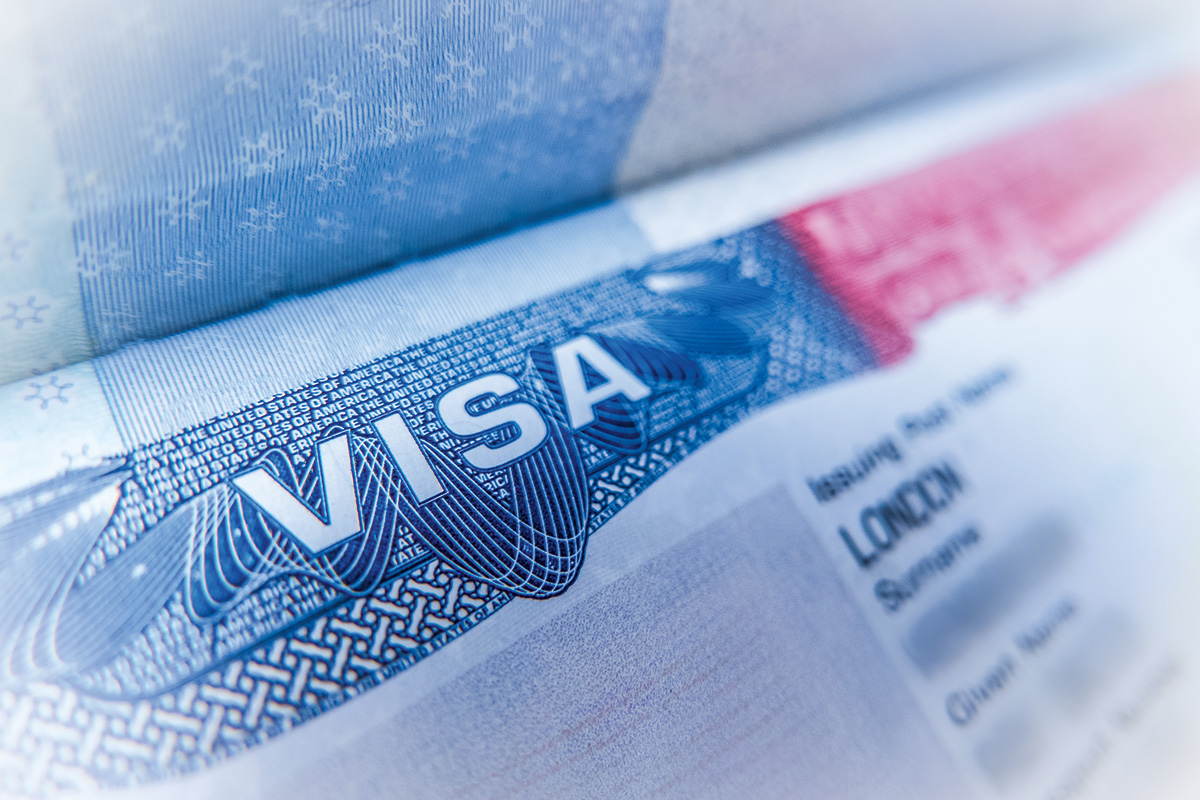
Last fall, the Trump administration launched "Project Firewall," a nationwide crackdown on the country's longstanding H-1B visa program.
Since 1990, the H-1B program has allowed U.S. employers to temporarily hire foreign professionals in specialty fields — from engineering to life sciences to medicine — requiring technical knowledge and a college degree. Tech companies such as Amazon, Meta, Microsoft, Google and Apple hire H-1B visa holders by the thousands. Last fiscal year, Florida's top beneficiaries were global consulting practice PricewaterhouseCoopers Advisory Services (861 approved visas), Tampa-based tech staffing firm Kforce (493) and Maitland-based medical staffing firm Avant Healthcare Professionals (309).
In a September proclamation, President Donald Trump cast the program as exploited, saying its recent uses displace American workers with "lower-paid, lower-skilled labor" from other countries. His solution under the U.S. Department of Labor's Project Firewall: slapping a $100,000 fee on new H-1B applications for at least a year, with discretionary exceptions. The initiative also calls for strengthened enforcement and compliance investigations — all moves the administration says will help curb abuse while preserving access to top foreign talent.
The federal charge is shifting state policies across the country. In Florida, the conversation has coalesced around higher education. The state's public and private universities, and sometimes colleges, have traditionally used H-1B visas to recruit international faculty, researchers and physicians.
In an October press conference, Gov. Ron DeSantis asked the Florida Board of Governors (BOG) — the largely appointed group that oversees the state's 12 public universities — to "pull the plug" on the use of H-1B visa holders. Public universities accounted for 6% of Florida's 10,000-plus approved H-1B visa applications last fiscal year.
In lieu of an outright ban, Ray Rodrigues — chancellor of the State University System of Florida — proposed a one-year H-1B hiring pause to the BOG in January, pointing to Trump's $100,000 application fee. The price tag alone, he said, called for a study of how universities utilize the H-1B visa program, whether those areas are of "strategic need," and if H-1B employee salaries are comparable to market rates. On March 2, the BOG voted 17-2 to stop hiring new public university employees under H-1B visas until Jan. 5, 2027.
The moratorium is murky, both in its reach and application.
It won't impact existing employees with H-1B visas, nor those whose visas are up for renewal. But it appears to restrict universities from hiring any new employees under H-1B visas, even those who already have a visa and are working in the U.S. — who policy experts say are not subject to the $100,000 fee. The Board did not respond to clarifying questions by press time.
Rodrigues told FLORIDA TREND the BOG was actively studying the H-1B program, and updates would be discussed at future meetings as they become available. Should issues emerge, the BOG could use emergency regulations to respond in 72 hours.
"This temporary suspension and study give us time to make informed policy decisions," Rodrigues said in a statement. "Our primary goal is to ensure a high-quality education for our students, while also maintaining operational efficiency as good stewards of taxpayer dollars."
While it's still too early to gauge its full impact, the H-1B hiring freeze clearly raises more questions than answers. Although the move leaves existing visa holders untouched, it halts what some Florida faculty call a key recruitment pathway. Critics fear potential consequences could outlast the pause itself — shrinking hiring pools, hampering research and teaching and tarnishing Florida's international reputation.
"The H-1B program is routinely used at any university in order to bring the best talent. ... The concern, of course, is that any pause in the ability to hire folks in those world-class areas of expertise leaves Florida behind competing states," says David Simmons, a University of South Florida professor of chemical, biological and materials engineering and the school's faculty senate president.
A HAZY PICTURE
With schools largely tight-lipped, it's difficult to fully grasp the scale of H-1B use or to quantify the real impact of the hiring freeze.
Most of Florida's 12 public universities declined to speak about their H-1B headcounts when approached by Florida Trend (see "Weighing In" on page 76). The only readily available public data comes from U.S. Citizenship and Immigration Services, which reveals how many H-1B visa applications have been approved per university each fiscal year. Finding out where such employees work within each school — and their pay and skill levels, plus what research or services they're responsible for — requires a bit more digging.
"By pausing H-1B hires, we are losing the opportunity to hire the best and brightest for at least one — if not two or more — hiring cycles because those who may have applied will go somewhere where they feel welcome." — Jennifer Proffitt, FSU communications professor and vice chair of the faculty senate, at a Feb. 25 FSU Board of Trustees meeting
Some insights come from the Institute for Progress (IFP), a Washington, D.C.-based nonpartisan think tank for accelerating scientific, technological and industrial progress. Using data obtained via a Freedom of Information Act request, the organization analyzed successful first-time H-1B petitions from Florida's public universities between 2017 and 2022.
The records were "highly censored" and riddled with blanks, says Connor O'Brien, an IFP High-Skilled Immigration Fellow. (Half of the petitions, for example, were missing job titles.) But his analysis of available data shows that at least one in every four first-time H-1B petitions filed in that timeframe were for recruiting physicians, Ph.D. scientists or STEM faculty. Faculty interviews corroborated this insight, with sources telling Florida Trend their universities' H-1B visa holders typically work in departments related to fields like engineering, AI, medicine and the sciences at large.
"The sooner that we can end this moratorium, and the sooner we can return to leveraging the H-1B program for the benefit of Florida taxpayers, the better off our universities will be, and the better off (the state will be). ... This is really a tragedy for the state of Florida." — David Simmons, USF professor and faculty senate president
The data also reveal where that talent comes from. About one-fifth (22.5%) of the first-time H-1B petitioners were born in China and 16% were born in India. Brazilians, South Koreans and Canadians each accounted for around 5% of the requests. Countries such as Iran, the United Kingdom, Turkey, Germany, Colombia and Italy each contributed a few dozen hires.
Nearly all applicants were highly educated. Almost every first-time H-1B petitioner (96%) had either a master's, doctoral or professional degree. Of those, 76% had a doctorate. Only one applicant — a Florida State University engineering teacher from Lebanon — was listed as not having a college degree. (Twenty-five new H-1B petitioners did not list an education level.)
"The goal here is not to preclude the ability to hire people who are needed in certain areas of need," such as in "high acuity" specialties like health care, medicine and engineering, said Alan Levine, chair of the Florida Board of Governors, at a January committee hearing. "The goal here is to collect information. ... There are other visa programs; we're not stopping the use of visas. It's just this one program where we need to gather more information and then make informed policy decisions."
Pay levels are a bit harder to parse out. Salary data appear to vary widely, from modest academic stipends to highly paid research positions. Within the 2017 to 2022 dataset, reported annual salaries of first-time H-1B petitioners ranged from $15,660 for a USF visiting instructor in political science from the United Kingdom to around $578,000 for a chemistry researcher from China at Florida International University.
Median salaries generally tracked with institutional scale. Among employers, Florida A&M University had the lowest median salary for its H-1B petitioners, coming in at $54,500. Florida Gulf Coast University, USF, New College of Florida and Florida International University offered median salaries in the $60,000s. The University of West Florida, Florida State University, Florida Atlantic University, Florida Polytechnic University, University of Central Florida and University of North Florida reported median salaries in the $70,000s, and the University of Florida reported in the $80,000s.
There are elements of truth within the main critiques levied at the H-1B program, O'Brien says, referencing Trump's claim that private tech companies use it to hire foreign workers who will work in the U.S. at lower costs. He also acknowledged some "questionable" uses of the program within Florida's public universities, such as an H-1B hire from Spain who's an assistant swim coach, which DeSantis referenced in his October press conference.
But, taken together, O'Brien's data complicate the narrative that universities are using the H-1B program to import cheap labor rather than hire qualified Americans. In March, he suggested the BOG consider adopting several exceptions to the proposed hiring pause for "exceptional foreign-born researchers and scientists," such as international physicians and STEM professionals. No such exemptions were included.
"So much cutting-edge research happens at public universities. A lot of those research projects are funded with taxpayer money, and so it's sort of silly to cut off a lot of these projects from potentially the best scientists or the best expert. It's already hard enough to recruit top scientists when you're not limited in this way. This is an arbitrary restriction that represents Florida kind of shooting itself in the foot." — Connor O'Brien, an Institute for Progress High-Skilled Immigration Fellow