










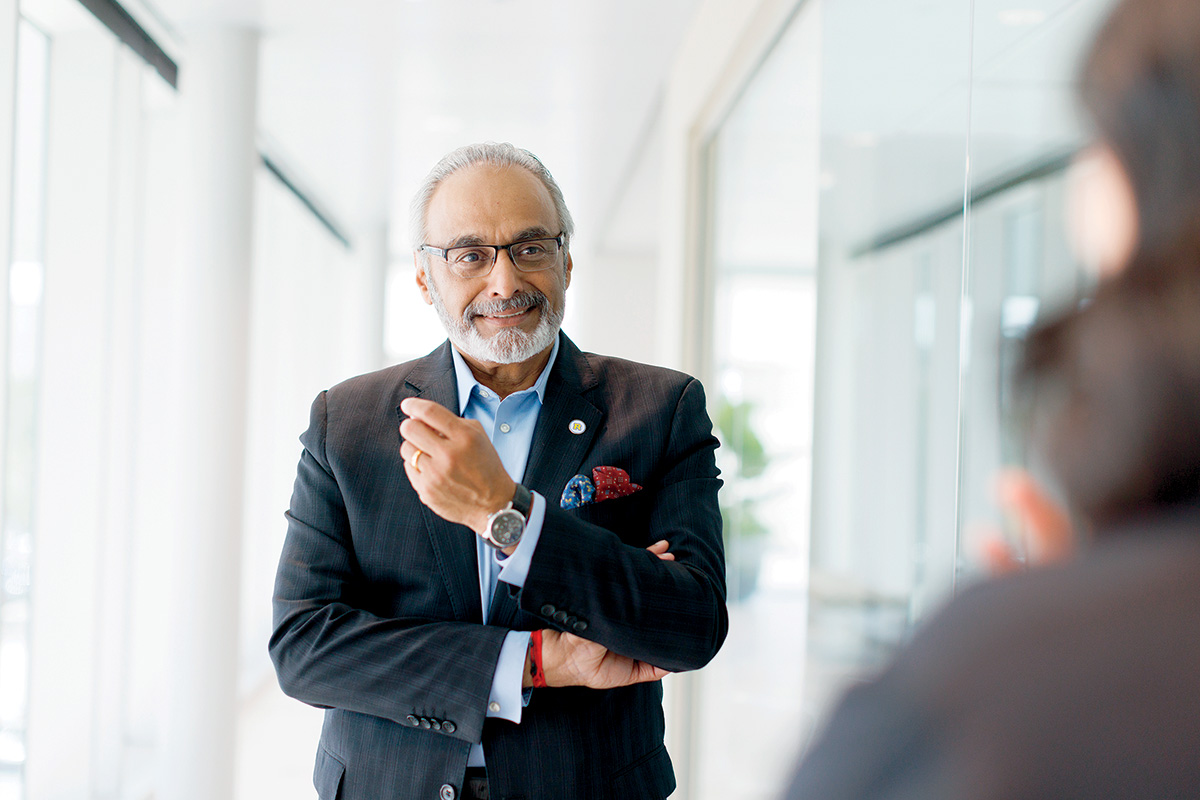
Anil Menon, dean of the Crummer Graduate School of Business at Rollins College in Winter Park, uses the term "permacrisis" to describe the onslaught of challenges the sector must confront.
"We are living through permacrisis — not a temporary disruption but a permanent condition of compounding instability: fracturing political orders, collapsing alliances and technology eliminating entire categories of certainty," he says. "The permacrisis facing nonprofits isn't one problem — it's four converging ones: surging demand for services, staffing shortfalls, government funding cuts and a fundraising environment that keeps tightening."
Thanks to its Edyth Bush Institute, Rollins has been involved in nonprofit and philanthropic thought leadership for more than 25 years. In February, it launched a complementary initiative, the Rick Goings Institute for Management and Executive Leadership, which will welcome leaders from both the nonprofit and for-profit sectors. Menon will serve as its CEO, and he believes technology can play a bigger role in the nonprofit world.
"Here's the irony: Nonprofits tend to view technology and artificial intelligence as antithetical to their human-first mission," he says. "But that gets it backwards. AI handles the operational burden so that leaders and staff can focus their full energy on what only humans can do — the mission itself. AI doesn't replace the human center of a nonprofit. It protects it."
But technology isn't a miracle drug for what ails nonprofits. Menon urges them to rethink their business model, organizational design and leadership structure. Technology, he says, is merely "the architecture" that makes institutional change possible.
Some nonprofit leaders are already jumping on the AI bandwagon.
"All of our executive business managers have accounts with one or more of the platforms that allow us take advantage of AI tools," says Miriam Singer, the president and CEO of Jewish Community Services of South Florida. "Whether it's to prepare proposals for grants, look for smart ways to fundraise, share stories about client cases or for development purposes, we're always looking at opportunities in terms of agility and efficiency for back-office functions. We're very much focused on a path to fully utilizing AI — where it makes sense and where it's responsible."
Sabeen Perwaiz, of the Florida Nonprofit Alliance, agrees that nonprofits can improve their systems and processes with technology. "We can't keep doing the same things the same way we have been doing for decades — that's a given," she says. "Think about database management; think about drafting PowerPoint presentations — the mundane work that takes hours and hours but that's not necessarily (related to) strategy or providing services."
A technological overhaul, however, comes with a price — one that small nonprofits might not be able to absorb. AI also introduces privacy risks that must be mitigated.
"The sector needs capacity to create AI policies, build their infrastructure and get subscriptions for all of these new tools that are available," Perwaiz says. "They're not all free. (Nonprofits) need to make sure that all staff are trained and are using these tools appropriately, because they have confidential client information that they can't put into a free system and share externally. There are compliance measures that come into play."