













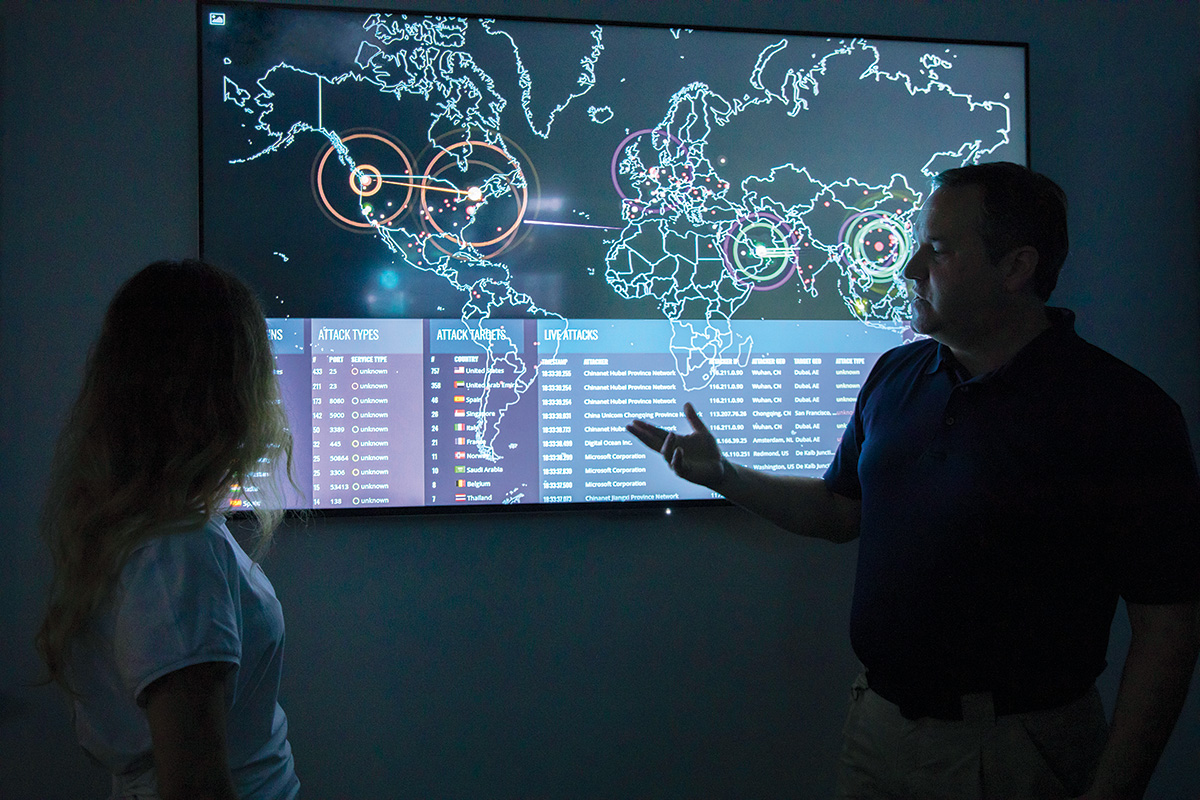

Her first day on the University of South Florida campus, during orientation, Karishma Tallreja stumbled across a table promoting cybersecurity. The tech-savvy international student from India had originally enrolled in computer science. But after learning about the school's cyber offerings, she decided to swap majors that very same day. The immediate impact of protecting data from threats — not unlike a knight protecting a castle under siege, she says — drew her in.
Now a junior, the 20-year-old is battling to secure a position in the field. She applied for 340 cybersecurity internships and landed just 12 interviews. "The search itself was not easy. To be very honest, it's very competitive," especially for international students, says Tallreja, who eventually accepted a security consultant summer internship at Google.
Students are pouring into cybersecurity programs across the state. USF's Bellini College of Artificial Intelligence, Cybersecurity and Computing — established in 2024 — is already nearing 700 cybersecurity students. Since 2020, the University of West Florida jumped from 20-some cybersecurity students to more than 300 today. A master's degree in cybersecurity and privacy is the University of Central Florida's fastest-growing program, surpassing 100 students since it was created in 2021.
National cybersecurity employment is projected to grow 29% between 2024 and 2034, according to the U.S. Bureau of Labor Statistics — and Florida would seem to be ripe with opportunity. In 2024, the state ranked third nationally for internet crime complaints, with 52,000 reports and losses topping $1 billion. Meanwhile, there are about 24,000 cybersecurity-related job openings in the state, according to workforce tracker CyberSeek.
Yet for students like Tallreja and Oscar Lin, a 22-year-old senior at Florida Polytechnic University, prospects seem at odds with that data. He had switched his major from software engineering to cybersecurity in pursuit of a better job market. Still, he has submitted more than 100 applications this semester alone. "Applying that much, it does take a toll on you," he says. "They say there's a shortage, but then at the same time, it's super competitive."
'TALENT TRANSFER' PROBLEM
Enticed by growing pools of talent and customers, data security tech company Varonis relocated its headquarters last year from New York to Miami's Brickell neighborhood. It plans to expand its statewide workforce from today's 20-something employees once its 17,900-sq.-ft. office is built out.
As early as this winter, Varonis will start recruiting from the nearby University of Miami and schools with "the most hands-on practical exercises and experience that they allow," says Dana Shahar, the company's chief human resources officer. But it's specifically in need of employees in supporting roles, like sales and marketing — not necessarily cybersecurity professionals.
"What we see in general in the trends in the market is entry-level (applicants) are now finding it very difficult to find a position and start their career. ... People who are at the end-tail of their career, if they're being let go, they will find it difficult to find another role," Shahar explains. "But everyone in between there — the experienced people that are still very relevant — there's a lot of competition around that talent."
It's a cyber conundrum: Cybersecurity graduates are reporting difficulty finding jobs in the field. Yet 80% of IT and cybersecurity professionals say there aren't enough workers to meet growing needs in the sector, according to the inaugural 2025 CyberBay Survey from USF, Bellini Capital and Cyber Florida. The report points to "unrealistic requirements" for entry-level positions, leading to constricted hiring pipelines and overlooked candidates.
For Brian Murphy, founder and CEO of Tampa-based cybersecurity company ReliaQuest, it's a matter of investing in the talent pipeline. The fast-growing company hires a few hundred cybersecurity employees every year with a focus on shaping new talent. (ReliaQuest's revenue is growing by more than 30% year over year.) It annually spends millions of dollars on proprietary training content and cyber simulations for teaching new employees. More than 80% of its promotions come from within.
Murphy says few, if any, other cybersecurity companies build their future talent to a similar scale.
"There's this mantra in the market that there's this shortage of trained and skilled cybersecurity professionals — that there's a million open jobs, or whatever number you believe that they advertise," he says. "While there may be a shortage of trained and skilled cybersecurity professionals, there's no shortage of people that would like to be trained and skilled in cybersecurity. So, this is not a talent problem. This is a talent transfer problem."
Around 75% of the 2025 CyberBay Survey participants believe existing undergraduate cybersecurity curricula are missing important elements. Programs may focus too much on theory — or, what respondents labeled "book knowledge" — instead of practical application. Some may need to integrate more lessons on soft skills and ethical decision-making or adapt better to new technology like artificial intelligence.
Cybersecurity professionals overwhelmingly told Florida Trend that, above all, they're looking for graduates with more hands-on experience. That could look like an internship, or a capstone project, or entrepreneurship. It could mean leadership positions in cybersecurity clubs or related industries, such as coding, or experience with penetration testing and security operations centers.
"Companies are looking for the ones that are going the extra mile," Shahar says.
MEETING INDUSTRY NEEDS
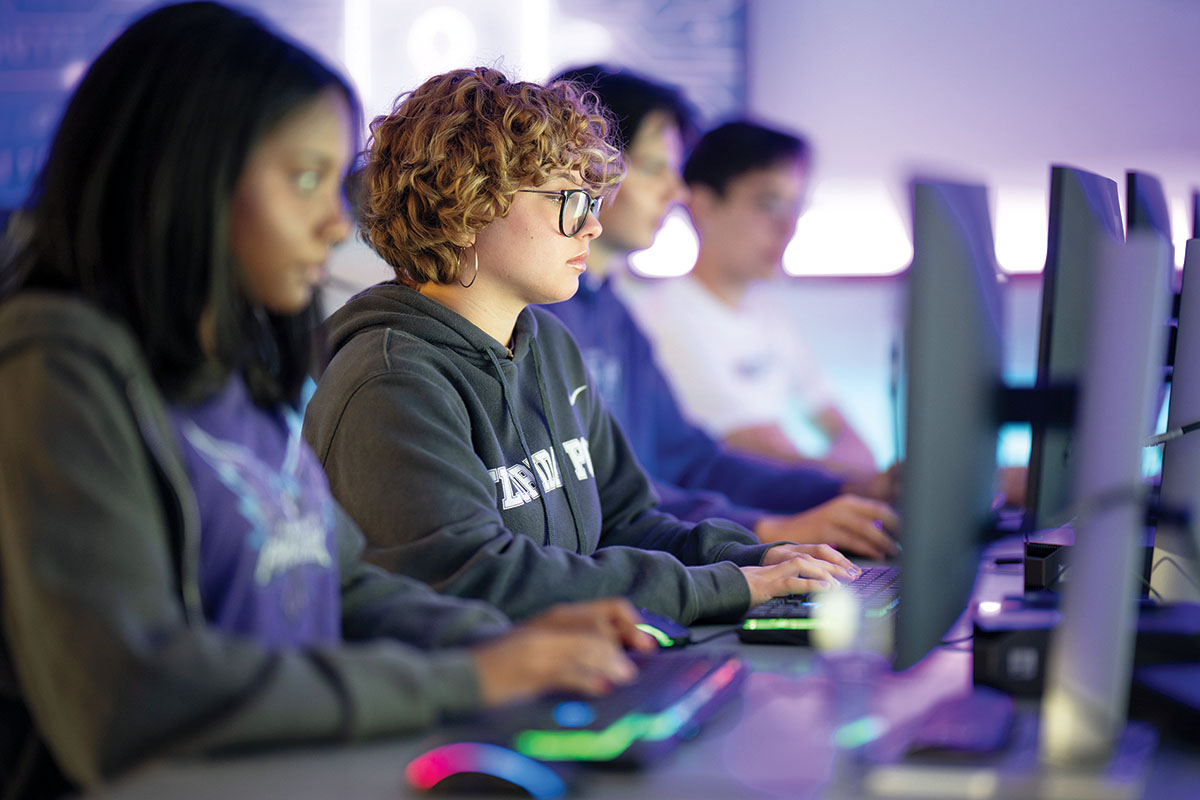
Deep within Florida Polytechnic University's Innovation, Science and Technology Building — the domed structure of curved white metal gleaming alongside Interstate 4 in Lakeland — four workers train their eyes on computer screens. Their hands flit over black keyboards backlit by rainbow glows. Ambient music hums in the background.
The room, traced by purple neon lighting, is a security operations center that protects Florida Poly from cybersecurity attacks. University-wide data pools here for review. The eagle-eyed quartet fending off infiltrators from their desk chairs? Cybersecurity students protecting their school from phishing attempts and other threats while gaining real-world workforce training.
"We've had students embedded in our cybersecurity operations since the birth of the university, but never like this — not to where students are really powering our cybersecurity posture," says Cole Allen, the school's CIO and vice president of information technology. "We really do rely on them. ... This is really our data and cybersecurity here at Florida Poly."
The student-powered security operations center launched last October with the help of Lakeland-based cybersecurity company Sittadel, which provides operational and technical support. Their partnership is destined to grow: Around 30 students will rotate through the center annually, and $2.9 million in federal funding will help further their cybersecurity research and development. By this fall, the team wants to replicate the model at other schools with a threat intelligence network for reporting attacks and proactively coordinating defenses. Eventually, it could work with local businesses and municipalities.
It's the latest attempt from Florida's network of universities and colleges to incorporate more hands-on learning in their cybersecurity education — a direct response to feedback from an industry teeming with demand.
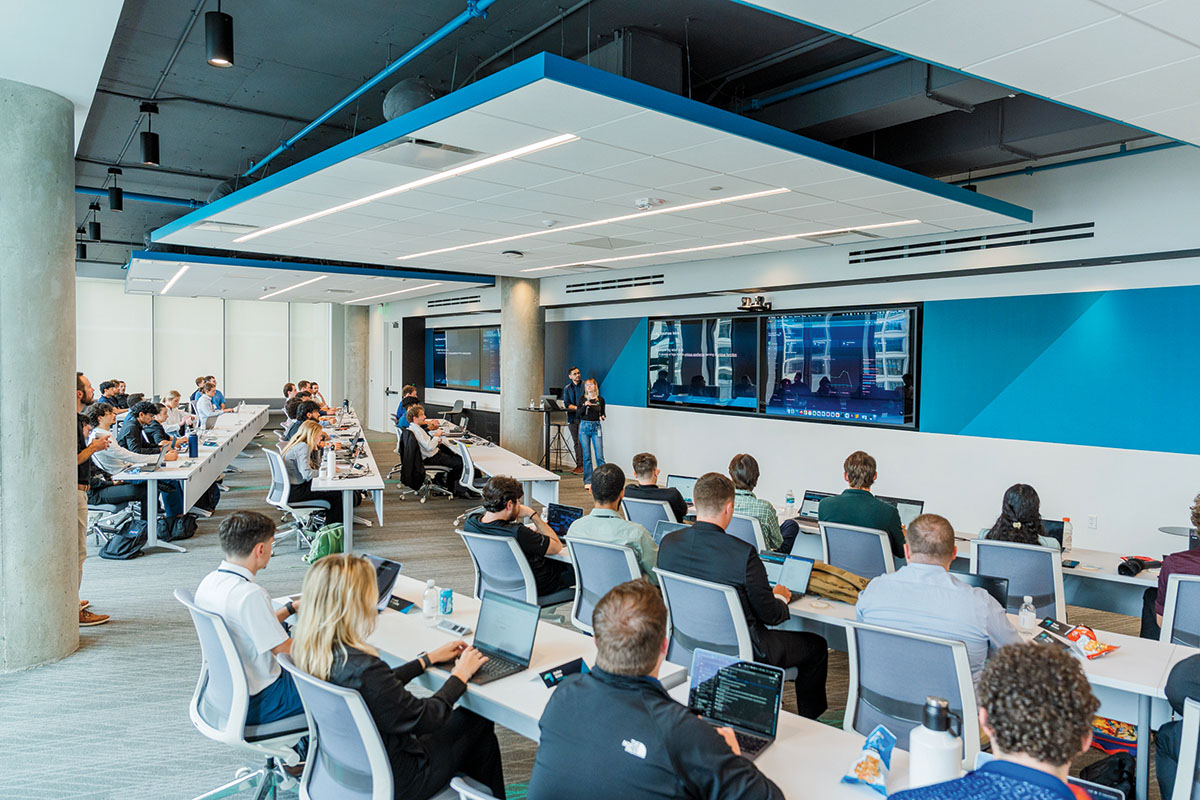
At USF, that push comes in the form of a partnership with ReliaQuest. Since 2018, the company has hosted a four-week lab for cybersecurity training "to prime the talent that we need to fuel our growth," CEO Murphy says. Each graduate receives a certificate of completion in cyber analytic fundamentals and a chance to interview for a paid internship or full-time position with ReliaQuest.
Over the past eight years, 432 USF students have completed the lab. ReliaQuest has hired about 200 of them. This past cycle, 110 applicants competed for 60 spots. "I don't think anybody has a model like that. Very valuable," says Sudeep Sarkar, dean of USF's Bellini College of Artificial Intelligence, Cybersecurity and Computing.
Keeping its cybersecurity curriculum updated with the quickly evolving industry is top of mind for schools like Nova Southeastern University, which lean on industry partners and accrediting bodies for guidance.
Lately, the private university has been weaving AI throughout its cyber courses. Most recently, it worked with the National Centers of Academic Excellence in Cybersecurity — a National Security Agency program setting standards for cybersecurity education — to help build a new Cyber-AI designation for schools. Last September, NSU was the first in the country to receive the designation for its master's program in artificial intelligence cybersecurity. (The University of West Florida became the second in November.)
Graduate school offerings help fulfill the cybersecurity industry's intermediate-level workforce needs. At NSU, where graduate students comprise 70% of enrollment, many cybersecurity enrollees already have the needed technical components. The school's College of Computing, AI and Cybersecurity offers 10 master's programs to help working professionals and career changers level up their leadership and management skills.
"Especially in research and development, we're seeing the need for students at that graduate level," says college dean and NSU Associate Provost Meline Kevorkian. "You can get jobs at the undergraduate (level), but if you really want to go out, make the big bucks and make a difference, you need those graduate degrees."
Competitive Edge
By the numbers, UCF is the winningest cybersecurity competitor in Florida — and one of the top teams in the nation. Of 238 competitions to date, its C3 Team has earned a first-, second- or third-place trophy 196 times. "We come back with a trophy over 80% of the time," says faculty advisor Tom Nedorost.
CLUBS AND COMPS
In spring 2016, David Maria was a computer engineering major finishing his freshman year at the University of Central Florida. He had secured a spot on the C3 Team, the school's application-only cybersecurity competition team that competes around 30 times per year.
The group took home first place at the prestigious National Collegiate Cyber Defense Competition that year — and Maria took home a cybersecurity internship offer with Uber, which recruited him onsite after the win. He'd later gain an internship with Facebook through UCF's Collegiate Cyber Defense Club, informally known as Hack@UCF, which he eventually led as president. Before his senior year, he had secured an $80,000-salary job offer with Maryland-based cybersecurity company Cisco Talos Intelligence Group.
All the while, he never took any official cybersecurity coursework. "Everything I learned was through the club," says Maria, 29, now a Fort Lauderdale-based principal consultant at the Texas-based cybersecurity company CrowdStrike. "That whole community is really the best way to get hands-on experience with cybersecurity."
The trajectory is not unfamiliar to Tom Nedorost, faculty advisor for Hack@UCF and its 500-plus members. He remembers a company recruiter telling a crowd of hopefuls at the 2024 National Collegiate Cyber Defense Competition that winning teams would receive job offers. His C3 Team took home gold that year — for the sixth time.
To date, every C3 Team member has graduated UCF with multiple job offers, many of which are intermediate-level roles with six-figure salaries, Nedorost says. Michael Roberts, a UCF alumnus who works at Abbott Diabetes Care, a division of Illinois-based Abbott Laboratories, has hired at least 28 UCF cybersecurity grads. Other notable recruiters include Lockheed Martin, CrowdStrike, Amazon, Microsoft and IBM X-Force Exchange.
"Being in the competitions clearly stands out," says Nedorost. "It's way better than we can do in a classroom. It's better than we can do in a structured lab, where we're asking all the students to do certain tasks. We're putting them into something they don't know ... and that's about as realworld as you can get."
Cybersecurity extracurriculars — such as competitions and clubs — are where networking, mentorship and hands-on training seem to collide across schools.
USF hosts the Whitehatters Computer Security Club and its CyberHerd competition team. Students describe the groups as collaborative and encouraging spaces to learn from peers, network with alumni, and interface with companies like Google and IBM.
"Whitehatters is probably a place that you're going to learn most of the skills that you'll need in the workforce," says Fagan Afandiyev, a 19-year-old junior from Azerbaijan. He recently accepted a summer internship offer from Microsoft. "Coursework itself teaches you a lot of stuff, but the club is taught by students and people who were invited by students to teach. ... It's a safe space that you can ask questions."
Respondents of the 2025 CyberBay Survey suggest introducing students to cybersecurity concepts earlier, in elementary or high school. It's a mission the University of West Florida has taken in stride, as seen through its extracurricular offerings.
The UWF Center for Cybersecurity and AI hosts two annual GenCyber camps for about 30 rising seventh through 10th graders. The center's Cybersecurity Ambassadors also attend as many as 15 K-12 events a year to spread cybersecurity awareness and literacy across Northwest Florida. UWF placed second in the National Centers of Academic Excellence awards for its cybersecurity community outreach in 2023 and 2024.
Beyond youth initiatives, UWF also leads CyberSkills2Work, a free cybersecurity training and workforce development program for transitioning military members, first responders, veterans and government personnel. Since 2020, the program has prepped more than 5,000 cybersecurity professionals across 10 participating universities.
"The way we looked at it is that, regardless of how many students we get in cybersecurity majors at UWF or across the state or nation, it would never be enough because it's such a dynamically evolving field," says Eman El-Sheikh, associate vice president of the UWF Center for Cybersecurity and AI. "We're going to need beyond college graduates in order to have a well-prepared cyber workforce moving forward."
Florida's CAE-C Institutions
Florida is home to 29 institutions that are recognized by the National Centers of Academic Excellence in Cybersecurity, a program managed by the National Security Agency to set cybersecurity education and research standards.