








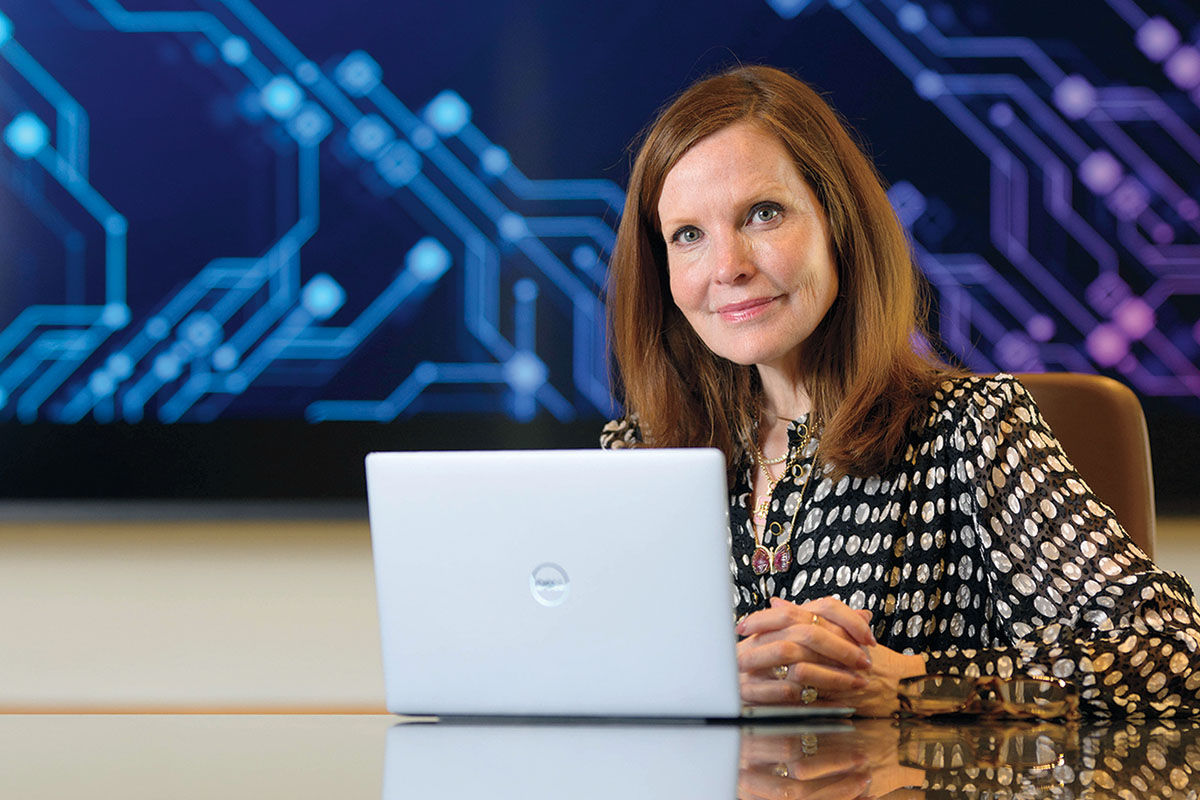
Michelle Six began her career as a professional theater actress — an unusual background for an attorney, she admits, but one that has served as an undercurrent throughout the rest of her life.
Her love of words and linguistics made her a self-described "geek" and proved to be an asset when she attended law school in her 30s. From the start, she focused on the field of electronic discovery — an early but growing endeavor to use technology for collecting, reviewing and exchanging evidence when building cases. "Through the benefit of good timing, I emerged into that scene at a very nascent time," Six now says.
She soon helmed a group of the earliest practitioners of electronic discovery (commonly known as e-discovery) at Kirkland & Ellis, the largest law firm in the world. After joining West Palm Beach-based law firm Gunster in 2023, she is now a litigator focused on e-discovery law, data privacy, cross border discovery and AI technology exploration.
In years past, litigators had to sift through physical copies of documents for court cases. Technology has introduced a new trove of data to explore — text messages, emails, DMs, cell phone videos and more. It's not unheard of to collect 50 million documents within one big case, Six says. "No one's going to sit there and pay people to look at 50 million documents. It would be incredibly burdensome. So, we relied on and became champions of the use of AI in the context of litigation to make discovery strategy more reasonable."
Within Gunster, she beta tests early-stage AI products to help the firm become more efficient. And in March 2025, she helped Gunster launch its technology services subsidiary — named Zest — to use AI tools to help enhance legal outcomes for its clients. She now co-leads what she calls "strategic technology incubation" for the company, testing new AI products in a controlled environment before deploying them on a live case.
Mid-sized law firms come to Zest for help with litigation or discovery, whether that means finding confidential evidence or sorting thousands of documents, though Six points out that it is not a platform for legal advice. The company partners with various generative AI tools — like AIDA and Epiq — to work through troves of data. Humans check its work for accuracy.
As Six puts it, Zest is enabling innovation with appropriate guardrails, making litigation faster, more efficient and cheaper. "Part of what we strive to do — and why we have that human touch element — is trying to find the right thing for the right project at the right time," she says. "These products can help us be better attorneys."
In 2023, Chicago-based legal data company Relativity named Six an "AI Visionary" for her work in the field. She has also been recognized as a Lexology Index "Thought Leader" in e-discovery since 2020.