






In 1914, Pittsburgh lumber tycoon Edward Vose Babcock Sr. purchased a pocket of agricultural land in Southwest Florida. Over generations, while surrounding towns gave way to suburbs and shopping centers, the 91,000-acre Babcock Ranch remained a working landscape — home to cattle, timber, rock mining, recreational hunting and other various farming operations.
By the late 1990s, the Babcock family heirs wanted to exit the Babcock Florida Company, the corporation that controlled their assets and business operations in the state. Selling the company itself would avoid a hefty tax bill that would come with a direct sale of Babcock Ranch land — and a line of potential buyers queued for a chance to buy and develop the land. But the Babcocks had another vision — one that would keep their land in well-stewarded, sustainable green spaces.
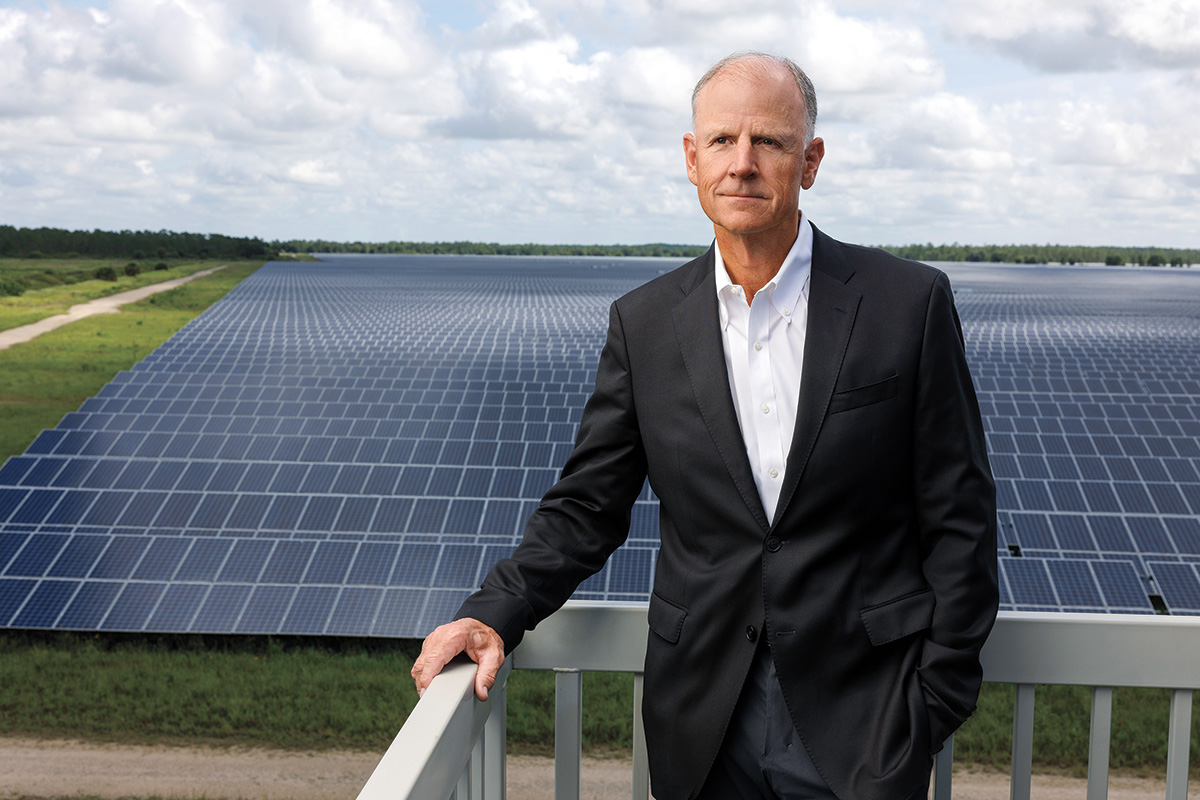
Enter Syd Kitson, a Palm Beach Gardens developer with an eco-forward mindset.
Kitson hails from New Providence, N.J, a 12,000-person town about an hour outside of New York City, where he recalls riding his bike to school, and camping and hiking along the nearby Appalachian Trail and other natural landmarks. He also had a knack for sports and went on to play football for Wake Forest University and, for a few years, in the NFL. After retiring from football in 1985, Kitson dove into development and eventually created the real estate company Kitson & Partners in Florida.
Some may find that career field at odds with a selfdescribed environmentalist. Kitson sees it as a synergy, where development can work with nature instead of against it.
Case in point: In 2006, he purchased Babcock Ranch — all 91,000 acres of it — in a complex deal for an undisclosed amount. (Some media place the sale around $700 million, but a spokesperson maintains that “the majority of what has been reported by the press is vastly overstated.”) Shortly after, Kitson sold 73,000 of those acres to the state and Lee County for $350 million — the largest land conservation deal in state history. It led to the creation of the Babcock Ranch Preserve, which connects natural areas from Lake Okeechobee to Charlotte Harbor and remains a self-sustaining working ranch.
Of the remaining 18,000-some acres — an area bigger than Manhattan — half would be preserved. The other half were designated for a new version of Babcock Ranch, one that Kitson calls “the most sustainable, the most resilient and the most innovative new town that’s ever been built.” It would be America’s first solar-powered town. It would stand resilient against Florida’s tumultuous hurricanes. And, perhaps most importantly for Kitson, the future-forward community would still feel like home for residents. None of it would be easy.
For one, there was no precedent in Florida for creating a city from scratch, Kitson says. His team had to navigate new terrain, winding through ordinances and regulations to get their master plan approved. He recalls giving presentations three to four times a day, every day, to spread awareness and garner local buy-in.
His vision would also take an enormous amount of funding. Kitson found that backing from the Washington State Investment Board, which manages public employee retirement plans and other public trust funds for the state, thanks to a senior investment officer willing to take a chance on a long-term investment. (The entity now boasts $222.5 billion in managed assets.)
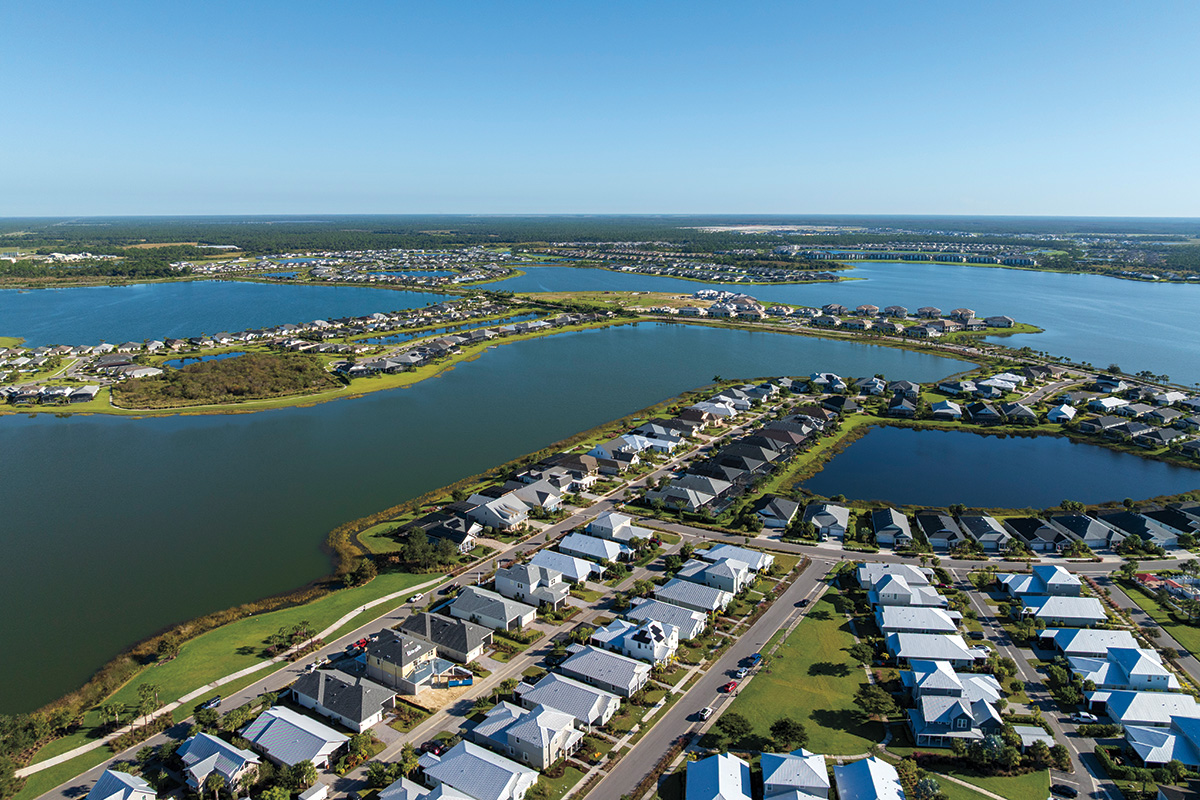
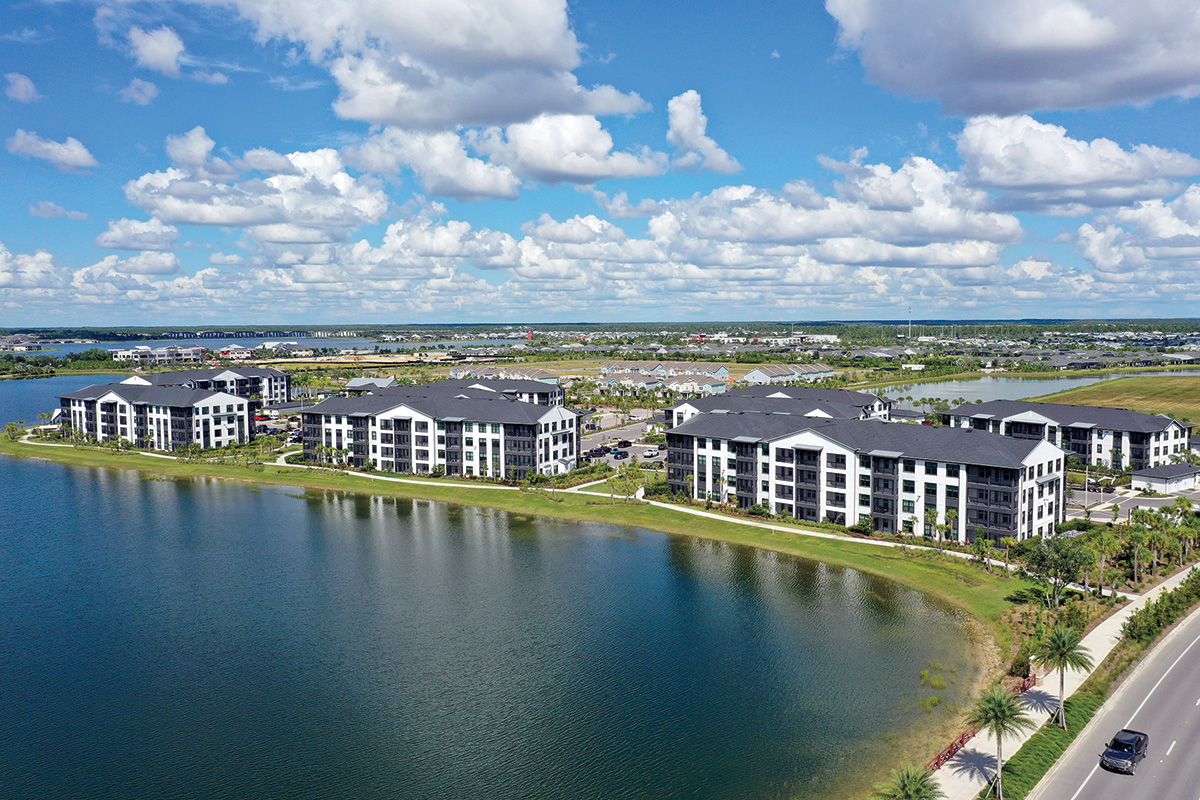
Babcock Ranch was designed to roll out in three phases that gradually add neighborhoods, retail, industry, parks and trails, schools, health care facilities and more across 18,000 acres.
Slowly — and then, seemingly, all at once — Kitson’s plan has been falling into place. By the end of this year, more than 15,000 people will occupy around 6,000 homes and rentals in Babcock Ranch. Nearly 5,000 additional residences have been closed on. At completion, the master-planned town will hold around 22,000 homes and 60,000 residents. The community hopes to get its own ZIP code one day.
Kitson and his team have laid the foundation for a healthy town with all its core tenants, from education to commercial hubs to energy infrastructure, plus novelties designed to cultivate community and to protect it. Florida Trend toured the expanding Babcock Ranch this fall for a peek behind the curtain into how a city — and one of America’s fastest-growing masterplanned communities, according to real estate consulting firm RCLCO, which ranked Babcock Ranch No. 7 — is created.
“Right up until the day we started construction, I’d say 90% of people thought it would never happen. I guarantee it. Not only would it not happen, but if it did happen, it wouldn’t happen the way that I said,” he says. “If you go back and look at all the promises that we made back in 2005, we fulfilled every single one of them. I’m very, very proud of that. We do what we say we’re going to do, and that’s what we did.”
Nature’s Blueprint
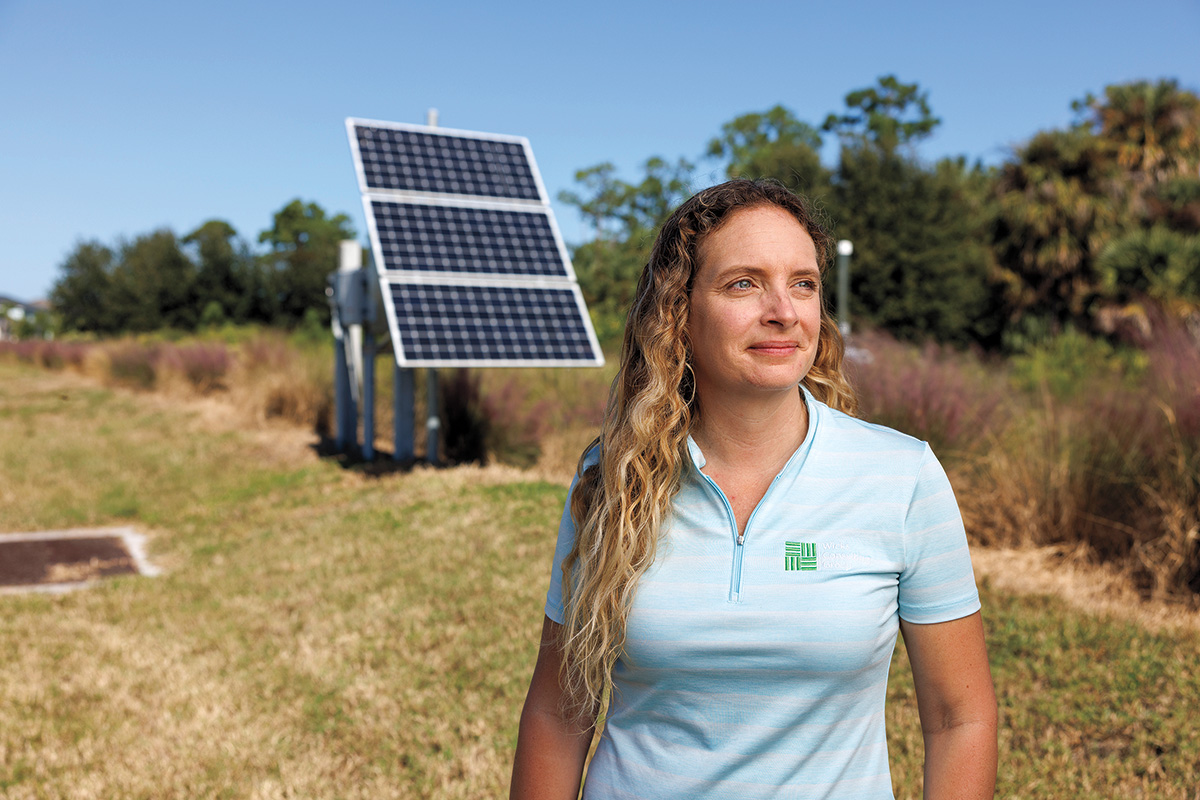
Amy Wicks, a civil engineer, has worked with Babcock Ranch since its inception two decades ago. As a contractor, she helped build the town’s stormwater systems and resiliency measures from the ground up, molding them in Kitson’s environmental vision.
That strategy capitalizes on the property’s existing natural features. Instead of carving into raw habitats, Babcock Ranch developments try to stick to land that was already altered by the area’s past life in agriculture. Wetlands, natural flow ways and other habitats are maintained to preserve wildlife corridors and bolster more than 100 miles of planned trails. “Basically, the land dictated the layout of the town,” says Lisa Hall, a community and media relations specialist who has been working with Babcock Ranch since its beginning.
Similarly, Babcock Ranch’s stormwater management strategy follows natural flood plains and is designed to operate as a regional system. More than 100 lakes dot the growing town and act as storage basins. They connect to each other and to nearby rain gardens and wetlands in all directions. Wicks can remotely monitor their levels via a smart sensor system, and she can manage their flow via weirs. Eventually, all that water feeds into the Caloosa-hatchee River Basin.
The community’s built environment also adds to its resiliency. Some developed areas, like Babcock’s interconnected web of parks, can withstand flooding if needed. In a seemingly novel move, Babcock’s roads were designed to direct floodwater to low points between homes that lead to storage areas.
It’s not the traditional method of stopping water with levees or walls. Rather, it’s an attempt to harness its natural flow.
“The traditional thought process is to get the water off as quick as possible,” Wicks says. “What we actually do is hold it longer and release it slower, so that capacity stays and we can continue to operate more like a natural system.”
Hurricane Ian’s swipe to Southwest Florida in 2022 was the ultimate test to the community advertised as “hurricane-proof” (see “Proof of Concept,” page 81).
Glancing at damage estimates to the nearby Lee and Charlotte counties is a testament to the community’s resiliency efforts. Coastal Lee County suffered an estimated $5.3 billion in property damages, and inland Charlotte County weathered more than $362 million. In comparison, Babcock Ranch suffered $3.4 million in damages, representing just 0.06% of the damages to the counties it straddles. No property in the community flooded.
Wicks says she’s proudest of how her ideas at Babcock Ranch are gaining traction elsewhere. There’s growing interest in rolling out similar resiliency measures in new communities across Florida, the country and the globe at large. Some municipalities have been inspired to alter their codes with resiliency in mind. She notes that the resulting safeguards should evolve with the changing climate.
“Storms are changing. I mean, we’ve been working on this for 20 years. It’s different patterns than it was before,” Wick says. “Being able to have that adaptability, to change and to consider what we need to do moving forward to make sure that it continues to be safe, has been super important.”
Shop Talk
Babcock Ranch is about a 30-minute drive to Fort Myers and a 45-minute drive to Cape Coral. Upon its groundbreaking, it lacked many of the amenities and services found in surrounding metro areas.
Now, commercial cores of the town are well underway. Babcock Ranch currently hosts two shopping centers — the 84,000-sq.-ft. Crescent B Commons and the 120,000-sq.-ft. Shoppes at Yellow Pine. Both are fully leased. Tenants include an animal hospital, a nails spa, a bank, a Starbucks, a sushi restaurant, an Ace Hardware, a chiropractor and Panera Bread.
A Publix opened in Crescent B Commons in 2021. A second grocery-anchored shopping center is set to open in 2026 in the emerging MidTown, the community’s newest district with a mixed-use town center, six neighborhoods and several parks. At completion, Babcock Ranch plans to host four to five grocers.
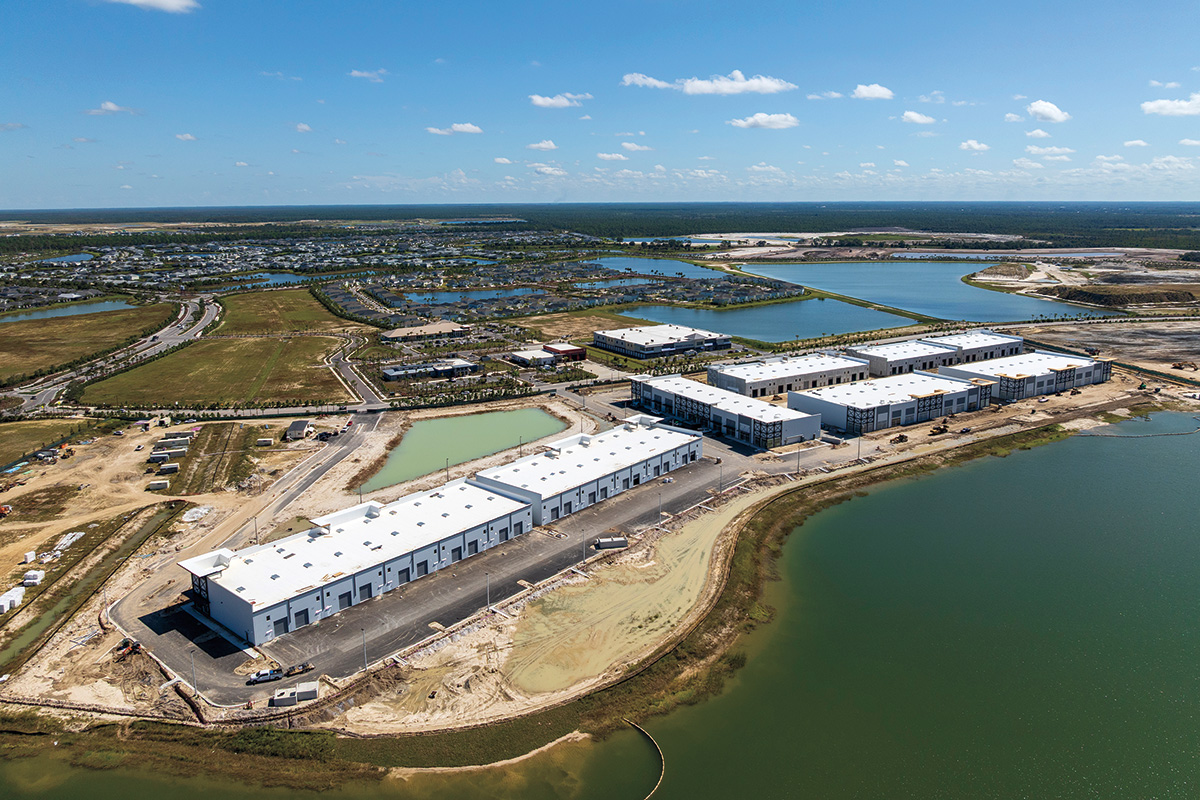
During Florida Trend’s September visit, the Curry Commerce Center was under construction. By completion, it will provide 225,000 square feet of light industrial flex space. Tenants run the gamut, from pool services to plumbing to a countertop showroom to a school for children with autism.
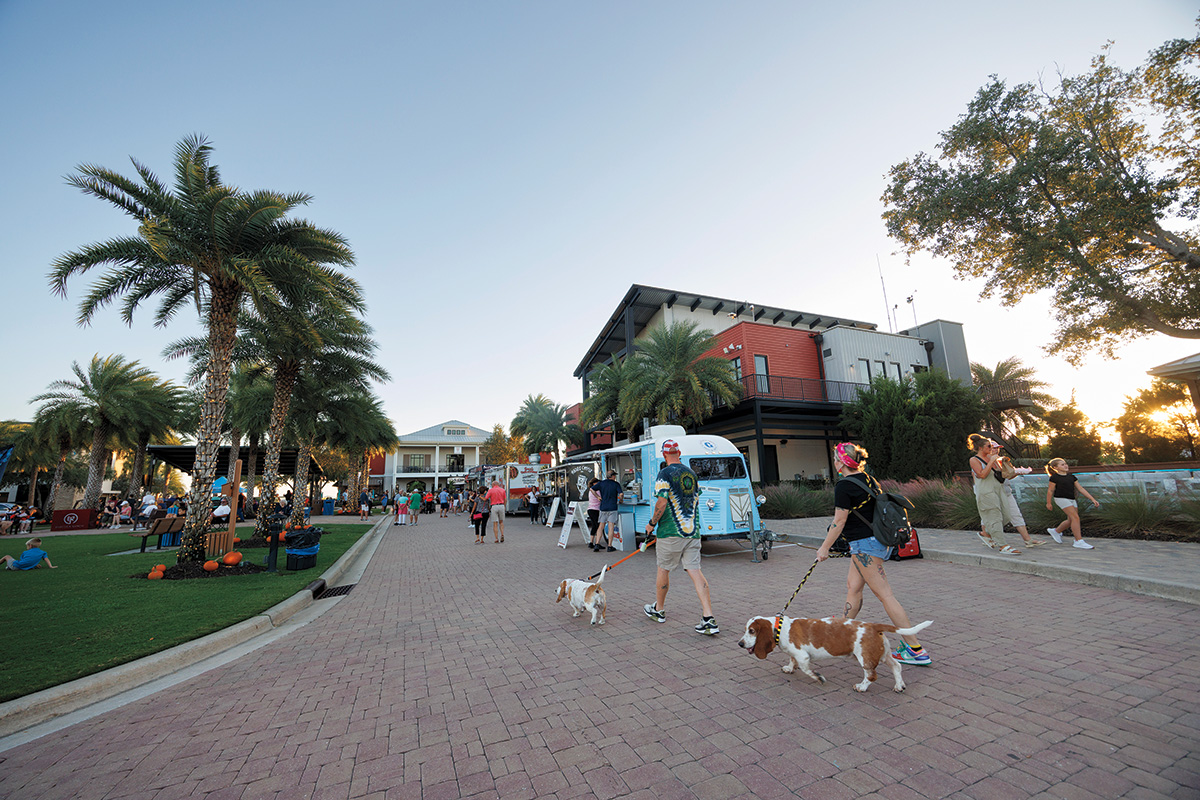
Altogether, Babcock Ranch has 6 million square feet reserved for non-residential commercial uses, including retail, industrial and office spaces. To date, Kitson & Partners has developed about 270,000 square feet of mixed-use and commercial spaces in the community, including the existing downtown district Founder’s Square. It’s currently building another mixed-use development called B Street, a 121,000-sq.-ft. hub with a 110-unit apartment complex plus retail and office space.
“The retail is important. If you want to be sustainable, truly sustainable, you want people to be able to live, learn, work and play in one place,” Kitson says.
Just over half of the community’s residents are employed, and anecdotally, it seems many work from home. Some commute into Lee and Charlotte counties. Several residents are starting up businesses and snagging office space in the town’s growing retail areas.
Susan Egan, who moved to Babcock Ranch with her family in 2019 as one of the first 150 households, is an example of the budding entrepreneurial spirit in the community. She owns Babcock Mortgage with her husband, Bill, and was seeking connections to other businesses in the area.
That year, she created a Babcock Ranch Entrepreneurs Facebook group to facilitate connections and share educational resources. The group has since surpassed 1,300 members who lean on each other for business, referrals and support.
“That’s the point of sustainability, right? Having a town that can run on its own,” says Egan, 48. “Now to see it come to fruition. … I know it Syd’s baby, but there’s a little tiny part that feels like, ‘Oh, wow, this is amazing.’ I feel just as proud of it, even though it’s not mine.”
Amped Up
Kitson wanted to create the first solar-powered town in America. He knew he’d need some help with the task.
After struggling to make contact with Eric Silagy, then president of Florida Power & Light, Kitson hopped on a plane to Tallahassee, where Silagy was scheduled to speak to a legislative subcommittee. As soon as the meeting ended, Kitson followed Silagy onto an elevator. On a two-floor ride, he recited what he calls “the quickest elevator speech you’ve ever heard in your life” — and Silagy said he’d take it under consideration.
About a decade later, Kitson’s dream was realized.
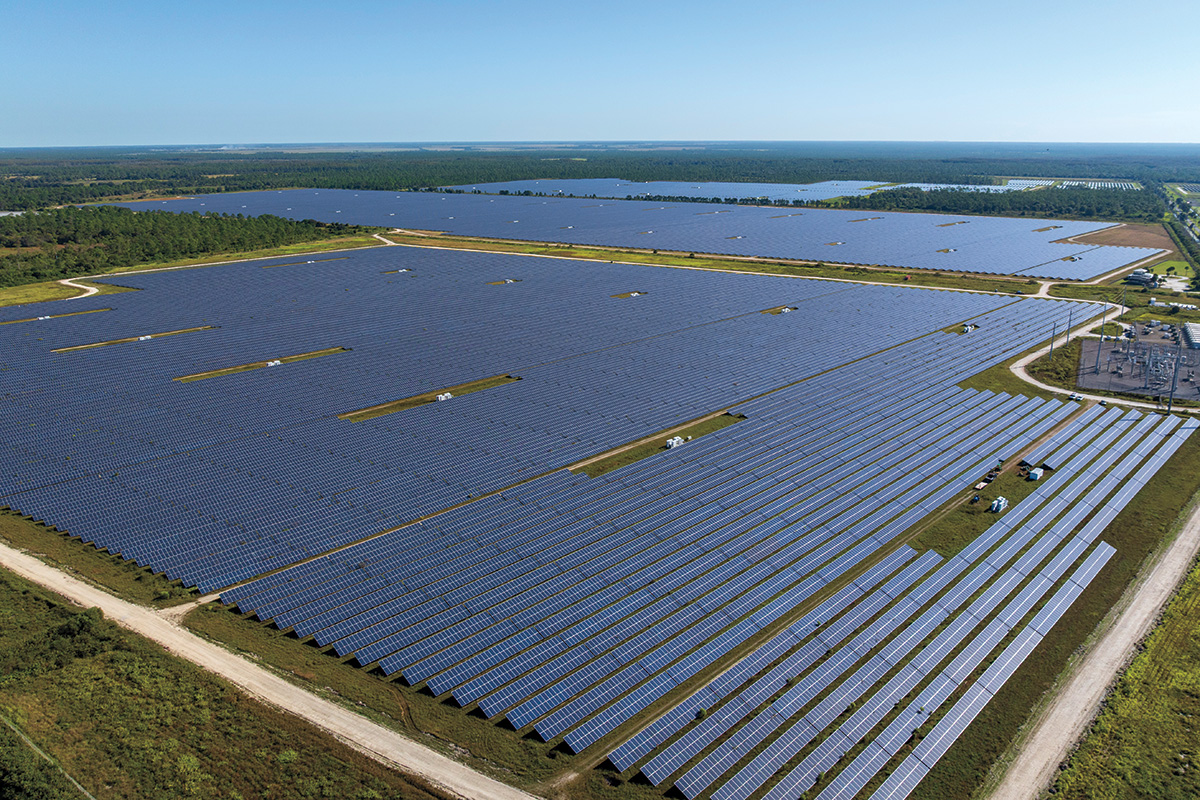
An FPL solar farm now stretches 870 acres — the size of about 635 football fields — between two solar energy centers on the edge of Babcock’s property. There, 687,000 panels gleam far into the distance. Their 150-megawatt capacity could power 30,000 homes. They’re complemented by a 10-megawatt battery storage system that saves extra energy for a rainy day (literally). There’s also the FPL Eco-Discovery Center, a 2,500-sq.-ft. onsite educational facility about all things solar.
For FPL, the move helps diversify its energy generation. It also aligns with the utility’s Real Zero initiative to eliminate its Florida carbon emissions by 2045 using a “diverse mix of solar, battery storage, existing nuclear, green hydrogen and other renewable sources,” parent company Next-Era Energy stated in a 2022 press release. For Babcock Ranch, it means its entire carbon footprint is offset with the output from its solar farm.
“It was about providing a clean source of energy to Babcock Ranch,” Kitson says. “It is the Sunshine State, and solar became the obvious solution.”
Class Act
One of the earliest additions to Babcock Ranch was a school — opened in a temporary location within the community’s Founder’s Square in 2017, before any homes were finished, on a suggestion by former Gov. Jeb Bush.
“I wanted to create a true hometown. Governor Bush is on our (advisory) board, and he said to me, ‘Syd, you have to start with a school,’” Kitson recalls. “And he was right.”
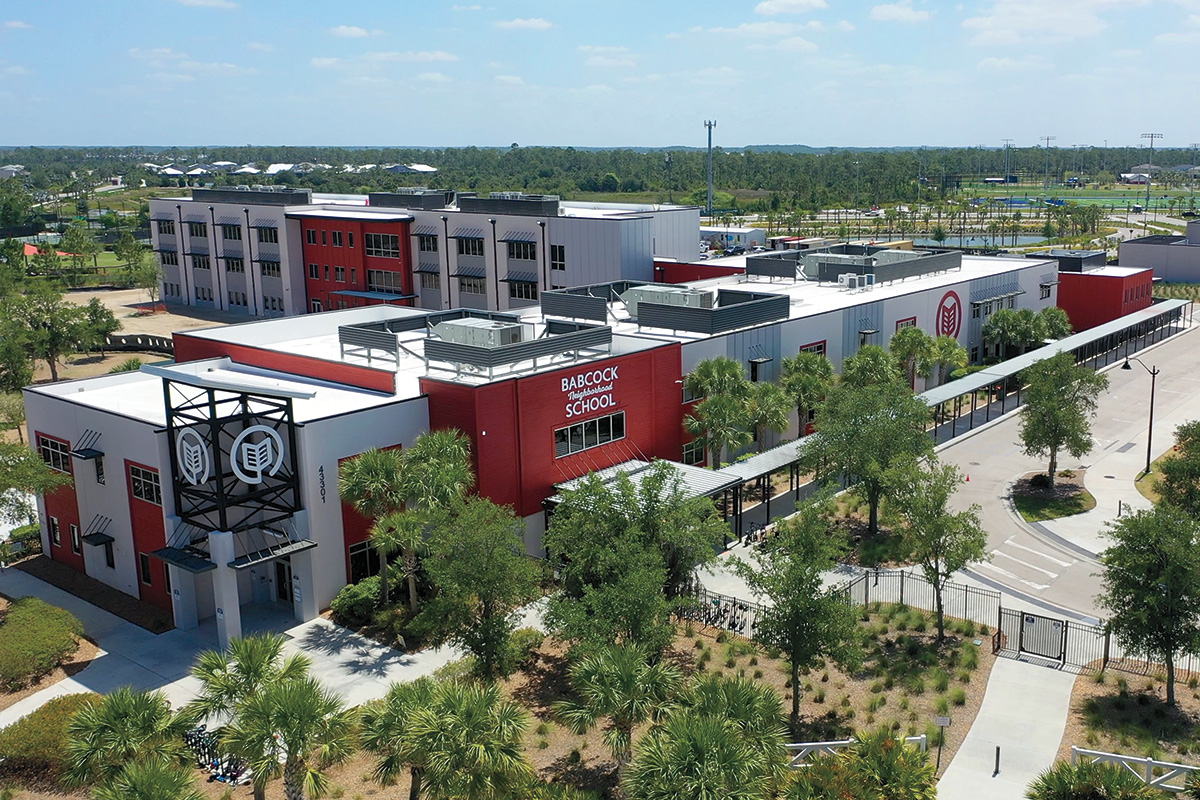
That initial iteration offered kindergarten through fifth grade and was open to local students. It immediately reached capacity at 158 seats, plus a 300-person waiting list, prompting construction of a new and expanded campus smackdab in the middle of Babcock Ranch — a testament to its importance to the community, Kitson says. The new school opened in 2018 and spanned up to eighth grade by 2020. In 2022, a high school was added to the mix, rounding out Babcock Schools. (Bloom Academy added a preschool and daycare to the community in 2019.)
At the public charter schools, all grades implement project-based learning, a classroom model where students collaborate to solve real-world challenges using critical thinking. A class lesson on accessibility, for example, turned into an all-new public playground outfitted with sensory areas and inclusive elements. A kindergarten class devised a plan to mount a camera to observe and study a pair of eagles in Babcock. One project partnered third-grade students with community authors specializing in different genres.
Babcock Schools became Florida’s first certified demonstration site for the project-based learning framework in 2021.
“It mirrored what the community was going to be designed around, which is this next-level thinking around sustainability, solar power. How do you do things differently and better?” says Shannon Treece, the executive director of Babcock Schools. “We felt it really needed to be reflective of that as well. So, how do we create an education system that’s based on where education is going, not where has it been?”
In its first six years, the staff of Babcock Schools ballooned more than 600%, and its student body grew nearly 500%. Now, the schools enroll more than 900 students K-12. This year, Babcock Schools received an A-rating.
Treece projects more than 2,000 students will be enrolled in Babcock Schools by the 2028-29 school year. Another expansion on the horizon will add 20,000 square feet, including 16 classrooms, offices and collaboration spaces, to the high school.
Yet another addition will extend the community’s education ecosystem even further: Florida Gulf Coast University is coming to town, specifically to Babcock’s forthcoming MidTown. The 125,000-sq.-ft. academic building will house a new institute focused on sustainability and resiliency — a focus both entities share, Kitson says. The Legislature appropriated $21.7 million to the project earlier this year, and Kitson & Partners committed a $3-million gift to help bring the vision to life.
That means, by the institute’s projected opening in 2027, Babcock Ranch will offer education from cradle to higher ed.
“It’s a game changer. We already work with (FGCU) on a lot of different projects for dual enrollment,” Treece says. “But for us, the ability to do more real-world projects around research, like (through) their water school, it’ll give us a direct connection to some of those programs, and it’ll be a highly visible structure for our students in the community. I mean, when you build your community around education, it sends a message, right?”
All Ages, All Stages
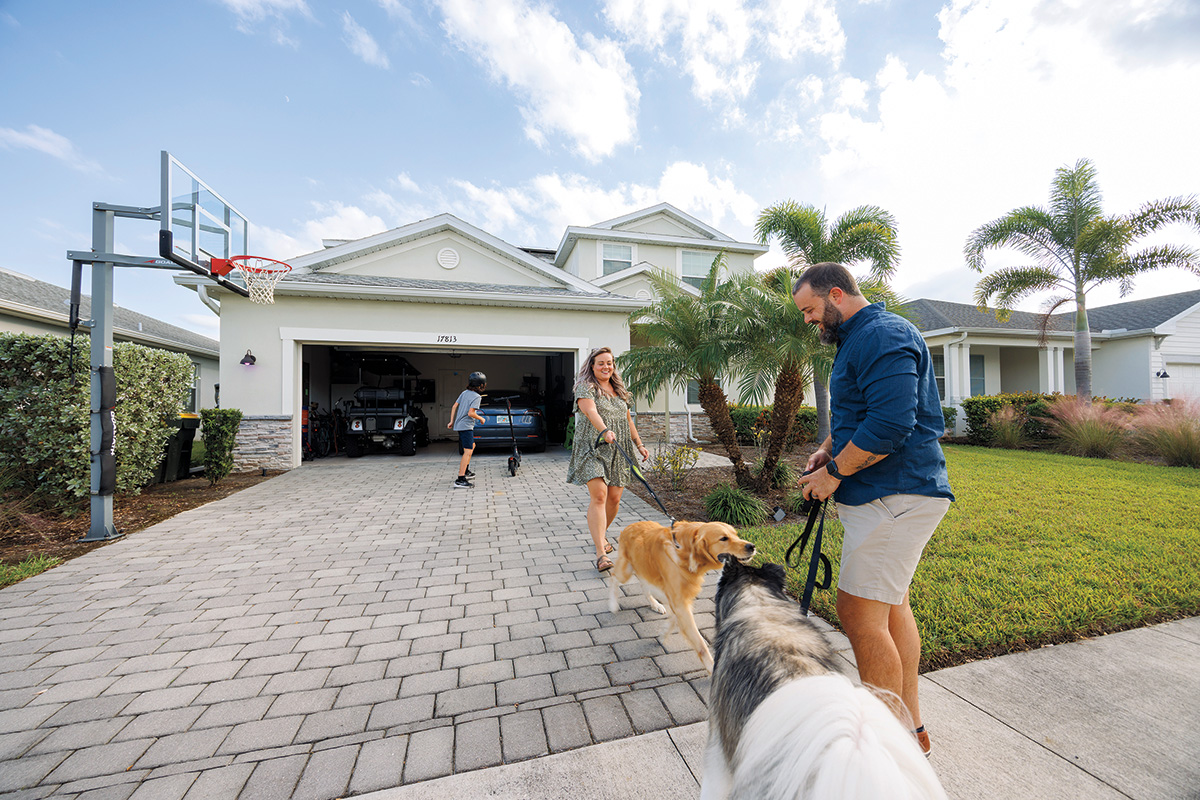
Kitson never wanted Babcock Ranch to be another retirement community. He has long envisioned it as a home for all ages.
To make that attainable, Babcock offers several housing options at different price points.
Rents at its Canopy apartment complex, sporting 373 units, start at $1,351 a month for studios. Its Flatwoods neighborhood offers 246 build-to-rent single-family homes, starting at $2,208 a month for a three-bedroom house. Condos currently start at $236,000. Townhomes, villas and detached homes start at $279,000 and can surpass $2.5 million for a custom build.
“We want a place where young and old are together and interacting — you know, a real town,” Hall says. “There’s a lot of things that they have to do intentionally to make that happen. Because in Florida, if you don’t, you’re going to have another retirement village.”
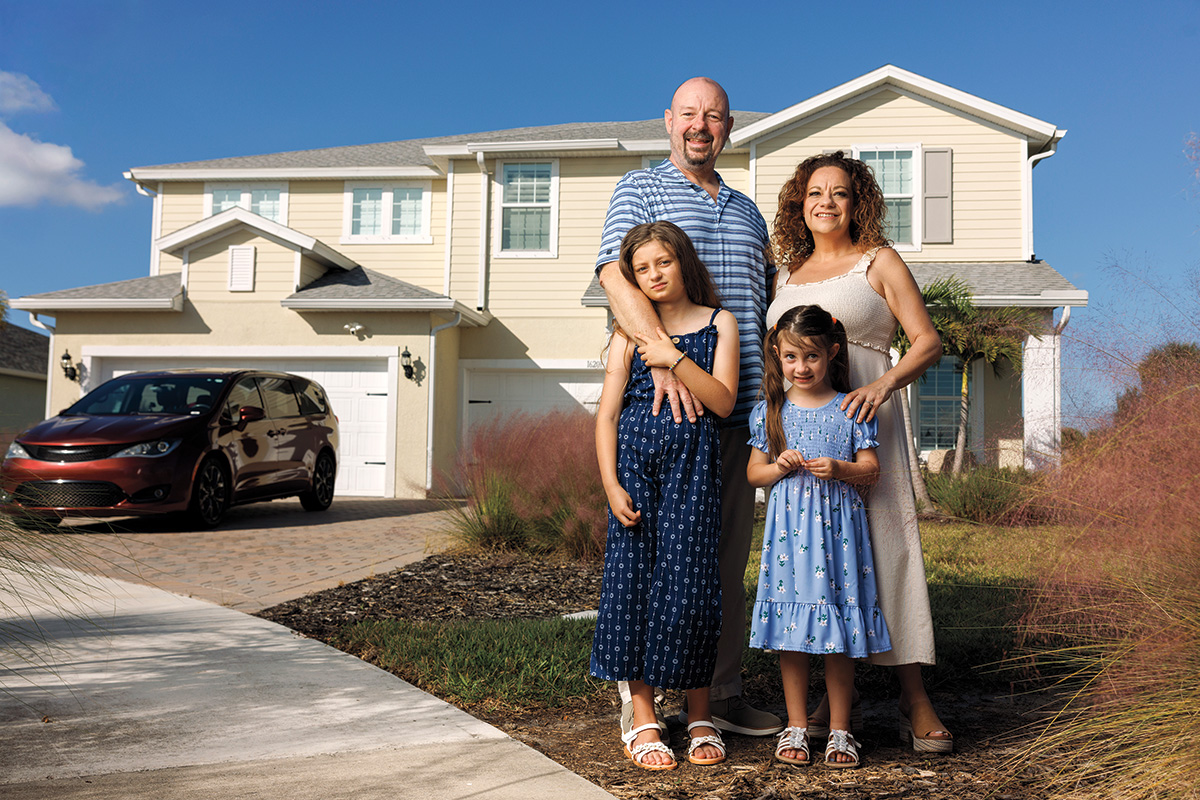
The first resident moved into Babcock Ranch in 2018. By the end of 2019, 500 homes had cropped up. The community doubled to 1,000 homes within a year. “We were selling them faster than they could build them,” Hall says. Babcock Ranch reached 5,000 new home sales this July, marking a 15% year-over-year increase.
Each house is designed to withstand 160 mph hurricane winds in accordance with the Florida Building Code. On top of that, every residence is required to meet standards of the Florida Green Building Coalition, a third-party nonprofit certification program recognizing sustainable structures. Builders and buyers can meet those standards through a mixture of home features, from a metal roof to hurricane-impact windows to storm shutters.
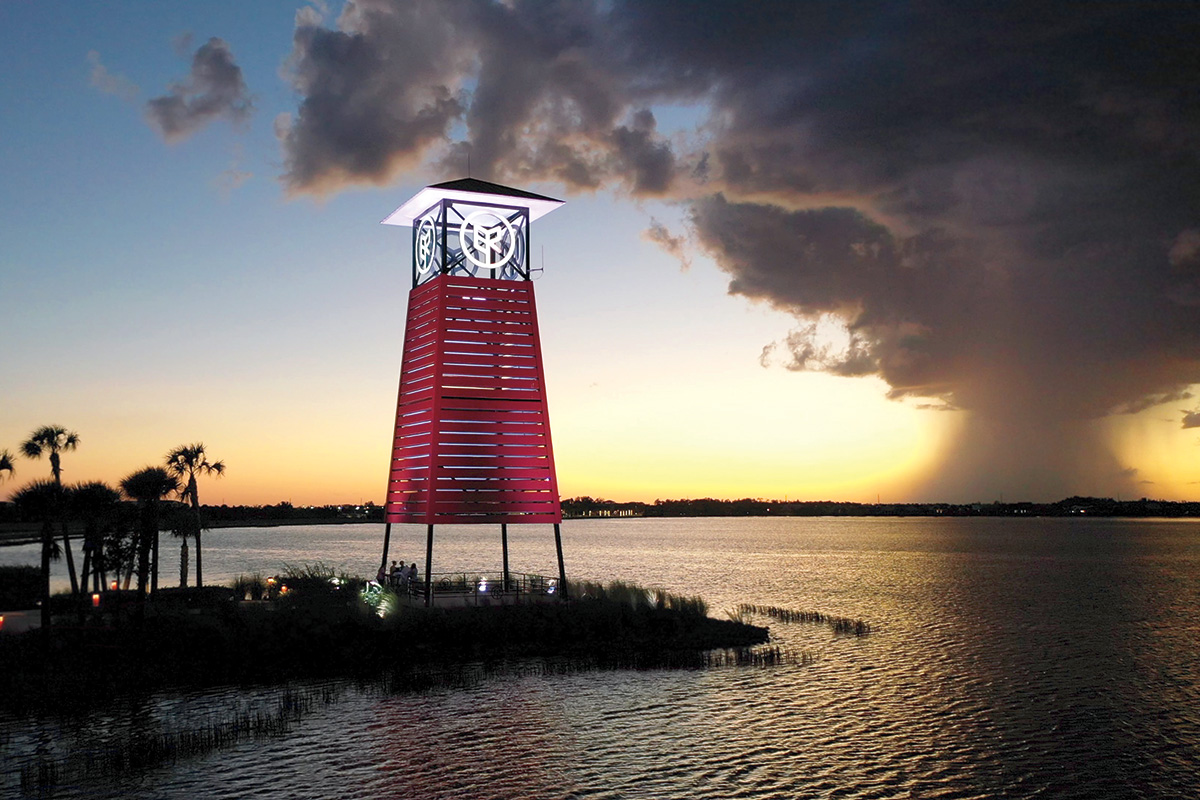
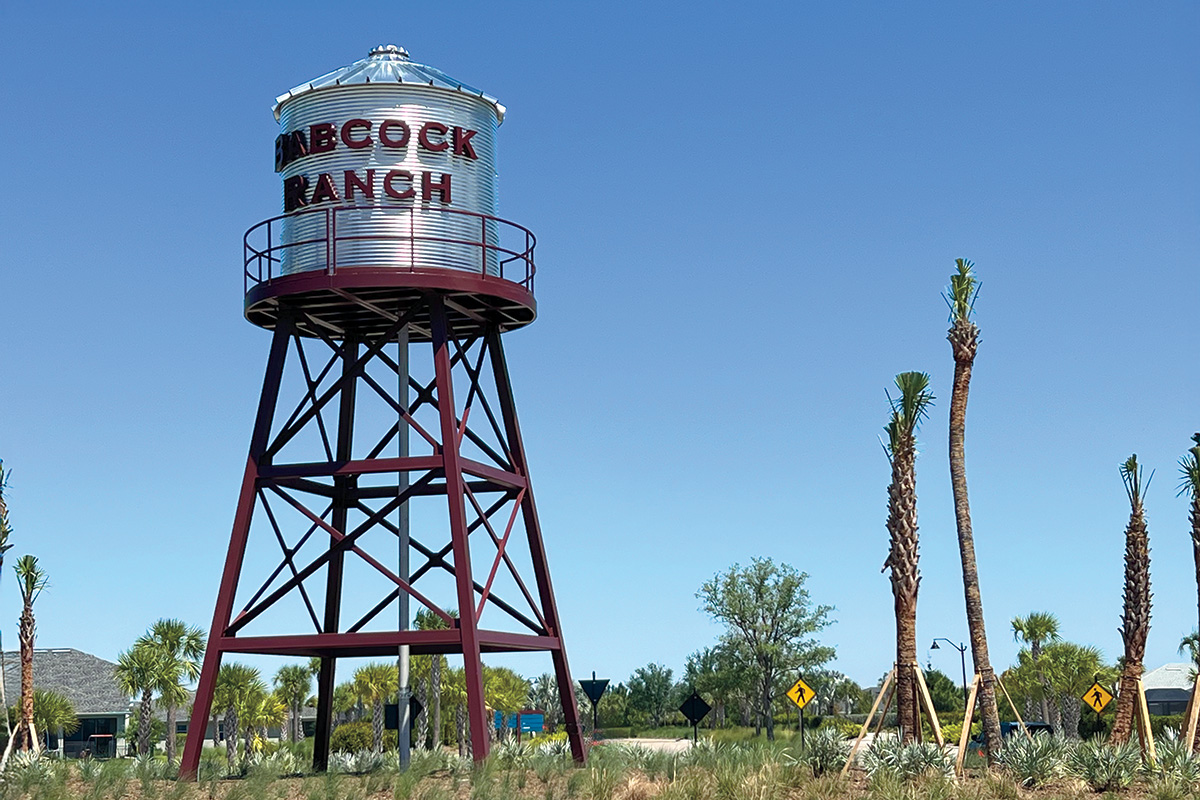
Around the brand-new community are small odes to its heritage. Roundabouts feature reproduced vestiges of ranch life, like a windmill, a water tower, a fire lookout tower. The town’s main street, Crescent Loop, is named after the property’s former Crescent B Ranch. Even Babcock Ranch’s symbol — a backwards B and an R, surrounded by a circle — was designed to look like a cattle brand.
“It’s part of placemaking so that when people see that, it gives the identity to the town. They say, ‘Oh, that’s my hometown,’” Hall says. “We’re trying to bring back those pieces of the land’s history into the future.”
Proof of Concept
Hurricane Ian in 2022 was the first major storm to hit once Babcock Ranch had builtout homes and infrastructure to worry about. Residents were instructed to shelter in their hurricane-grade homes.
“To be honest, I sat here through (Hurricane) Ian like, ‘Oh my God, what’s going to break?’” Wicks remembers, hoping the stormwater management system she designed would hold up according to plan. “It was a guess. Like, I think it should work all right. Probably? ... I was sweating it the whole time.”
When she emerged from her home the next morning, she found a fallen stop sign. A few downed trees that had recently been transplanted. Some streetlights that had unscrewed with changing wind directions. A handful of pool cages were destroyed from the wind.
The worst damage, Wicks recalls, was erosion on the edges of water bodies in the community. Some lakes were big enough to create their own three-foot storm surge, which ate away at some of their vegetated banks — marking the costliest damage to Babcock Ranch during the storm. (Those shores now have underground armoring to better protect them from erosion.) No homes were impacted by the water.
Even more so, Babcock Ranch never lost power or internet service. That meant — for better or for worse — residents were kept updated as the storm raged overnight, the glow of their TVs lighting living rooms amid howling hurricane gusts.
Kitson recalls watching the national news from home during the storm and hearing Gov. Ron DeSantis usher evacuees toward Babcock Schools’ Field House. (Kitson says he had no forewarning.) The 40,600-sq.-ft. building is one of the region’s few ICC 500-rated storm shelters, meaning it’s designed to resist 200-plus mph winds.
It held 1,300 people during Hurricane Ian, and another 1,000 sheltered in the Babcock Schools. A couple thousand more were estimated to be staying with friends and family in the community.
“I had 5,000 neighbors who were depending upon us. We had spent all this time, money and effort … to make (Babcock Ranch) resilient. And we had no idea if it’s going to work,” Kitson says. “Here we were, being tested. And boy, did we get tested. But we had very little damage and no flooding. It worked out really, really well.”
‘Multiplier Effect’
The mere existence of Babcock Ranch has churned economic impacts in the region.
To date, the community has generated $2.3 billion in home sales, contributing an estimated $30 million annually in property tax revenue. More than $1 billion has been invested in its infrastructure and commercial development. At completion, Babcock Ranch is projected to employ more than 20,000 people, according to a 2007 economic study.
“It has a multiplier effect. It is really remarkable when you start to really mine down into all the tentacles, because then you have thousands of homes under construction, and you have all the commercial (properties) under construction, the road, everything,” Syd Kitson says. “It’s very significant.”