











The latest research of Joshua Hutcheson, an associate professor of biomedical engineering at Florida International University, was inspired by his wife.
As a classically trained opera singer, she studied how changes to vocal cords can alter someone’s voice. Hutcheson saw similarities between vocal cords and the heart tissues he researches. It sparked an idea: Could an abnormal heart sound indicate an underlying condition — and thus serve as an early indicator for disease?
Most heart disease patients don’t get diagnosed until it’s too late. There may be little to no symptoms in the early stages of disease. Silent signs — like high blood pressure — may go unrealized without regular checkups. Other warning signals, such as fatigue or shortness of breath, may be mistakenly attributed to aging. Delayed diagnoses leave patients with few treatment options, forcing them to manage the disease for the rest of their lives.
“Even when people start having symptoms for a lot of different cardiovascular diseases, especially these very chronic ones, they develop over the course of decades,” Hutcheson says. “We have a lot of interest in these really low-cost modalities that you could put, say, into a general practitioner’s office to help find people who are in need of further workup.”
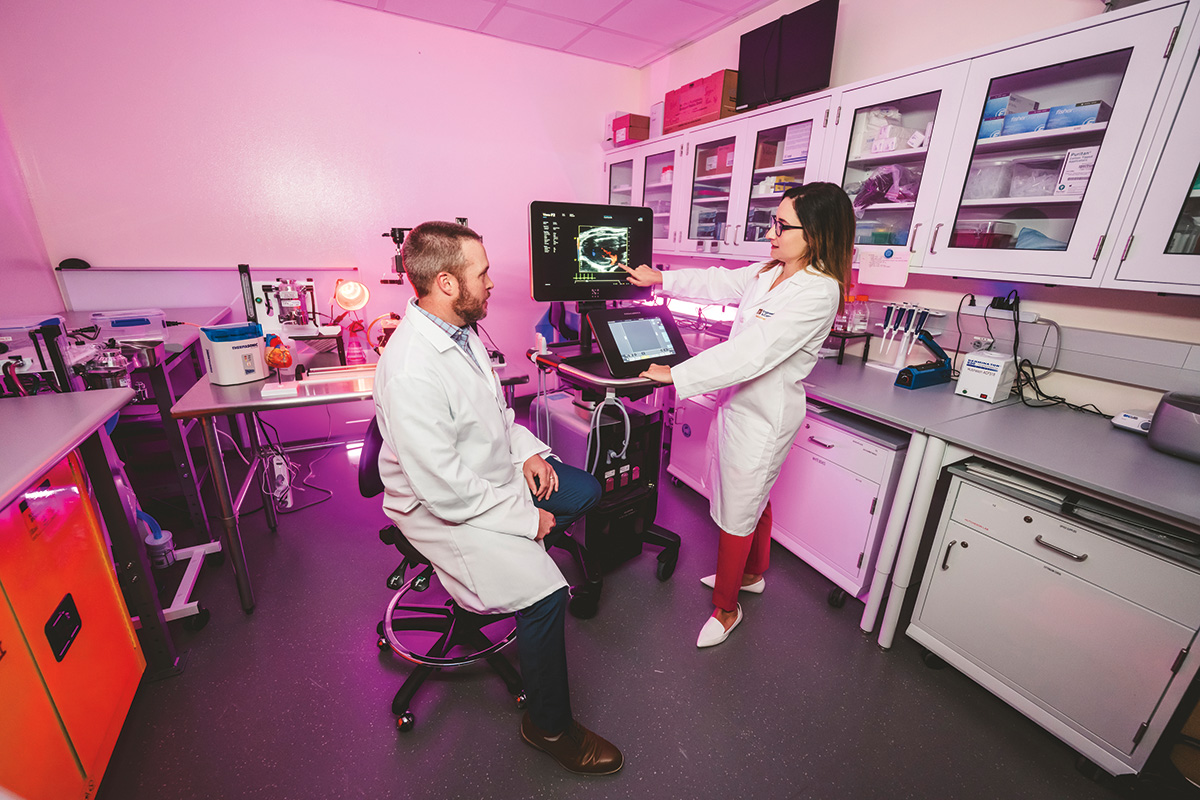
The first digital stethoscope that could record heart sounds originated decades ago, but doctors didn’t know how to interpret the signals. Now, researchers such as Hutcheson and Valentina Dargam, an FIU research assistant professor of biomedical engineering, are using artificial intelligence to pinpoint previously undetectable heart sound abnormalities that could be early signs of disease.
In their research, Dargam led preclinical studies to determine what new information could be gleaned through AI analysis of the two sounds that make up a heartbeat. She recorded mice hearts with a digital stethoscope and ran the tapes through a machine learning algorithm trained to identify abnormalities. She found the algorithm around 95% accurate at detecting healthy heart sounds and around 85% accurate for detecting unhealthy heart sounds.
“From the mice, what we’ve learned is that, yes, we can identify these early markers of disease,” Dargam says. “That gives us the motivation and the preliminary data or proof of concept to say, ‘OK, look, we could potentially also find early markers of disease in humans. Maybe it is worth starting a trial.’”
The team has received interest from Baptist Health South Florida to transition to human studies, which could uncoverer more variability in heart sounds according to a patient’s body shape and sex. Clinical trials could start within the next six months, depending on funding and regulatory approval.