





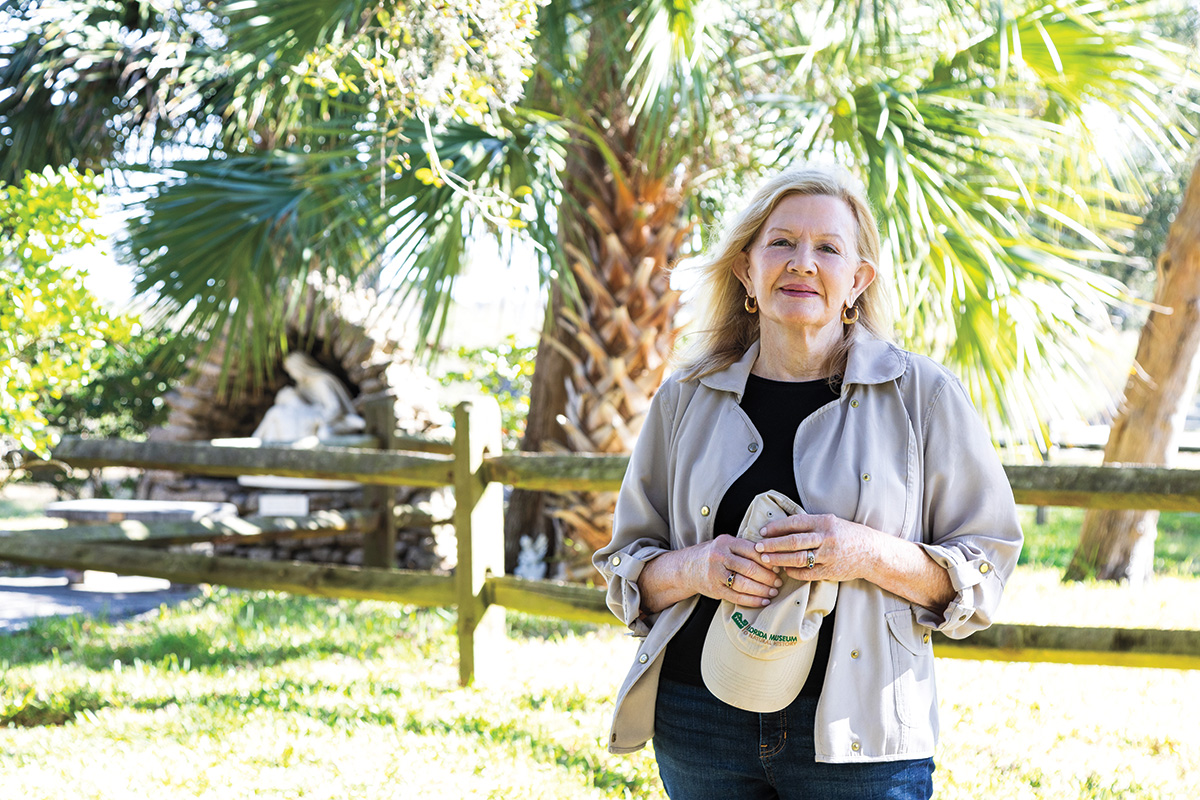
I would love to say that all my childhood I wanted to be an archaeologist, but that’s not really the case. I didn’t know much about archaeology until I came to college, and then I had a wonderful teacher who became my mentor. It was 1966, and there was no such thing as women in archaeology. I was supposed to study something that led to getting a job after college. So I majored in journalism and education, but I kept sneaking in anthropology courses. In the end, it was more efficient for me to major in archaeology. It just gripped me.
When the Bicentennial of the United States was approaching, there was funding for people to do research. I was curious about what happened when colonizers came here and met up with the native people. How did they merge? In St. Augustine, I was able to work on a site where a Native American woman was married to a Spanish soldier.
St. Augustine was a different place then. When I was teaching field school there for FSU, we used to pile in the truck and drive to Jacksonville to get a burger. There weren’t even any fast-food places.
We did locate the original settlement of St. Augustine, when (Pedro) Menendez came with settlers and soldiers in 1565. As it turns out, that first settlement was at what is today the Fountain of Youth Park. In this case, I give tourism a lot of credit for saving that site, because everything else on the St. Augustine waterfront has been really built up. But that piece of property was preserved as a tourist attraction.
Fort Mose (in St. Augustine) was the first free Black community in the country. It was established in 1738, when enslaved people in South Carolina started escaping the plantations and coming to Florida. The first group came in 1687. The governor decided that if you reach Florida and you agree to convert to Catholicism, you’ll be free. The word spread, and people kept coming.
We didn’t really discover Fort Mose, we just verified it, but it has brought the Black community and white community together in a way that I’ve never seen before.
I’ve been so fortunate to have worked on projects where you could find something that we knew was there, but not where or what it was like. Most recently, the work in Haiti at the site that we thought was probably where Columbus shipwrecked and landed. It was pretty exciting because we did find all the things that were supposed to be the smoking gun — the right kind of building, the right musket ball, radiocarbon dates were right on target. … But it became impossible to work in Haiti.
People don’t appreciate the depth of both history and prehistory here in Florida. It was one of the earliest places that humans came into what’s now the United States, and it’s the earliest place where Europeans and Africans came in. We think of Florida as this wacky, overgrown place where everything is new, but European people settled here more than 50 years before Jamestown.
Almost 15,000 years ago, people were in Florida. There were Ice Age people hunting mastodons and giant sloths. There are a number of sites around Florida left from that time period.
Most Floridians think of the Seminole as the native Florida tribe, but they really didn’t come here until the 18th century. There were a number of other pretty powerful groups in Florida — the Apalachi, the Timucua, the Calusa — who are no longer here. All of the original Florida societies are essentially extinct from lots of different diseases.
I also wonder how many people know about Florida cowboys. This was a ranch state in the 19th century. The Spaniards, the first vaqueros in the 17th century, had huge cattle ranches. And when they left, a lot of the cattle went feral. And then the Florida cowboys in the 19th century pioneered that whole industry and had really big herds. We don’t really think of Florida as a cattle ranching state anymore, but it was.
At this point, my students are retiring, so it’s kind of horrifying. But the great thing about retiring in St. Augustine is that I’ve been able to continue field work here with Flagler College and the city of St. Augustine. I’ve been very lucky.