







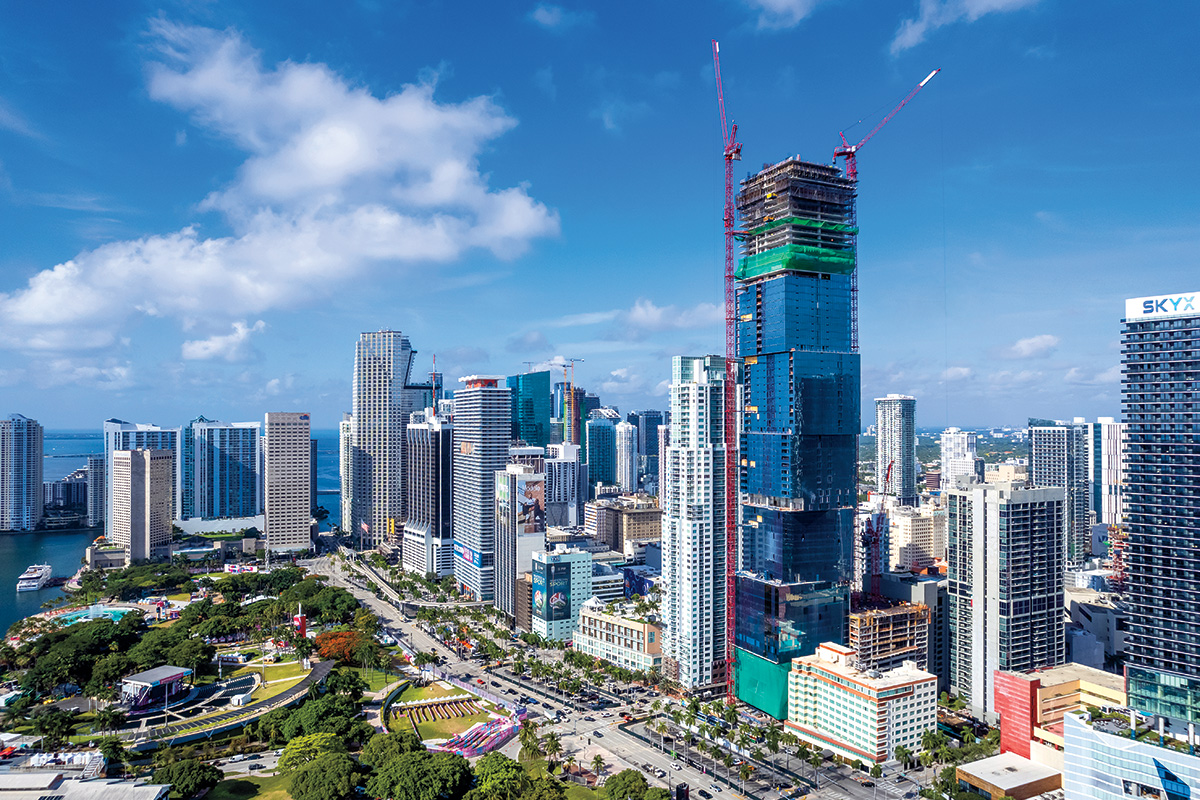
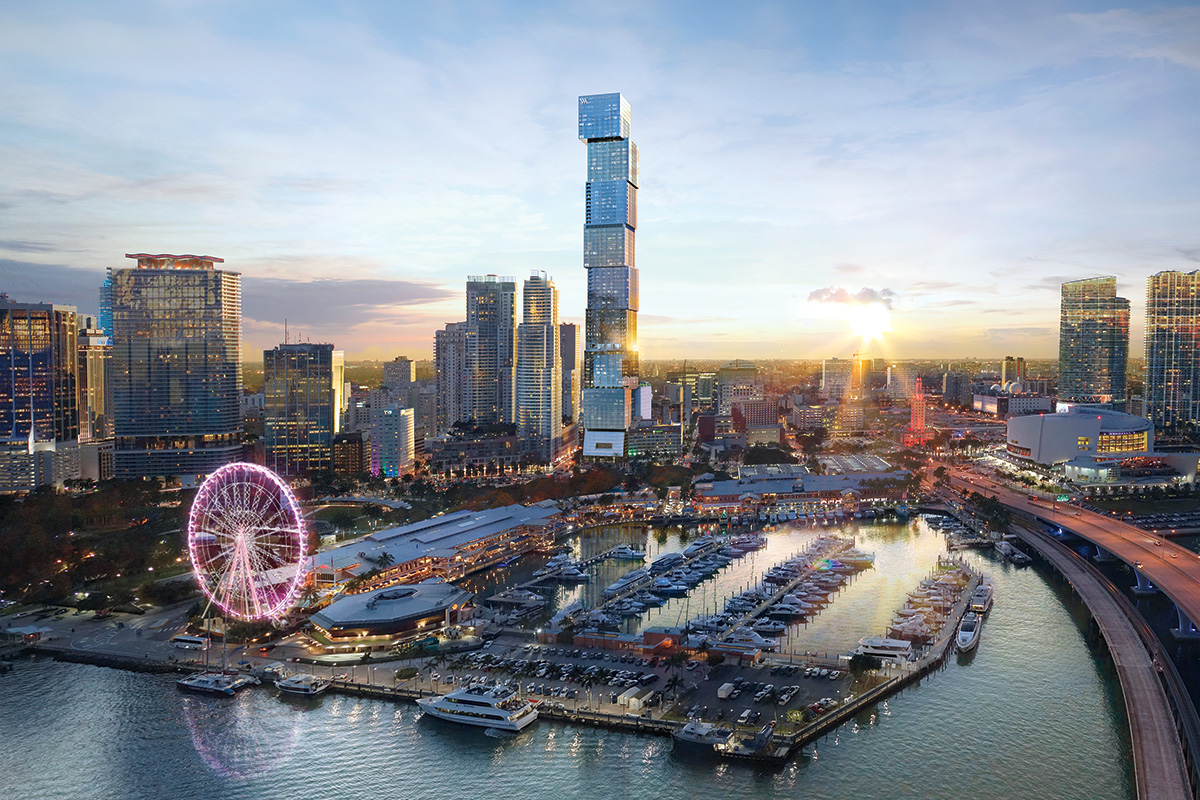
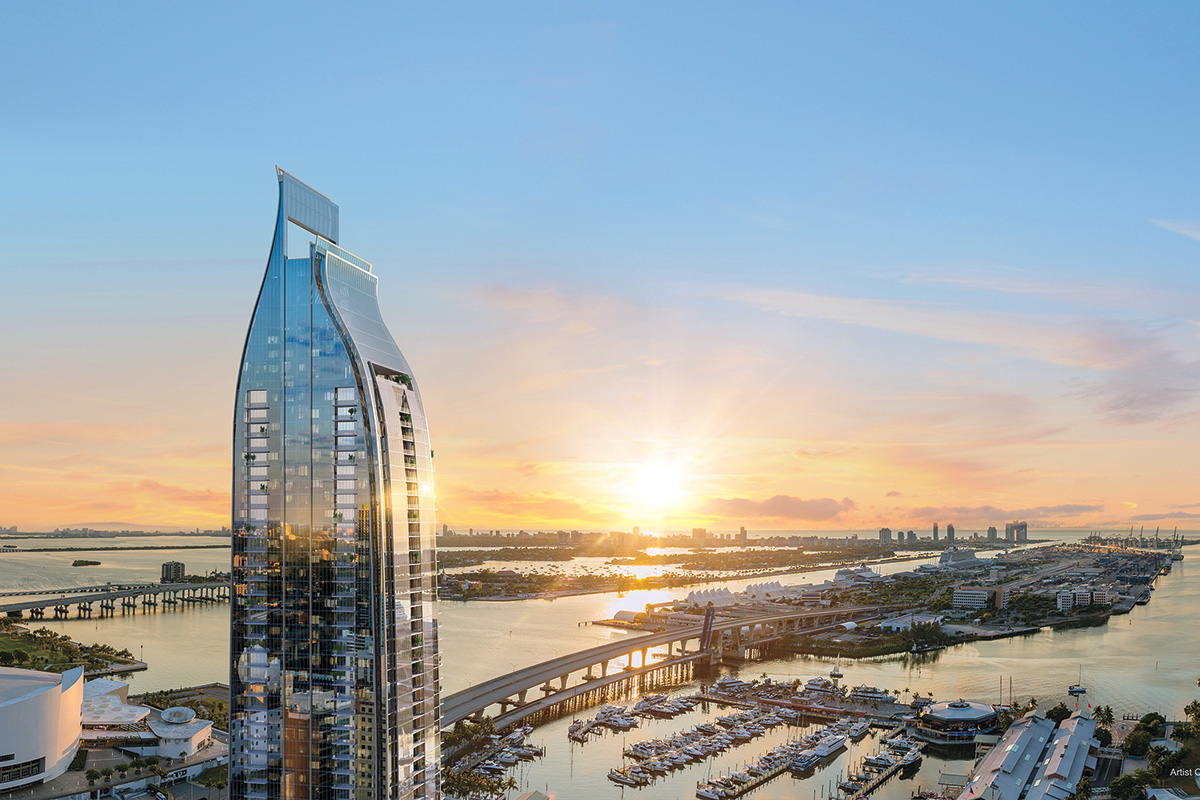
When completed next year, the 100-story Waldorf Astoria Residences on Biscayne Boulevard in Miami will be Florida's tallest building and the tallest residential tower south of New York. It will have 360 condos ranging in price from $3.5 million to $50 million and 205 hotel rooms and suites. At a height of 1,049 feet — nearly 320 meters — the tower will be the first in Florida to surpass the 300-meter mark that defines a "supertall."
THE DEVELOPER
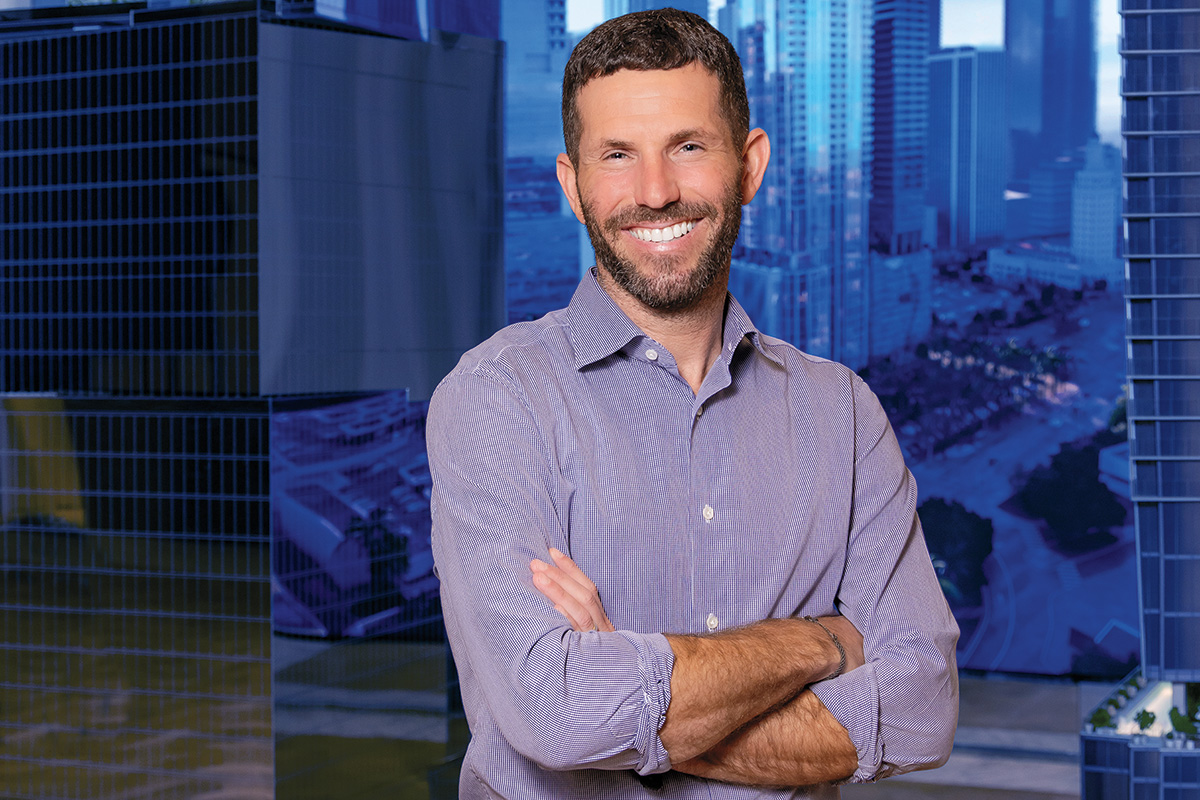
"Developers are dreamers," says Miami native Ryan Shear, a managing partner for New York-based Property Markets Group. Shear joined PMG in Miami in 2006. Since then, PMG has built or is building a slew of towers under such names as Sage, Echo and Society. PMG projects dot Miami, Hollywood, Sarasota, Longboat Key and Orlando, plus the Waldorf condo in St. Petersburg.
Before the Miami Waldorf, PMG had one other supertall on its resume: 111 West 57th St. on billionaires' row in New York. "It is a massive undertaking to do a supertall. Everything's longer," Shear says. "Sales are longer. It's longer to build. It's more hurricane seasons. It's more time. The loans are larger. Everything that you're used to doing is just more complicated. Remember, development is over time. The longer a project takes, the more risk you have. Fifteen years of my life I've been involved in this project."
The Waldorf development group includes Toronto private equity firm Greybrook, which invested $37.37 million; local real estate firm S2 Development; Cyprus-based luxury real estate developer Mohari Hospitality; and Hilton.
THE SITE
PMG spent $80 million in 2014 on a two-acre site on a parcel opposite Bayfront Park with an unobstructed view of Biscayne Bay and Miami Beach. A supertall was always envisioned. The Waldorf will be the first in a supertall row. One block from the site, PMG is building another supertall, the 985-foot-tall Delano Residences & Hotel. Between the two projects is a shuttered Holiday Inn slated to be demolished for a supertall.
Tower Economics
FINANCING
The Waldorf predevelopment loan totaled $33 million from Miami-based BridgeInvest to fund approvals, marketing and sales. For the construction financing, a $52.5-million loan was secured from Mack Real Estate Group for underground activities, while Bank OZK and New York-based Related Fund Management, an affiliate of Related Cos., put up $668 million for vertical construction — a record for a Florida condo project. (West Palm Beach-based Related Ross' CityPlace office development holds the overall record at $772 million.)
PRE-SALES
PMG opened sales in 2021. "If you like living in the clouds, Waldorf will provide a wonderful experience for you," Shear says. Presales demonstrate to lenders the money will be there when repayment time comes, which makes developing a condo tower easier to finance than an office tower. Shear says buyers, on average, put down a 40% deposit. One year after sales launched, 87% of the units were spoken for, according to a 2022 news release from Mohari, which also said more than half the buyers are domestic, while a significant number of the rest come from Latin America, Russia and Turkey. As of May, sales were "just shy of a billion" dollars and 26 units remained, Shear says.
The Construction Process
POURING THE FOUNDATION
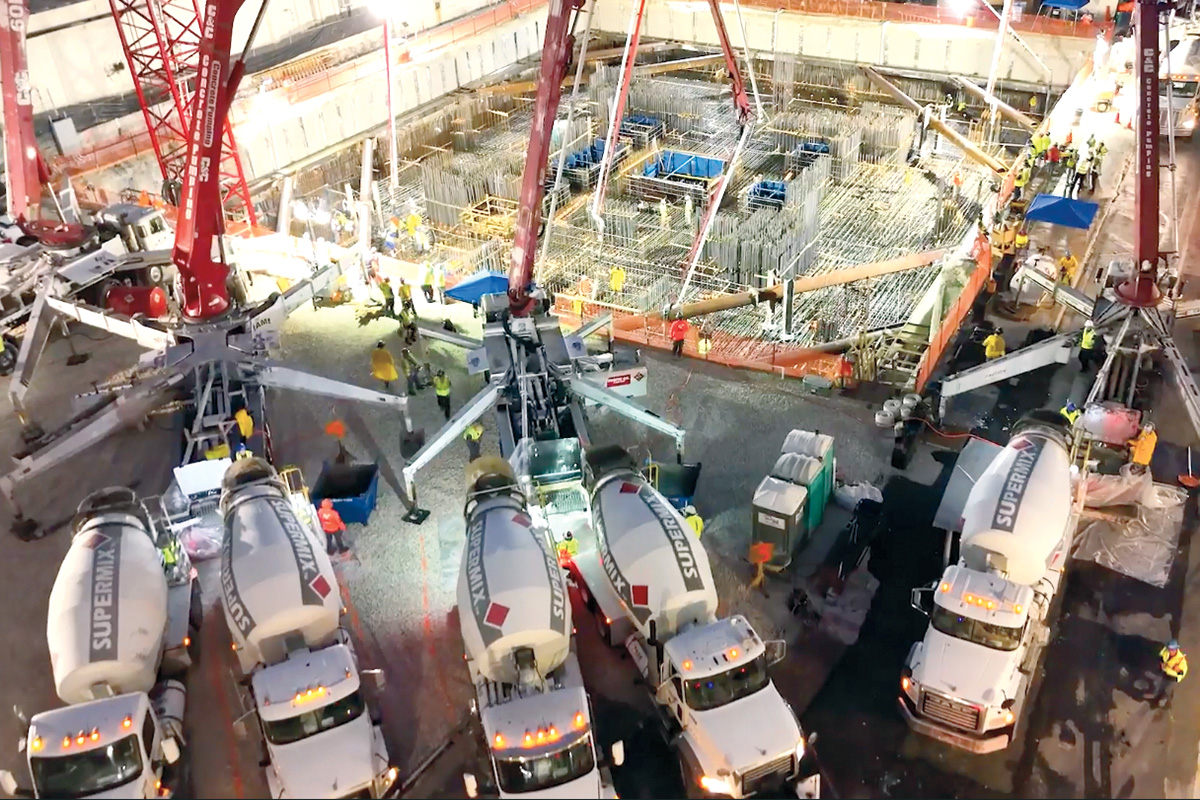
Foundation slabs — mat is the industry term — under buildings have to be made with a continuous pour to ensure foundation integrity. If the pour is stopped, all is waste. In 2024, over the course of 32 continuous hours, general contractor John Moriarty & Associates and concrete contractor Capform pulled off the Waldorf mat foundation pour. The concrete was made to a specific recipe and temperature dictated by structural engineers to achieve a specific strength per square inch. The challenge was moving 1,400 truckloads of that concrete mix from cement plant to the Waldorf job site downtown within the 90-minute shelf life the material has on the truck. The task couldn't be done on the weekend — Miami's too busy then to get trucks through. It took a battalion of drivers, police, on-site laborers and mix testers to pull it off. "It was a military operation," Senior Project Manager Jessica Berthin says. "It was unbelievable."
TO GO TALL, DIG DEEP
PMG's geotech engineers bored down 300 feet to sample the ground and found the optimal mix of limestone rock and sand at around 160 feet. Beyond that, the sand got too silty and slippery.
Miami's porous limestone, sand and shallow water table — workers hit water just three feet down — present a tricky challenge for builders. Water seeps into the job site constantly. And after the Champlain Tower collapse in nearby Sunny Isles Beach in 2021 killed 98 people, the city and developers worry about settling issues and the effect of construction vibrations on neighboring buildings. (Authorities in June released a final report on the Champlain collapse that found neighboring construction didn't play a role in the failure.)
To avoid slamming steel sheets into the ground to act as walls while digging a hole for the foundation, builders have turned to a prep technique with ancient roots. The Romans and Chinese mixed lime with local soil in building roads and wall bases. Now, massive blades with a diameter of 10 feet are inserted into the earth to churn the native ground while simultaneously injecting grout.
"Deep soil mixing," as it's known, became common in civil works projects in Florida and nationally. In Miami, developers of high-rises adopted it. The "soilcrete" forms a rock-solid mass with a higher load capacity than the natural ground and is nearly impermeable. "Think of it as a bathtub, where you're keeping water out and plugging the bottom," Berthin says. "That is a much more expensive way of building it, but it minimizes all the vibration for the neighbor."
LABOR
At peak construction, 650 workers will be on the site. Just inside a security checkpoint on Biscayne Boulevard sit a slew of bicycles, motorized bikes and scooters that workers use to commute. PMG also obtained vehicle parking for workers in three nearby sites. Shear and Berthin say finding labor hasn't been an issue. Subcontractors and their workers value a project that provides steady employment for years. "In terms of having that close relationship with the developer and subcontractor, I've never seen it as tight as here," Berthin says.
GOING VERTICAL
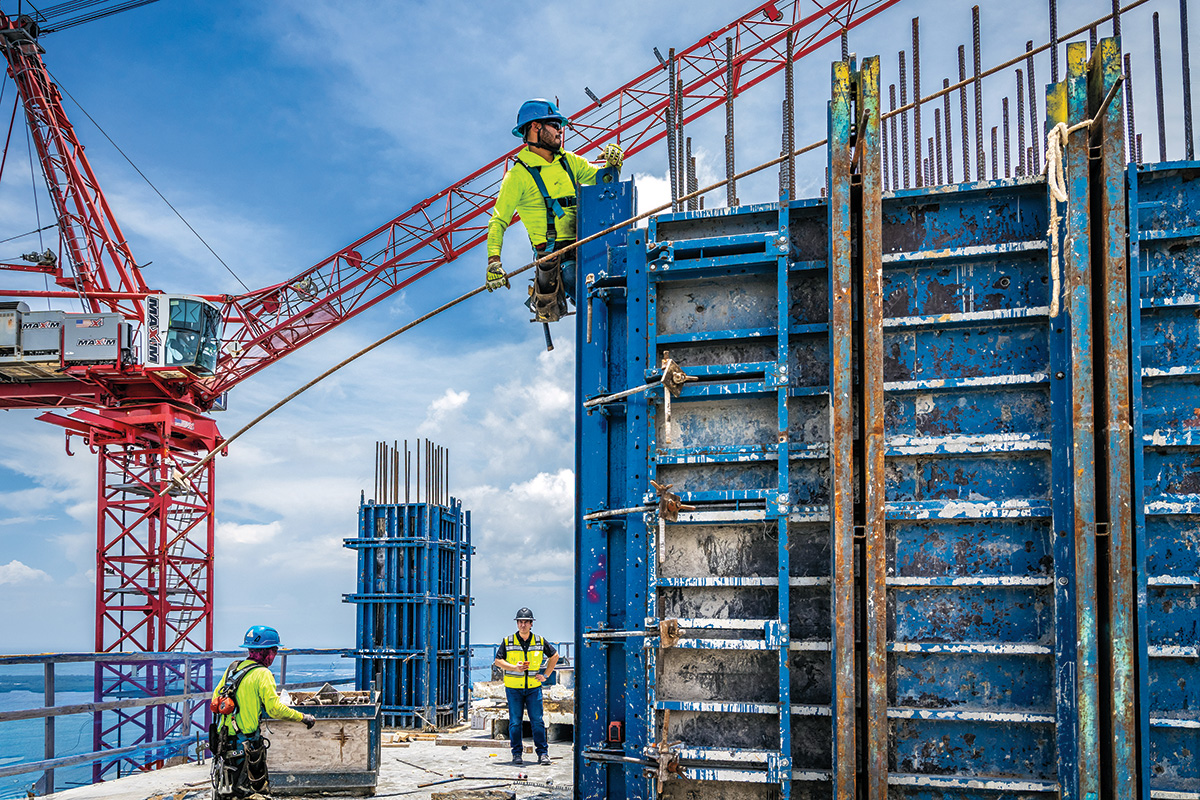
After two years spent on the foundation, the Waldorf went vertical in 2024.
A day in May finds Berthin on the highest floor built up to that moment — the 72nd.
At street level, Miami is roasting. At 700 feet up on an exposed concrete slab, however, a steady wind makes for a pleasant temperature. Heights don't bother her. "You can see how we're pretty much past our neighbors," she says, gesturing to Miami's tallest buildings below. The din of laborers toiling away is a reminder that the building, even at 700 feet, has another 300 feet to go.
Contractors pour a new story about once a week. The city allows work on the project between 1 a.m. and 7 a.m. up to five times a week. The glass contractors and interior finishers are about seven floors behind the level builders.
"We are blessed to have this view every day and to be able to see this. We live in a really beautiful city," Berthin says. "This is a privilege."
To the east is the blue of Biscayne Bay, Miami Beach's sparkling towers and the Atlantic. To the west there's the Miami-Dade County Courthouse, built in the 1920s and for a long time the tallest building in the south. It looks quaint at only 28 stories. In the distance sits Miami International Airport. The airport's location has the practical effect of capping future Miami buildings at 1,049 feet — same height as the Waldorf. "Nobody will top us," Berthin says.
THE DESIGN
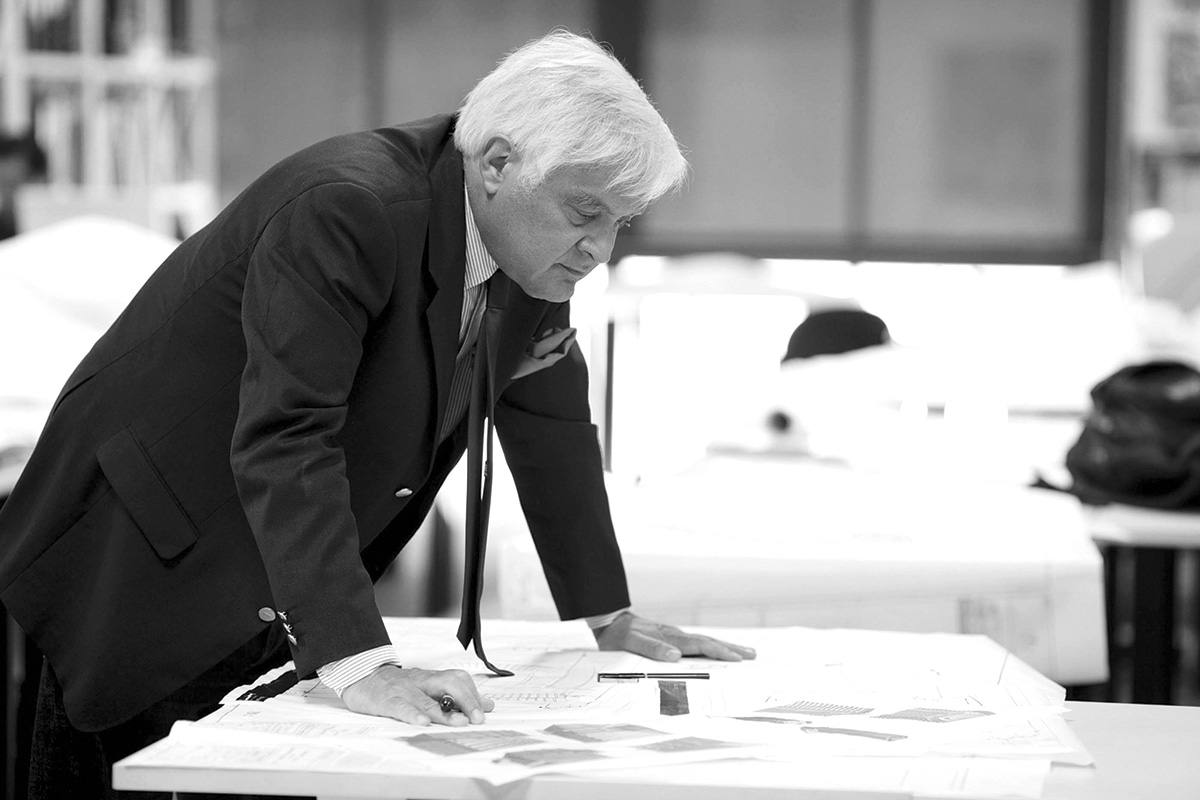
PMG chose an architect it had worked with before, Uruguay native and Canada-based Carlos Ott, who won the competition to design the Opera Bastille in Paris. For the Waldorf in Miami, he conceived a tower of nine offset cubes. "It was intended to be not only the first supertall, but something that very much stood out, whether you like the architecture or not," Shear says. "I've heard this from many people over a long period of time now: 'I hate it,' (or) 'I love it.' It's very polarizing, which is what we wanted."
Aesthetics aside, the cantilevered cubes disperse wind load. The first three cubes comprise the hotel. The top six are condos.
Units have floor-to-ceiling windows with no blocking columns. Glass covers two-thirds of the balcony space — otherwise the winds aloft would make them unusable.
Sieger Suarez Architects in Miami is the architect of record.
THE PROJECT MANAGER
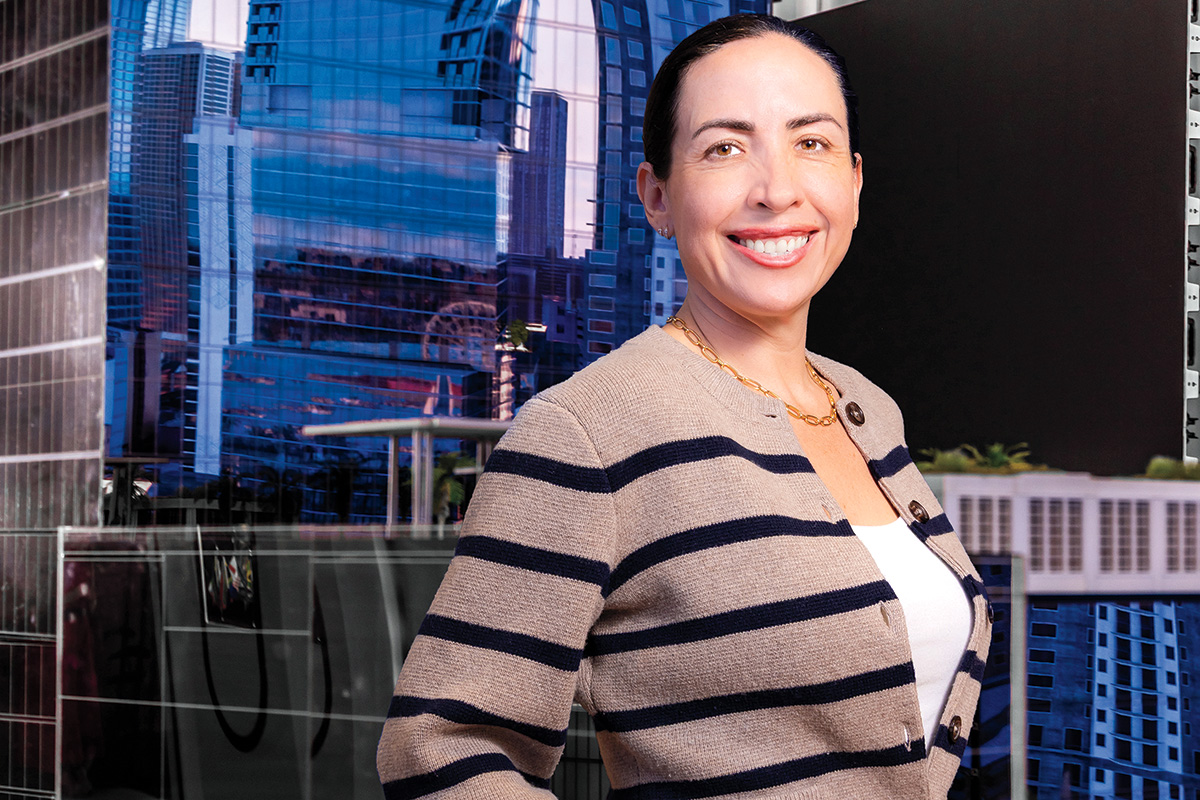
Jessica Berthin is literally rising to the top. A student of architectural history and Spanish at the University of Virginia, she returned to her native Miami in 2001. She became a construction manager for the Miami-Dade County cultural affairs department while earning a master's degree in architecture at Florida International University.
Berthin, 47, moved in 2015 to the private sector, spending four years with Miami uber developer Related Group and then in 2019 joined Coral Gables-based Driftwood Capital as a project manager on hotel developments.
Before PMG, her tallest building was 65 stories.
For the Waldorf, PMG wanted a project manager whose skill set covered high-rise condos and hotels and interacting with a brand. "My experience was perfect because it kind of meshed everything that was needed for this project. We have the best group. It's the A-team all around whether it's the GC (John Moriarty & Associates), subcontractors, consultants," Berthin says. "This is a monster project. For all the partners, it's exciting because there's a lot to learn in a building like this."
Engineering Challenges
STORM RESISTANCE
Wind force increases with height. With no ground and building friction, the winds of a Category 2 storm at 30 feet can become major hurricane force winds at 900 feet. The Waldorf structural glass can withstand 175-mph winds. The habitable floors of the tower are above flood level. Shear notes Miami has the country's strongest hurricane building code. "They are built like mini-fortresses, frankly. But they should be," he says.
SWAY
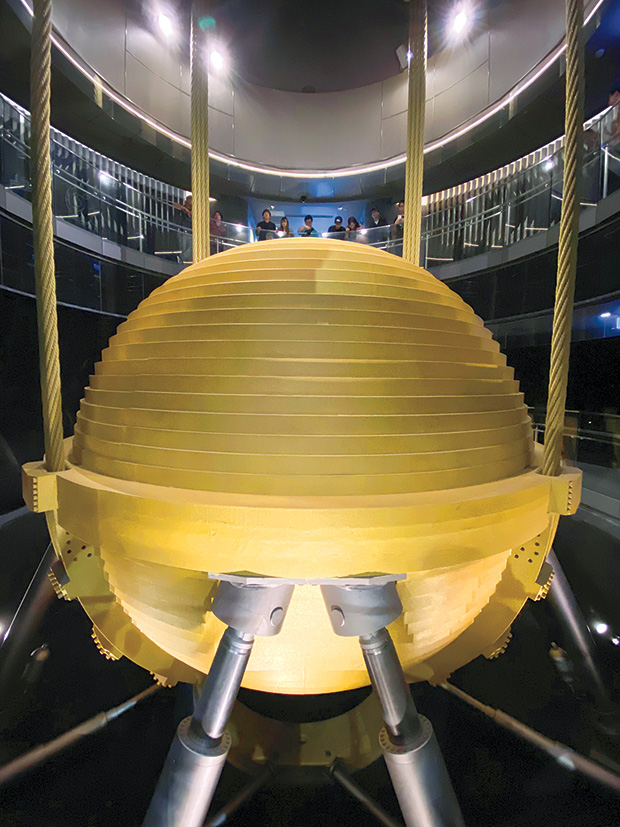
Being hundreds of feet up in a building moving in the wind is more than a bit unsettling. Thus, the first supertall in Florida also will be the first to sport a "tuned mass damper," which dampens the movement of tall, slender buildings in strong winds by moving in the opposing direction that the building moves.
Placed at the very top of buildings, tuned mass dampers can be dense ball pendulums, while others are liquid-filled "slosh" dampers. In the Waldorf's case, the damper is a bug-shaped, two-piece contraption of 1,003 tons of steel called an "opposed pendulum." Shear says the device cost north of $8 million to purchase and install. The Waldorf mass damper contractor, Canada-based Motioneering, a sister company of wind engineering firm RDWI, has designed and implemented more than 100 dampers for tall buildings globally, each a custom project, says Motioneering project manager Gary Clark.
It's a "passive device," Clark says. "The building needs to move first before the tuned mass damper starts to kick in." People won't notice any motion even when Miami is hit with a "wind event" of such magnitude that it happens statistically only once every 10 years, Clark says. The device controls the building's motion and acceleration for the comfort of inhabitants. The storm of the century? The assumption is that people will leave.
Clark says Motioneering is working with developers in Florida on upcoming projects of which three or four will need a damper — though maybe the sloshing kind.
Next Up
Of 10 or so proposed supertalls for Miami over the years, seven still are said to be in the works. "Time will tell," says Shawn Ursini of the Chicago-based Council on Vertical Urbanism, an organization that advocates for smart, dense vertical growth as a solution to societal challenges. It tracks tall building development globally.
Among those in the works are One Bayfront Plaza, a 1,049-foot, 93-story tower that Florida East Coast Realty is developing in downtown Miami. FECR is demolishing a 19-story building on its site in the 200 block of Biscayne Boulevard.
In presales is a 1,049-foot condo tower at 888 Brickell branded with Italian fashion house Dolce & Gabbana.
In terms of tall towers (more than 100 meters) and supertalls (at least 300 meters), "as far as U.S. cities go, Miami might be the most active market right now," Ursini says. "Skyline-changing buildings" are in Miami's future, he adds, even if none can exceed 1,049 feet because of the airport. Suburban Southeast Florida markets also are seeing 100-meter-plus buildings.
Miami (with 70 skyscrapers) ranks a distant third to New York (315) and Chicago (135) in skyscraper count nationally. New York's One World Trade Center at 1,776 feet is the nation's tallest building.
Miami in the last decade saw a 68% increase in its number of buildings taller than 100 meters, according to the Council on Vertical Urbanism.