


A dead battery changed the course of Daniel Chase Bethea's career path. The senior University of West Florida mechanical engineering student was leaving a calculus 3 class two summers ago when he came across a classmate whose car wouldn't start.
"Being the good Samaritan that I was, I went to go help him." As he rewired the terminals and charged the battery, Bethea learned that the classmate interned at GE Vernova, which has a massive manufacturing center in Pensacola that makes wind turbines, through UWF's Talent Catalyst Program.
"I said, 'Hey, I would like to work at General Electric. Can you put my name in for the next time of interviews?'" A few months later, a program representative came to one of Bethea's classes to talk about the program and new openings at GE. He was hired in January 2025, splitting his time between facilities and data management.
As someone who likes to work with his hands, he also dreams of starting his own knife manufacturing business but sees that as more of a complement to a full-time job. Now, in addition to his course load, he spends 20-25 hours per week at the GE plant doing everything from hunting for operating efficiencies to dealing with vendors to assisting with forklift maintenance. He created a sensor to determine how long the plant's roll-up doors were open to optimize routes and use less air conditioning.
UWF's Talent Catalyst Program was created in the 2023 academic year and requires a participating employer to provide a mentor who is outside of the intern's chain of command to help him or her navigate workplace challenges. Back on campus, Bethea receives professional development instruction. It's all aimed at helping UWF students develop the soft skills they need to succeed in the workplace, says Laura Swann, assistant director of UWF's Office of Workforce Development.
"Our local business community is craving this," she says, with more lining up to hire and mentor student interns. Some are coming to UWF through Landrum, a 55-year-old privately held human resources business that does everything from payroll and recruiting to HR compliance.
Landrum even handles payroll for smaller businesses wanting in on the catalyst program but never had interns before. Kara Bloomberg, Landrum president, calls the program "high touch" and tailored to fit a specific company's needs.
It's necessary to give students the best chance to succeed, Swann says. "When they come in, they don't know what they don't know. A lot of them have hard part-time jobs where they're baristas — now they're in a real job and it becomes really relevant. 'How do I talk with my team when there's all these different age groups on my team? How do I get my point across? How do I listen to other people?' It's very eye opening for them."
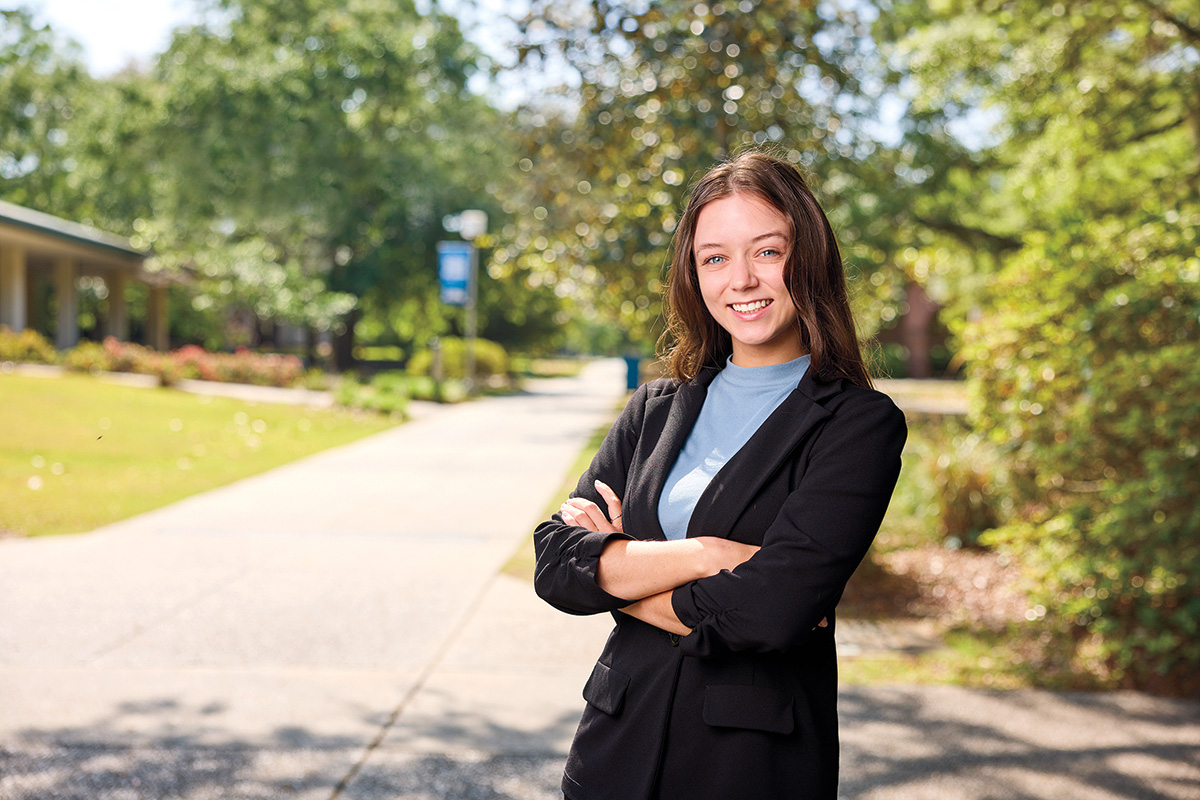
That was part of the challenge for senior business major Savannah Guilford. She's interning in UWF's marketing and communications department after previous service jobs, including one at a local Asian restaurant. It was fun, she says. "I got to make boba."
Now she's writing profiles of UWF students and alumni, drafting news releases and part of a "Happens Here" marketing initiative. "I get to talk to these amazing people who have had such incredible stories and experiences, and I get to write their story."
The work has helped her gain confidence knowing how and when to join conversations and how to exit gracefully.
The education can be a two-way street, Bloomberg says, especially for smaller businesses that might struggle adapting to branding and social media. Interns bring a comfort with technology that the business owner might lack.
"They've grown up with a phone in their hand and a computer by their side," she says. "A lot of the small business owners that may be in their 60s and starting to think about retirement or succession of business, they just don't have that same comfort level."