



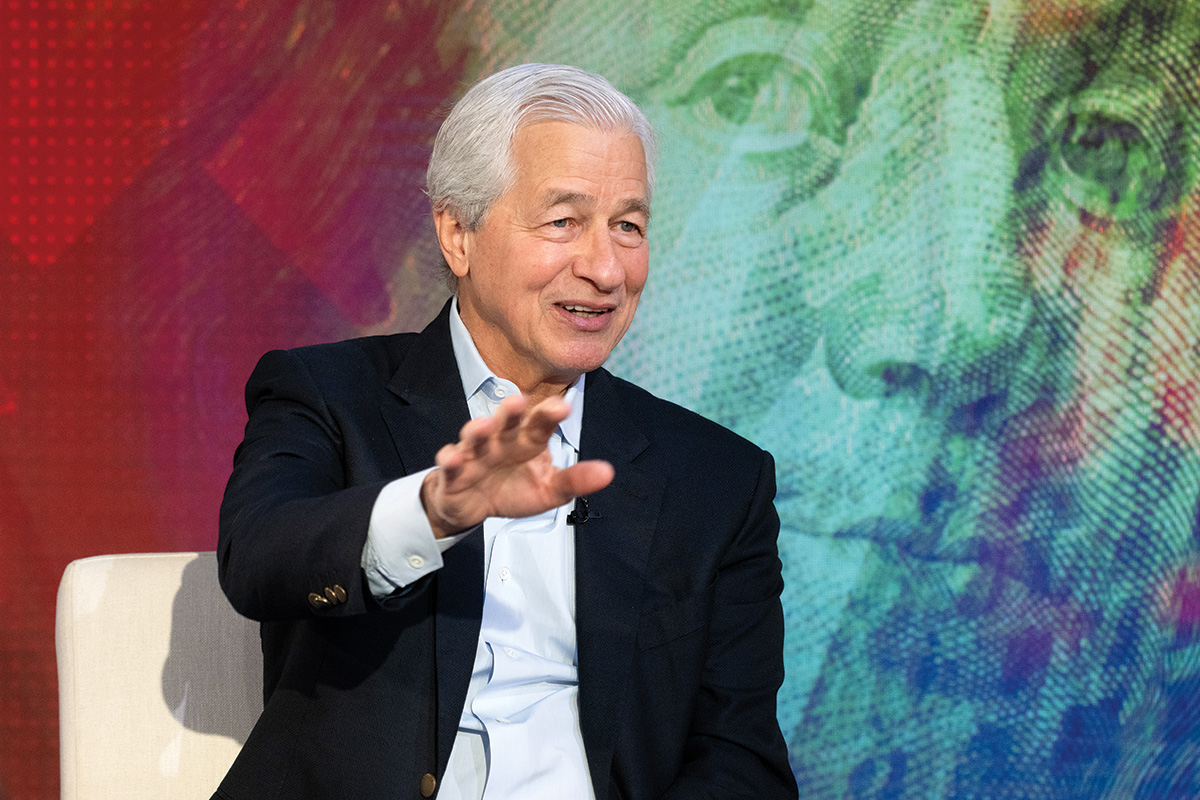
A living legend, he's been called "the voice of Wall Street." Barron's recently called him "the most consequential banker of his generation." In a 2010 profile, the New York Times called him "America's least-hated banker." Jamie Dimon, 70, has been CEO of JPMorgan Chase for 20 years and has no plans to retire just yet. The bank's $777-billion market value makes it the biggest bank in the world — larger than Bank of America, Wells Fargo and Citigroup, its three main competitors, combined.
Dimon recently sat down with Florida Trend for an interview as JPMorgan Chase continues to aggressively expand its footprint in Florida. Here's a sampling of what the world's biggest bank is up to in the Sunshine State:
New branches: Last year, it added 12 new Chase branches in Florida. Over the next two years, it plans to open around 40 new branches statewide, with nearly three-quarters of those in Central Florida. It anticipates hiring about 250 people to staff the new branches coming to Central Florida alone. It's also opening new "JPMorgan Financial Centers" in Palm Beach, Jupiter and Palm Beach Gardens.
Orlando: Over the past year, it began major renovations at its 250,000-sq.-ft. Orlando Heathrow campus, one of its key corporate centers in the U.S. This will modernize the campus for its 2,000 employees. The bank is also committing $500,000 to CareerSource Central Florida to fuel job training for the region's growing semiconductor industry.
South Florida: It renovated and doubled the size of its Miami Brickell offices to fit 400 additional employees and opened a 13,000-sq.-ft. office in West Palm Beach.
Tampa: It renovated and expanded its downtown and Highland Oaks offices in Tampa.
Jacksonville: It plans to open at least four new branches over the next three years.
Panhandle: Next year, it plans to open its first branch in the Panhandle, with more to follow. (The bank has locations in Tallahassee, but not as far west as Pensacola or Destin.)
Commercial banking: It has expanded its commercial banking team by more than 25% in the past year. It anticipates continuing that growth, with statewide headcount expected to increase by roughly 18% over the next five years.
Travel advisors: It's adding roughly 260 new Chase Travel advisors — agents who offer trip planning and booking services for Chase cardholders — at its Orlando Corporate Center. By the end of 2027, it should have roughly 500 travel advisors in Florida.
As for Dimon, he met with Florida Trend while he was in Orlando for an annual event recognizing the bank's best branch employees.
Here's how the conversation unfolded:
Florida Trend: Why does JPMorgan Chase view Florida as such an attractive target for expansion?
Dimon: People keep moving here — more and more businesses, middle-market businesses, more and more wealth. Florida is very hospitable to business. The individual tax rate, the business tax rate and the ability to work with government. You're making it a good place to work. People want to build here. You've got a lot of people moving here and moving their companies here.
The governor passed that insurance law trying to make insurance work better. Got rid of some of the criminal behavior. That's gotten more money to the people who needed it. So if we reform these systems, you will have a healthier economy. I always write about how nobody has a divine right to success, and that includes cities and states. And you can just see it. I mean, how do you track California losing population, New York losing population ... while in Georgia, North Carolina, South Carolina, Florida and Texas, you have pretty rapid expansion. I think that'll continue. It should be a lesson to these other states.
FT: Speaking of that, we're seeing a lot of high-net-worth individuals moving from other states to Florida, particularly South Florida. Billionaires like Ken Griffin, and others. West Palm Beach is marketing itself as "Wall Street South." Do you see this trend continuing?
Dimon: It may accelerate if some of these states don't understand what's happening. It's so much better here, that differential is so large at this point, that I think it will continue no matter what.
FT: You write an annual letter to shareholders where you cover a lot of ground and hit a number of topics. Last year most of the news coverage of your letter had to do with your views on tariffs and inflation. What do you have in store for this year's letter?
Dimon: I talk about specific issues facing the company — competitors, requirements, regulations — things that a shareholder would want to know, basically. I cover U.S. economic policy, things that can make the country better, and I try to make recommendations. So this year, I'll make a recommendation about the earned income tax credit. [Dimon has previously advocated for it to be dramatically expanded to boost low-income workers.]
On immigration, we should finish immigration reform — not border control, although that's a good thing, we should have had it before. Now that we have that, we should have citizenship for law-abiding immigrants, more merit-based immigration, proper asylum — and it's good for growth. Immigrants help build the country. My grandparents were Greek immigrants who never finished high school.
I cover foreign economic policy — national security-type policy. We have this big new security resiliency initiative. I just got back from Washington, D.C., the Department of War, going through some things we can do to help them a little bit.
I also talk about our country's 250th anniversary.
I talk about capital formation. Look, we love small businesses. We bank six, seven million small businesses. But there are 30 million small businesses and 17,000 larger ones, and capital expenditures and R&D are mostly the 17,000 larger ones. They are critical for the growth of our country's productivity. Countries that don't have capital formation and the ability to make huge investments do not grow. Think of most of Africa. There should be a deeper recognition of how important that is, how important for America.
FT: What else do you think Florida is doing well? What are some strengths and high points you see, as well as any cautionary things?
Dimon: Taxes. Pro-business. They want you here. When (Rick) Scott was governor, he used to call me up. (Jeb) Bush used to call me up. I've not spoken to Gov. DeSantis, but they were all very pro-business, meaning that if you need to build a building, if you need to change the bus stop, they want you to be here. The mayor of Miami, I did events with him. That's what kind of place it is. It's got schools, universities, it's got the arts — so it's the whole thing.
FT: Any additional advice for Florida lawmakers to encourage more business, more economic activity?
Dimon: Just do what they're doing. Focus on that one issue. Obviously, it's got to work for all the citizens of Florida. The insurance reform — you know, litigation is such a problem in our country. Permitting — I think you've done a good job with permitting here. In a lot of the states, it's almost impossible to get a permit to build something. So if you were to build something, and you knew that it should take two years to get the permits, but it's probably going to take seven years and a lot of litigation, it dramatically reduces two things: It reduces your return on the investment, and it may have limited the need to do the investment. It's just too much. Consistency of rules and regulations and the speed of it is critical. Red tape! You want to have fun, one day at a table like this, invite 10 small businesses to lunch and start asking about what rules and regulations that they respond to. You'd be surprised. I went to a barber shop, they had to have three licenses. That was in New York. This lady had to have a state audit, federal audit, city audit, OSHA audit — it's just endless bureaucracy. It's not the way America should be.
FT: You've spoken before about the current presidential administration's tariffs and trade wars. What is your current take on the international trade situation?
Dimon: I'm in favor of free and fair trade generally, but we made two mistakes when it comes to national resiliency. To the extent that we need our own rare earths, we shouldn't be trading for them. We get most of our rare earths from China. We get most of our active pharmaceutical ingredients ... from China. That is not a trade issue. It's a unilateral issue. Some of those things need to be made here for safety and security — or friend-sourced.
Let's kind of put that aside. Other than that, I think there is unfair trade. But trade, it comes in many forms. There's quotas, subsidies, there's grants, there's loan grants, there's tariffs, there's regulations — like the reason you don't have American cars in certain other countries is because they'll literally say, 'The button that locks the doors is too close over here.' But you can't change all the manufacturing and change one button that's basically irrelevant. They know it knocks out American brands.
It is a perfectly reasonable thing to say trade should be fair, and tariffs got people to the table. But there still is, like, a little bit of a trade war. They weren't so bad that they're hugely inflationary or recessionary. But they worked, and I'd love to see them finish it — you know, have good trade agreements with everybody.
There's another example of dramatically unfair trade. That's called mercantilism. That's when China's now being accused of dumping things around the world, so if you're in a business and they just undercut your price, they bankrupt you, that's not fair. It's not competition. And you know, China has three or four times better subsidies than most other countries do. Again, those subsidies could be taxes, cheap loans, government purchases. It can be a lot of different things, but it's really unfair.
FT: You mentioned JPMorgan Chase's ongoing security resiliency initiative. (Note: This is a $1.5-trillion, 10-year plan to finance and invest in industries critical to national economic security and accelerate strategic manufacturing, not to mention a $500,000 grant to a semiconductor training center outside Orlando.) What impact might that have on Florida?
Dimon: It's not a Florida-based effort, but it will land here. We looked at 28 industries which are critical for national security: space, drones, cyber, AI, semiconductors, rare earths. There's 28. Submarines, shipbuilding, military — in some cases not directly military, like getting LNG (liquified natural gas) to Europe is security. They need it for their national security, so every country could define it slightly differently. They have slightly different needs, so we looked at what we do. We already do a lot of financing for it, and we decided to up it by 50%.
We also hired Todd Combs, a world-class investor from Berkshire Hathaway, to invest $10 billion of our own money into some of these industries. They need the money to grow. We've already done several deals around rare earths and other things and around a company that builds rocket engines for Patriot missiles.
"The lesson is, get out, go to call centers, go to branches, sit down with people. You can learn a tremendous amount. You can do better for them. You can do better for the client. It's a constant learning process." — Jamie Dimon
And then every one of those companies, if you dig into it, has multiple vendors — I think 5,000, 10,000. When you're talking about submarines there are about 20,000 vendors, and some of those vendors are critical, and they're all over the place. They're usually middle-market companies or small businesses. Also, now that the government needs to spend more money on equipment, those companies have got to double or triple their production. We seek them out and we can finance them. Sometimes they need workers. If you're running that company, you say, 'I can triple my production, but I don't have enough workers. I don't have trained workers, and the workforce I have is 60 years old, retiring.' We have an issue in this country to get this done and done right and done quick. Any state that's growing has these companies.
FT: You came to Orlando today to recognize high-achieving employees from branches around the country. Why is it important for you to be part of that event?
Dimon: When I first got to Bank One (which later merged with JPMorgan Chase in 2004), I was CEO of the company. They didn't even tell me about an event like this. I found out at the last moment, and I literally got on an airplane down there. I think it was in Washington, D.C., I told them that you can never do that again. Anytime you have our top people recognized, I have to know — to go as much as I can. That started it. That was 25 years ago. We always did things like that in my prior companies, so it was normal to me.
I did get very upset the first time because half the management team wasn't there and it was more of a boondoggle — like, they didn't have any work sessions, so when we do it, the management team is all here. They host it. And these employees spend two half-days working in workshops.
But it's a two-way learning street. They're learning from us and we're actually learning from them. But the highlight is the recognition event where 1,000 people get recognized. They'll all come onstage. I used to stand up for the whole thing but I don't do that anymore because it takes three or four hours. You'd be shocked. Some of them have never been in airplanes. They've never been recognized. Some are crying. It's a melting pot of people — Asian, Hispanic, white, from all over the country. It's all different job types. And it's quite motivating when you know you're making people's lives better. It also makes us better as a management team.
The lesson is, get out, go to call centers, go to branches, sit down with people. You can learn a tremendous amount. You can do better for them. You can do better for the client. It's a constant learning process.
FT: Do you anticipate JPMorgan Chase continuing to expand in Florida in the future?
Dimon: Absolutely, consistently. As long as Florida is expanding, we'll expand. Plus, we want to gain share.
Jamie Dimon, 70, has been CEO of JPMorgan Chase for 20 years and has no plans to retire in the immediate future. The bank's $777-billion market value makes it the biggest bank in the world — larger than Bank of America, Wells Fargo and Citigroup, its three main competitors, combined. The bank is aggressively and noticeably expanding its footprint throughout Florida.