







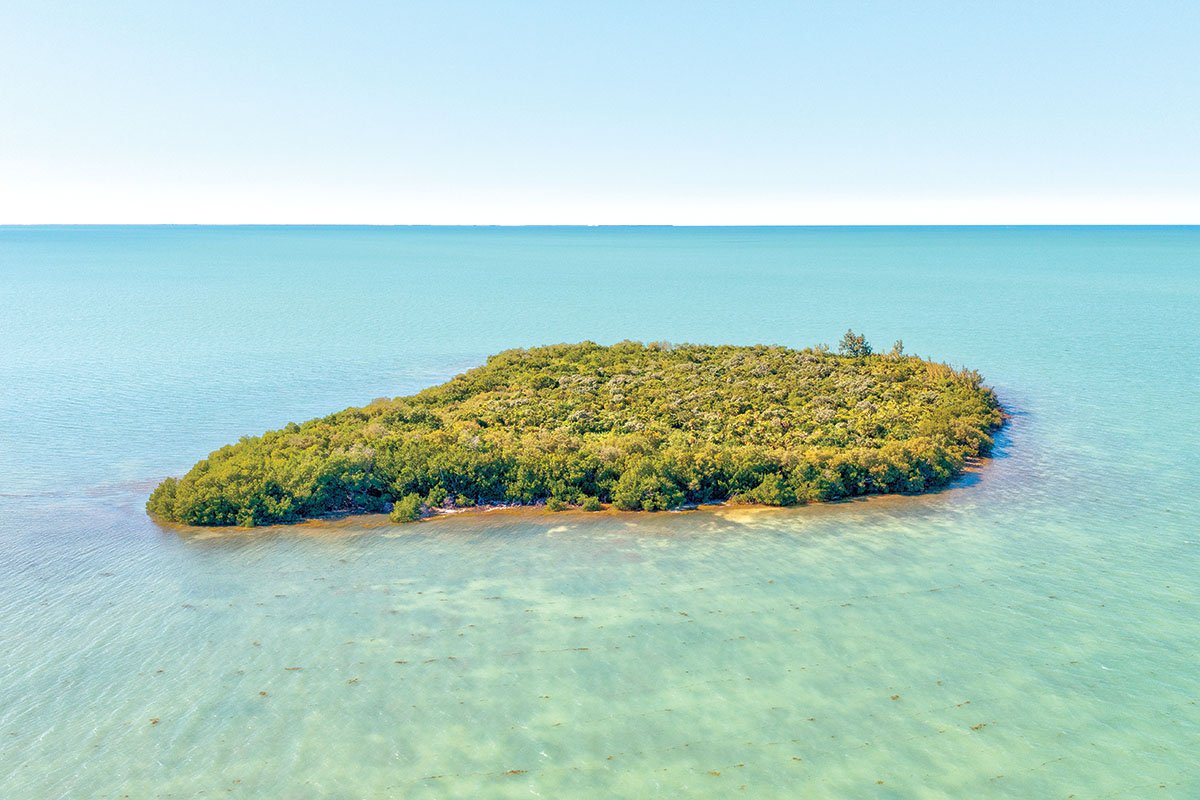
In 1956, Dr. Robert E. Shands, a World War II battlefield surgeon from Mississippi, bid $20,500 at auction to win a tree-covered island in the Florida Keys the federal government no longer wanted.
Little Fat Deer Key, all 7.9 acres of it, sat just north of the string of the Middle Keys carrying the Overseas Highway from Key Largo to Key West. He forked over another $1,400 to the state to acquire seven acres of bay bottom he needed to build a short bridge joining his island to civilization. He envisioned a family compound for himself, his wife and four kids.
Seventy years later, those Middle Keys have become the city of Marathon. The Keys' home county, Monroe, has added 40,000 people. But Shands' purchase remains a tree-covered island — no dock, no bridge, certainly no family compound. What it has become is the subject of a bellwether court case for how much money local and state government owe property owners stymied by land use regulations forbidding development. At stake in the Keys are some 6,171 parcels the county appraiser's office values at $2.2 billion.
For water lovers, few places surpass the tropical Keys and the continental U.S.'s only barrier reef. "Everyone wants to come to the Keys," says David Steinmeyer, CEO of builder Gulf Southern Construction in Key West.
Most of mainland Monroe County is Everglades with a bit of population on the peninsula's west side. All the rest of the county's 84,700 people and 54,000 residences sit on the 112-mile stretch of rocky islands connected by U.S. 1 from Key Largo to Key West. The county ranks 38th among the state's 67 counties in population with less than 0.4% of the state total. The population in general is whiter and better off than the rest of Florida. Crime is low. Like other places in Florida tending toward the affluent, second-home market, it's tough for working people — whether commercial fishermen, tradesmen, hotel room cleaners or teachers — to afford to live. Unlike pricey markets elsewhere in Florida, working stiffs commuting to the Keys face a long drive down a single road from the mainland.
Generally, the real estate market is robust, though not as juiced as it was during the COVID-19 pandemic. The luxury market has been strongest, says Brian Schmitt, president and broker of Coldwell Banker Schmitt Real Estate in Marathon. Homes with a boat dock and open water views start around $1.8 million to $2 million.
Growth in the Keys is governed by a rate of growth ordinance (ROGO) enacted in 1992 limiting the number of new residences. The framework is rooted in the idea that all residents be able to evacuate within 24 hours before a hurricane makes landfall.
PARADISE CONSTRAINED
Growth in the Keys, in a manner unique in Florida, is controlled by government. Florida's population increased more than 132% since 1980; Monroe's population increased by 28%. Between local, state and federal regulations, "Monroe County is one of the most regulatory complex jurisdictions in the nation," lawyer Derek Howard, of the county attorney's office, said in 2024.
Date some of that complexity to 1979 when the Keys became one of just five "areas of critical state concern" in which local land regulations require state approval. The government concern manifests in its mandate that all residents be able to evacuate within 24 hours before a hurricane makes landfall, as there's just one road in and out. The means to that end is the byzantine "rate of growth ordinance" enacted in 1992 that limits the number of new residences. Winning approval to add a new residence under ROGO — as it's universally known — is done by amassing the points needed to make the top of the list for the dwindling number of allocations handed out each year.
Points are awarded to a property based on whether it's in the Upper or Lower Keys. Is it an infill lot already served by a road and utilities? Will it have solar power, a concrete cistern, infringe on marsh rabbit habitat? There are even "perseverance points," for each year an applicant tried and failed. It's a complex system that invariably requires a skilled attorney to navigate. To some, it steers new housing to already developed areas and away from sensitive ecosystems. Others aren't so enamored.
"ROGO's a scam," says Steinmeyer, the Key West-based builder. "It doesn't matter how long you've been in line. It's based on how much you're willing to pay. You pay to play."
Indeed, applicants literally can purchase points by donating money to the county land acquisition fund, by purchasing a second property and giving it to the government or by buying multiple properties and aggregating them into a single property with just one residence.
ROGO, it should be said, doesn't apply to tearing down a home and replacing it with something new. "One thing I've learned," says Monroe County Administrator Christine Hurley, "if you want older housing stock to get redeveloped, you put a limit on the number of new units you can issue."
In 1986, Marathon rezoned Shands Key from "general use," which would have allowed its owners to build a home there, to "conservation offshore land," which requires at least 10 acres to build one home. The only suitable uses for the island, the city said, were beekeeping, enjoying nature or maybe camping.
ISLAND IN LIMBO
Local government through the decades spoon-fed out the yearly allocations for additional residences, which put off the question of what happens to owners when allocations run out. "You had waitlists, but not long waitlists," says Bart Smith, a Key West attorney. "If you were capable of persevering, you basically got it." But the number of points needed to win approval has gone up as the number of allocations left has fallen. Marathon, for example, is widely said to be out of allocations. The county was projected to run out of allocations this year. "Your supply is not going up with demand," Smith says. "Something is going to break."
The break for Dr. Shands' island came in 2004. After he bought it at auction in 1956, the federal government renamed it Shands Key, according to the court filings, to honor his service in the Pacific Theater and his work with his rural Shands Hospital medical center in post-war Mississippi. His family said that after seeing war in Okinawa and Saipan, he wanted to live on an island in peace. He didn't get there. He died in 1963 of pancreatic cancer before building his family compound. His wife passed the property to their four children when they reached adulthood. One son became a doctor in Mississippi; another became a county attorney and judge there. Over the years, they testified, they visited Shands Key regularly to clear brush and debris left by trespassers. In 2004, they asked the city of Marathon for permission to build a dock.
The city refused their application. In 1986, the county — the city inherited the land rules when it incorporated in 1999 — rezoned the island from "general use," which allowed a home per acre or seven homes on Shands Key, to "conservation offshore land," which requires at least 10 acres to build just one home. What's more, the island had high-quality hammocks with a mangrove fringe and habitat for the White-crowned Pigeon, a state-listed threatened species that in the U.S. generally is found only around Florida Bay.
From the city's viewpoint, the only suitable use for the island was beekeeping, visiting and perhaps camping — though no tent platform could be built — provided the family waded ashore as no dock could be permitted. The city offered to take title to six acres in return for giving the Shandses some development rights they could use elsewhere in the Keys. Called transferable development rights or TDRs, they are an important incentive in land use regulation in several Florida cities and counties.
The Shandses declined the trade. Their case, following the legal process in Marathon, went to a special master. One appraiser testified the island was worth $3 million to $3.5 million if a home could be built there. Another said it was worth $147,000 to someone who wanted it just for the transferable development rights, or between $46,000 and $60,000 for someone who just wanted to own some nature and use the property for activities such as camping and hiking. The special master recommended the city either let the Shands family build or pay them the appraised $3 million or negotiate a price for the island. Marathon's City Council rejected that by a 3-2 vote. The family, represented by the public interest law firm Pacific Legal Foundation, sued. (The foundation's attorney in Florida, Kathryn Valois, said the family declined to be interviewed for this article.)
The Fifth Amendment and the Florida Constitution require that when government takes property it must pay — in the words of the Florida Constitution — "full compensation."
The Shandses alleged Marathon through regulation had taken their property's economic use for conservation without paying. Such regulatory-taking claims "have always been an uphill battle," says Valois.
Marathon argued the awarding of transferable rights meant no taking had occurred. The island still had value as a passive recreation site or for the transferable rights. The Pacific Legal Foundation argued those transferable rights are just paper chits the government uses to avoid liability and serve as only partial compensation. "Shands Key remains zombie property, undevelopable and forever vacant," according to one Shands family pleading.
AT WHAT COST?
Financial liability is a major question for Keys' and state government budgets. Some estimate buying out property owners in the Keys could run from $1 billion to $3 billion. "You are going to have to pay these folks if you don't give them a permit," says Schmitt, the real estate broker.
Not so, says activist Ed "Capt. Ed" Davidson, who says the Keys are "already way over carrying capacity." He says it's a myth that property owners all will have to be paid "retail" value compensation. All buyers since the mid-1980s have been on notice they might never get to build, he says. "There's not very many" properties like Shands Key, he says. "Most of the properties have changed hands several times."
In a presentation in 2024, Howard, from the county attorney's office, concluded there was no liability for every lot. He listed the slew of Keys victories already won by government in courts against a slim number of losses. Efforts to obtain comment from Howard and County Attorney Bob Shillinger were unsuccessful. One case Howard said to watch, however, was the Shands family's suit.
For going on 18 years, the Shandses and Marathon fought in Monroe Circuit Court and several times in the appellate court for Monroe and Miami-Dade, the Third District Court of Appeal. Finally, in early 2025, the appellate court in an 8-1 ruling agreed Marathon had done a regulatory taking. The follow-up question is how much the Shandses are owed.
The city appealed to the state Supreme Court. Environmental groups and the Florida Association of County Attorneys lined up to file briefs in the city's support. But the state Supreme Court in December declined to hear the appeal. Edward Guedes, of law firm Weiss Serota Helfman Cole + Bierman, one of Marathon's appellate attorneys, says the Third District decision "has significant repercussions for ROGO" and a predecessor program. "The city believes, respectfully, that the court adopted an unduly restrictive interpretation of the key Supreme Court precedents," he says.
Marathon's City Council in December voted to appeal to the U.S. Supreme Court. Absent a win there, it will have to give the Shands family a permit or go to trial over the value of the site.
Since the state high court declined to hear the case, it's the law in Miami-Dade and Monroe and, unless another district appellate court rules otherwise, across Florida. That said, when it comes to the decision's impact on transferable development rights used by Florida counties and cities, there's "the Keys and everyone else," says Ken Tinkler, a local government specialist with Carlton Fields in Tampa.
Financial liability is a major question for Keys' and state government budgets. Some estimate buying out property owners in the Keys could run from $1 billion to $3 billion. Others say it's a myth that dissatisfied property owners all will have to be paid "retail" compensation.
Other parts of Florida that issue transferable rights don't have a state-imposed growth cap, he notes. Transferable development rights outside the Keys are used differently. For example, a city could grant them as an incentive to a historic property owner to keep the property as is but realize value by selling the rights to someone developing a separate site.
Valois, the Shands' Pacific Legal attorney, says the ruling means Keys property owners who can't get a permit are entitled to just compensation if they've lost all use of their property.
The open question is just how many such properties there will be when the ROGO allocations run out. The Legislature in 2025 expanded the mandated evacuation window for the Keys by a half hour and allowed another 900 homes in Monroe County and incorporated jurisdictions. Those 900 are designated for vacant, buildable parcels with preference for owner-occupied, workforce or affordable housing, not second-homes or vacation rentals. In the Keys, workforce housing spans a wide income range. "We actually lose doctors down here," Hurley, the county administrator, says, "because they cannot find adequate housing — believe it or not."
EXPANSION MEETS REALITY
The state on Jan. 1 released the first 300 of the 900 allocations to the county and municipalities of Marathon, Islamorada and Key West and will release 150 a year thereafter. The law containing the 900-home expansion is being challenged by environmental groups over other provisions impacting local government planning in Florida. Assuming the 900 survive the courts, there still will be thousands of properties that won't get an allocation. The 900 are just "staving it off — so stay tuned," says attorney Smith.
The expansion does buy time for state and local government to peck away at reducing liability by acquiring land or by seeing lots "retired" through the ROGO process of gaining points by donating or aggregating parcels. The state has dedicated $5 million of its Florida Forever conservation and recreation lands buying program toward Keys purchases.
Even so, "it's not enough to buy everything," Hurley says. "No one has given us a billion bucks." She says the county also has trouble finding willing sellers. "We try and buy them," she says, but many owners won't sell. Says Hurley, "I guess people think, 'I'm going to wait. Maybe someday I will be able to build on it.'"
As for the Shandses, their next step depends on U.S. Supreme Court interest. For now, says Valois, their attorney, "They're very happy with the outcome and hopefully the end of an 18-year quest for them to get just compensation."