











The future of data center power may be modular.
Two Florida startups are drawing millions of dollars in seed money with a promise to manufacture clean, reliable, renewable energy housed within 40-foot shipping containers. Each offers data centers the ability to line up as many containers as they need to operate off the grid or in conjunction with traditional utility-based power.
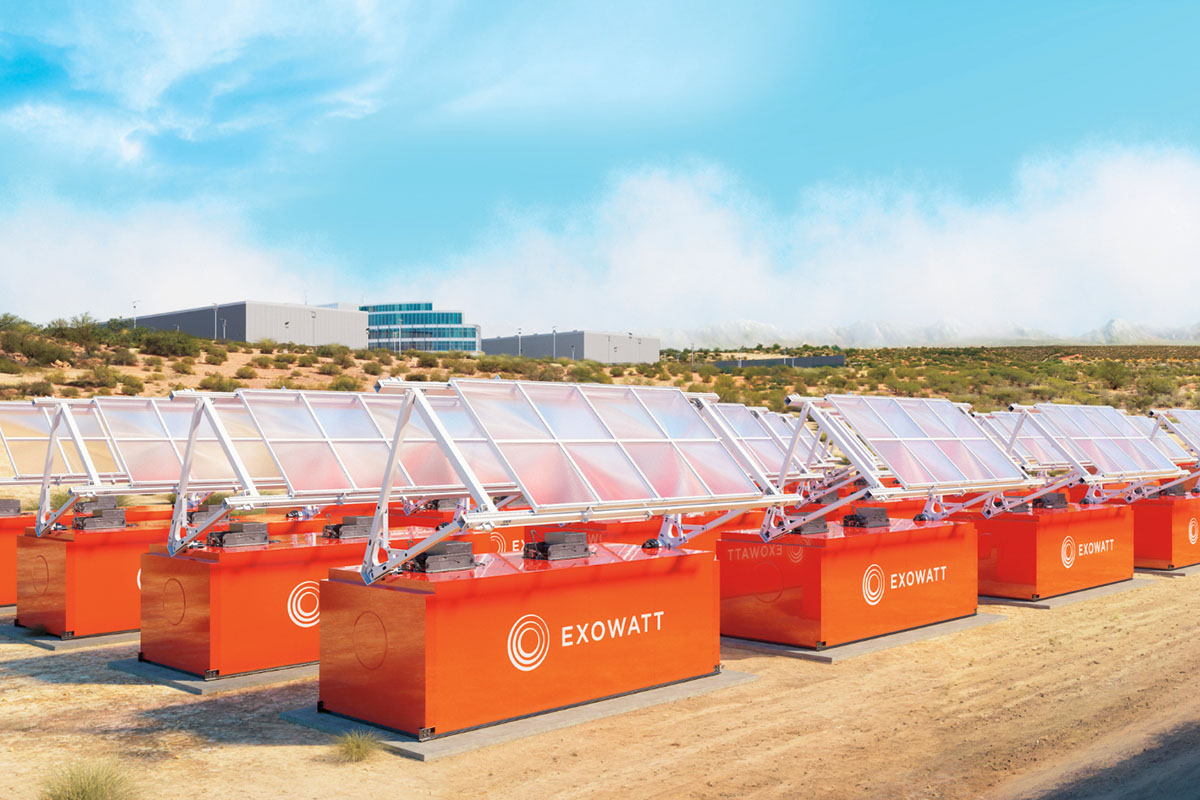
Palm Beach Gardens-based Ampera aims to build uranium-free micronuclear reactors by 2030 that are fueled by a fusion-fission system using Thorium, an abundant, sandy mining byproduct. Miami-based Exowatt already manufactures its P3 units, which use solar panels to convert sunlight into heat that can be tapped to generate electricity.
There's a bit of buzz around Exowatt. Fast Company magazine named it one of the "five next big things in sustainability and energy." Co-founder and CEO Hannan Happi says it has 5 million units on backorder, and its funding rounds have attracted more than $140 million the past two years including investments from a16z (Andreesen Horowitz) and OpenAI CEO Sam Altman.
The P3 system is not as complicated as it might sound, says Happi. "Nothing about our technology is like, 'Wow, we discovered new physics here.' It's more about how do you take some technologies that exist, like the lenses that we use, the heat storage method that we use, the heat engine that we use — these are technologies that individually have been validated by themselves ... and then put them together, (to) make a modular system out of them and make that in the millions using raw materials that we domestically source and manufacture ... to bring down the cost of electricity."
A mechanical engineer who previously worked for General Electric, Siemens, Accenture and Tesla, Happi was recruited to Miami four years ago by Hims and Hers founder Jack Abraham's Atomic VC to be "a founder in residence to work on powering AI load growth."
Exowatt has 50 employees in Miami and is hiring 50 more at other sites. While no P3s operate in Florida, one of Exowatt's contract manufacturers is in Tampa to go along with builders in Utah, New Hampshire, Texas and California. The company's growth is fueling thousands of jobs at those contract sites, Happi says, and some data center developers want P3s manufactured on site to save time and costs.
Ampera, which is in the midst of a Series A funding round, is working with its Palm City sister company Additec to build 3D-printed prototypes of its silicon carbide core and other components. One module can house one or two 15-megawatt spheres — each strong enough to power about 5,000 homes, says spokesman Greg Brostowicz. The reactors use no water, generate no emissions and leave no long-term nuclear waste.
The idea has been around for decades, and similar Thorium-based micronuclear systems are being developed in Europe and China, but those use molten salt, while Ampera uses "a different technology" that Brostowicz wouldn't define. He did emphasize that "it can't melt down" and "can't be used for weapons." But it can be used militarily, he says, pointing to the Army's Janus Program that is soliciting microreactors at nine U.S. bases. Because they can be transported by train, ship or airplane, the units can be sent into disaster areas or used to power military operations abroad.
Last June, San Jose, Calif.-based data center builder Super Micro Computer, a Fortune 500 company, obtained an 11% interest in Ampera for $6 million, SEC records first discovered by Bisnow (commercial real estate news) show. Ampera expects to have 100 employees by year's end, growing to about 2,500 in the next five years, Brostowicz says. It hopes to manufacture 100-150 units per year.
For data centers, Ampera is promising "ultra-low-cost" power once in the market that beats the megawatt hour price from traditional nuclear options.
Exowatt's P3 solar modules can cost operators around 4 cents per kWh, far less than most electric utilities charge, and the company hopes someday to reduce that cost to 1 to 2 cents per kWh. Still, Happi isn't touting his innovation as the solution to the data center electricity challenge.
"There is no panacea for generation," he says. "Unfortunately, no power generation system can give you round-the-clock power all the time with no down time. Even nuclear technology is not capable of doing that. The idea here is that you want to reduce the load and the burden on the grid by providing as much off-grid, behind-the-meter generation as possible to meet data center loads."
Hannan Happi, the co-founder and CEO of Exowatt, says the Miamibased startup has found a way to turn solar energy into a reliable, round-the-clock asset.