








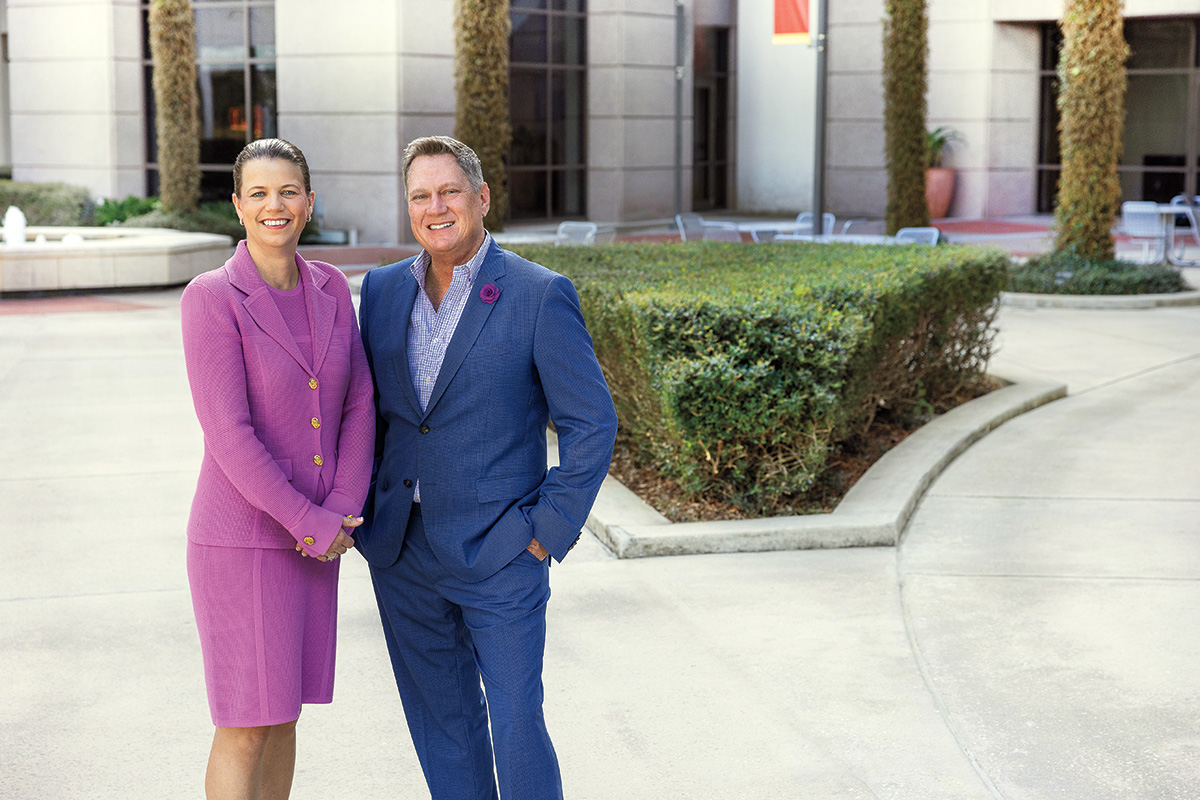


The future for thousands of Osceola County students changed immeasurably in January 2022 inside Tallahassee’s Liberty Bar & Restaurant. There, County Commissioner Brandon Arrington met Valencia College President Kathleen Plinske for dinner to brainstorm ideas for $12.5 million in available COVID-19 relief money the county set aside to support education.
Over the years, Osceola County has invested repeatedly in Valencia College, one of Florida’s 28 state colleges. The county has provided resources for an advanced manufacturing training facility, underwritten the cost of a new building and given the college land to build its Poinciana campus. At dinner, Plinske pitched Arrington on an idea that no one had ever tried: What if they used that COVID money to cover tuition and fees for every Osceola County high school graduate to go to Valencia or Osceola Technical College?
She’d already run it by longtime County Manager Don Fisher, who saw it as a great opportunity for students, and an even better long-term economic development investment.
“It was like, ‘Oh my gosh, this could be the greatest thing we’ve ever done,’” Fisher remembers thinking. “There’s no such thing as free college, but we really believe that if you invest in these students in the community, what will our community look like 10 years later? It would be more stable … more entre-preneurial and all these things just inspiring opportunity for these kids that may not have had it before.”
Arrington agreed. Weeks of frantic planning and meetings took place to hash out the specific costs and implementation plans. County commissioners then approved the plan, leading to a series of raucous pep rallies before the Class of 2022 on March 14.
The first announcement for Osceola Prosper was “kind of like the Oprah show, where ‘You get a car, and you get a car,’” Arrington says. Initially he saw confused faces in the crowd. “It was total disbelief in there. It was pretty amazing. It was one of those days where you get choked up with tears in the eyes. … Those people were floored. It’s really kind of life-changing for people.”
A majority of Osceola County residents are Hispanic and come from places where a community college system doesn’t exist. “There’s not even a word for community college in Spanish,” says Valencia College President Kathleen Plinske.
Plinske recalls the same initial confusion Arrington did. “And then the auditorium just erupts. The students are jumping, they’re screaming, they’re hugging. There’s so much excitement. And I remember very clearly having the thought, ‘I just had the best day I’ll ever have in my career.’”
The full return on the county’s investment won’t be known for years. But the initial indicators were strong enough for commissioners to fund the program from county coffers after exhausting the COVID money. Just three years later, there are 10,000 Osceola Prosper students. Nearly 3,000 have completed an associate’s degree or technical and skills certifications.
It’s “the greatest feel-good in our community,” Arrington says, and it also appears to be the only publicly funded tuition-free program in the country. Perhaps that’s expected from a county with the slogans “Be First to What’s Next” and “Building for Tomorrow Today.”
GOT COLLEGE?
Fifteen years ago, Osceola obtained a 485- acre tract of land from a developer and set it aside to build NeoCity, a semiconductor and high-tech hub [“Chipping Away,” March 2022, www.FloridaTrend.com]. It stands to gain hundreds of millions of dollars in Defense Department and National Science Foundation grants.
A year ago, county commissioners approved a memorandum of understanding with South Korean semiconductor manufacturer ELSPES to build a $470-million, 75,000-sq.-ft. headquarters in NeoCity, pledging at least 600 jobs averaging $85,000 by 2029.
That’s a big deal, Fisher says. But Osceola Prosper may be bigger because it touches more people and “really gives hope. Not everybody wants to be in the semiconductor industry. But everybody can get something out of Osceola Prosper.”
The two initiatives go hand-in-hand with the county’s economic development vision, Arrington says. Students taking tuition-free courses at Valencia and Osceola Tech are “our supply line for personnel. If I’ve got an educated workforce, I can attract higher-paying jobs and I can change that whole social dynamic here in my community.”
Kissimmee’s tourism-reliant workforce suffered especially hard during the pandemic, with unemployment soaring above 30% at its peak — the third highest in the country.
For too long, Fisher says, Osceola played the traditional economic development game, piecing together incentive packages to lure businesses looking to relocate. Those efforts often don’t work and the gains are limited when they do, he says. He believes the county needs to invest long-term to broaden its base and better absorb economic shocks.
Before Osceola Prosper, Osceola County ranked 61st among Florida’s 67 counties for sending high school graduates to college. Today, it ranks third.
“I’ve seen the waves, whether it was the housing bust of 2008 and what that looks like. We saw after COVID what that looks like. Every time there’s a recession, Osceola County unfortunately, we rose to the top of all the wrong lists over and over again.”
One of those lists tracked the number of high school graduates who went on to college. That’s where Plinske’s experience and knowledge come into play. When she came to Valencia College as provost and president of its Osceola, Lake Nona and Poinciana campuses in 2010, Osceola’s college-bound rate for high school graduates was 61st among Florida’s 67 counties.
She launched a “Got College?” campaign to try to figure out what was stopping more people from continuing their education.
“It was very, very, very grassroots,” Plinske says, recalling bilingual community meetings and meetings with high school students along with 7 a.m. meetings with guidance counselors. She quickly saw that many families had grossly exaggerated expectations of the cost of attending college: “Almost always I would hear $50,000.”
In reality, a complete state college education is closer to $6,000 — tuition hasn’t increased in more than a decade — and many families qualify for Pell grants, federal assistance, without realizing that help was even out there.
A majority of Osceola County residents are Hispanic and come from places where a community college system does not exist. “There’s not even a word for community college in Spanish,” Plinske says. There’s also no direct translation for an associate’s degree.
The outreach seemed to be effective, with Osceola’s college-bound rate rising to 27th in Florida by 2015. But it “dropped like a hot rock once COVID hit here,” Arrington says.
The idea behind Osceola Prosper was rooted in the Got College experience, Plinske says. “It’s like the next chapter in a very long book. It wasn’t the prologue.”
Both initiatives are founded on increasing awareness among students and their families about the available opportunity.
“So many of our students are coming from low-income first-generation families where all they know is that productive struggle of just work really hard, get what you can, but you’re really never going to be able to get ahead,” says Danielle Malfara, Osceola County Schools’ coordinator of college and career counseling. “And it’s hard to envision what that looks like when you’ve never experienced it.”
School counselors work with seniors to ensure they complete the Free Application for Federal Student Aid (FAFSA). Many students will qualify for federal Pell grants and other financial aid, something many wouldn’t have realized without being urged to submit FAFSA applications, Malfara says. The county provides “the last dollar,” meaning whatever it takes to fill the gap between those grants, scholarships and other sources.
A key component of Osceola Prosper: Because most students will still have to work to support themselves and their families, they have up to five years to complete their programs as long as they take 12 credits per year and maintain at least a 2.0 GPA.
“Kids were able to dream big again and get excited about the programs available to them instead of thinking about, ‘there’s this paycheck hanging over me,’” Malfara says. “To change a whole social structure of a community and give them what they need to climb as high as they want is remarkable, beautiful. ‘Life-changing’ gets thrown around, but I can’t emphasize enough the power of what that promise did for those students, especially that first year coming out of COVID where they lost so much.”
Many Osceola County students qualify for federal Pell grants and other financial aid, while Osceola Prosper provides “the last dollar,” whatever it takes to fill the gap, says schools counseling coordinator Danielle Malfara.
CRITICAL CROSSROADS
Osceola County, once 61st among Florida counties sending high school graduates to college, is now third.
To Ricky Booth, a former Osceola school board member and now the county commission’s lone Republican, “it just means that (Osceola Prosper) was desperately needed. If you want to change the dynamic you’ve got to do something really bold. If you want to go from 61 to 3, you’ve got to do something really, really bold.”
Osceola Prosper’s $10-million cost for 2025-26 is “really not that big of a number” in a $3-billion budget, Booth says, “but it makes a huge, huge difference and has a huge impact.”
Booth is quick to acknowledge that Osceola Prosper’s future is tenuous. He’ll continue to support it if budgets stay strong and data shows the college-bound rate remains strong and other indicators like employment status and median income rates show gains.
Budgets do face stresses, however, and next month in Tallahassee debate begins on property tax cut proposals ranging from Gov. Ron DeSantis’ desire to eliminate them to more modest relief like greater homestead exemptions. Every dollar will come from local government revenue.
Public safety and infrastructure are budgetary necessities, Booth says. Osceola Prosper may be popular and transformative, but it’s “the icing, not the cake.”
Some parents seem to recognize that reality, Malfara says. She’s heard about some residents trying to get their child to graduate high school early to ensure access to Osceola Prosper.
“We know that (commissioners) see the value of this gift and we know that they’re doing everything in their power to make sure that there’s money that can fund this initiative and keep it going,” Malfara says. “We also know it’s not a guarantee.”
“My fear is that if this goes away it’s going to tarnish a lot of dreams.”
And it will set Osceola County’s economic development efforts back, Arrington says. Students either won’t go to college, or they might leave town to find opportunity. “That brain drain hurts. Think about it, all of your best kids are graduating, going off to get trained someplace else and not coming back.”
“I want you to get educated and stay here. Stay here,” he says, thumping an index finger on his desk.
An announcement about the Class of ’26’s access to Osceola Prosper is set for next month.
Plinske believes there’s better awareness about financial aid and the low cost of a state college education. But “I am swayed by data and evidence,” she says. “I saw what happened in 2020. I saw how quickly we lost the momentum. So that is top of mind. It feels very fragile.”
Ending Osceola Prosper would “be tragic for our community,” Arrington says, predicting that “our postsecondary education rates would just fall off a cliff again. There’s no doubt about that.”
But it’s also the program most loved by his fellow commissioners, he says.
“Obviously you’ll always have some haters who think we’re just giving something away,” he says. “But an education is a great thing to give away.”
Thinking Long-term
Don Fisher is the longest-tenured county manager in the state. Brandon Arrington has been on the Osceola County Commission so long he made the motion to hire Fisher.
In an era of term limits, Osceola stands out. Commissioner Chair Viviana Janer is in her 12th year on the board, as is Commissioner Cheryl Grieb.
“In some counties,” Fisher says, “by the time you get going as an elected official, you’re out. … I communicate constantly with the commissioners. There’s never a surprise. And I think we trust each other. It allows us to do some pretty unique, bold things for a local government.”
Arrington’s mother, Osceola County Elections Supervisor Mary Jane Arrington, was the first woman to serve on the county’s Board of County Commissioners. He says she often reminds him that “when you leave office, your ideas go with you.”