











As an emergency room physician at UF Health's Shands Hospital who specialized in clinical informatics — a field that leverages data and technology to improve the quality and efficiency of healthcare — David Crabb considered it a win if he found a way to alter a workflow and save doctors and nurses 30 seconds on a task.
In an emergency room, patient care is thought about in terms of minutes, Crabb says, so 30 seconds multiplied dozens of times per day, thousands of times per year, can really add up and increase the clinician's ability to focus on the patient.
Then he realized that patients who needed it were waiting up to an hour to be transported to the imaging department. "You're like, what was the point of me saving two minutes with my patient? I'm going to order the CT (computed topography) scan and they're going to wait an hour to go 200 yards down the hall. It felt very frustrating."
It's a problem plaguing hospitals everywhere, especially as they grapple with staff shortages. Technology to move people autonomously has been around for years, he figured. How could it be applied to hospital patients?
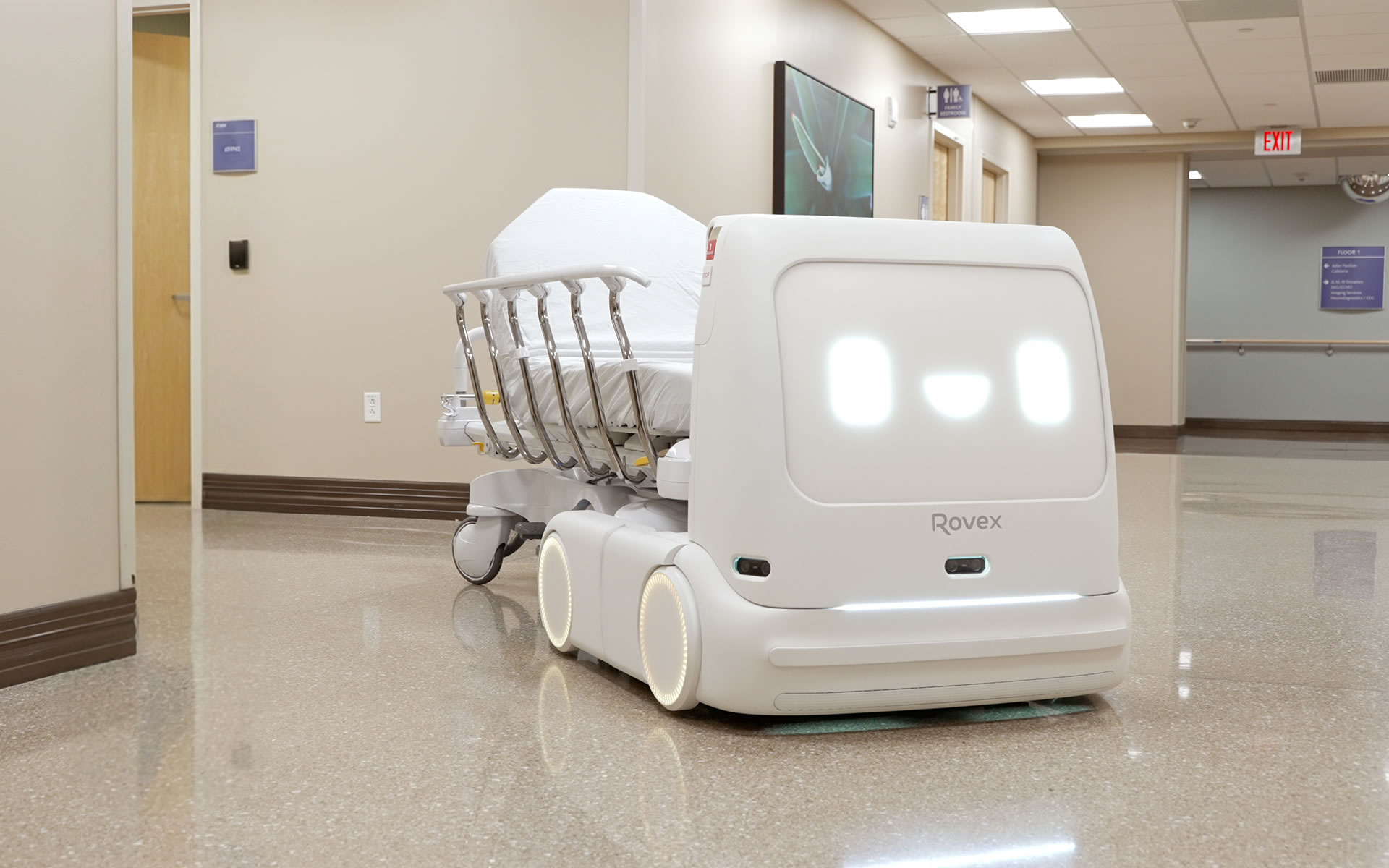
Teaming up with engineers he met through the university, Crabb created a company called Rovex and developed a robotic bed transport prototype in a garage. Using lidar and other sensors, they realized the AI-powered system could be programmed to navigate hallways, stop if someone crossed its path and reach a pre-determined destination. The concept is similar to automated vehicles, Crabb says, except "I'm not trying to drive 65 miles per hour down a highway. I'm trying to go like 1.5 miles per hour down the hall."
His robotic transporter, Rovi, is being tested at Clearwater's BayCare Morton Plant hospital. It connects to stretchers (wheeled beds) and guides them through hospital hallways. But it won't be transporting patients yet: "Patients are precious," Crabb says. "You can't be testing out new tech on a vulnerable population." Rovi's sensors will map out the hospital's hallways to create a guidance database. It will call for elevators, then enter and exit at the appropriate times.
BayCare was willing to give Rovi a try after successful outcomes with separate robotic services, says Vice President for Innovation Craig Anderson. A robot named Beaker takes patient samples to the lab while Hygeia, named for the goddess of cleanliness, delivers pharmacy orders.
Testing out robotic patient movement was "a very natural progression."
"Adoption is everything with innovation," Anderson says. If nurses don't like it, they won't use it. "They've got to see what the value prop is for them. And once they understand that this is helpful, this is something that's safe, they gravitate to it."
Beaker and Hygeia have been embraced by BayCare staffers, Anderson says, who sometimes dress them up for holidays. Patients and their families also seem to be comfortable around the robots. "The thing we weren't aware of until we started was how many selfies Beaker and Hygeia are requested to be in. ... They're cute. They've got their little scrubs, they've got their name badge on and they kind of look like a little R2D2 moving around everybody."
The robotic service is being added to BayCare's Winter Haven hospital and BayCare St. Joseph's Children's Hospital in Tampa.
It might not fit with all hospitals. In 2022, Jacksonville's Baptist Health became the state's first hospital to roll out a robotic delivery system. Moxi, like Beaker, picked up and delivered lab samples and medicines. Baptist Health "decided not to move forward with it" after the pilot period ended, but it isn't saying why.
It is pursuing other robotic innovations "prioritizing investments that will have the greatest impact on patient care and support our teams' day-to-day workflow," a spokesperson said. That includes using an Omnicell IVX robot to sterilize IV needles.
It's too soon to know whether Rovi works as planned or whether it's worth an investment, Anderson says. BayCare will conduct a time study to determine how much time it saved nurses "down to the minute" and figure out if the cost savings are worth the investment.
"We know the price of these robotics. We need to at least eclipse the cost in time saved, giving that back to nursing, and we more than did that" with Beaker and Hygeia, Anderson says. "I would say for each robot, on average, they contribute 4,000 hours a year of nursing time back to the team to be at the bedside, to do the things that we need the humans to do. The robots can handle that back and forth."