








4 Seaports
5 Commercial Airports
16 Colleges / Universities
Unique features, rankings and statistics
With its legendary ties to 17th Century pirate lore, the eight-county Tampa Bay region offers a rich mix of historical sites, festivals and natural attractions.
Tampa’s Ybor City, a historic neighborhood known for its cultural heritage, remains a highlight of the area.
Famous for its cigar factories established by Cuban immigrants in the late 19th and early 20th centuries, Ybor City is also home to the 120-year-old Columbia Restaurant — Florida’s oldest dining establishment and widely recognized as the largest Spanish-themed restaurant in the world.
Complementing the Tampa Bay region's rich history are its colorful festivals, including the Gasparilla Pirate Festival, celebrating the legend of pirate José Gaspar, and the Florida Strawberry Festival in Plant City.
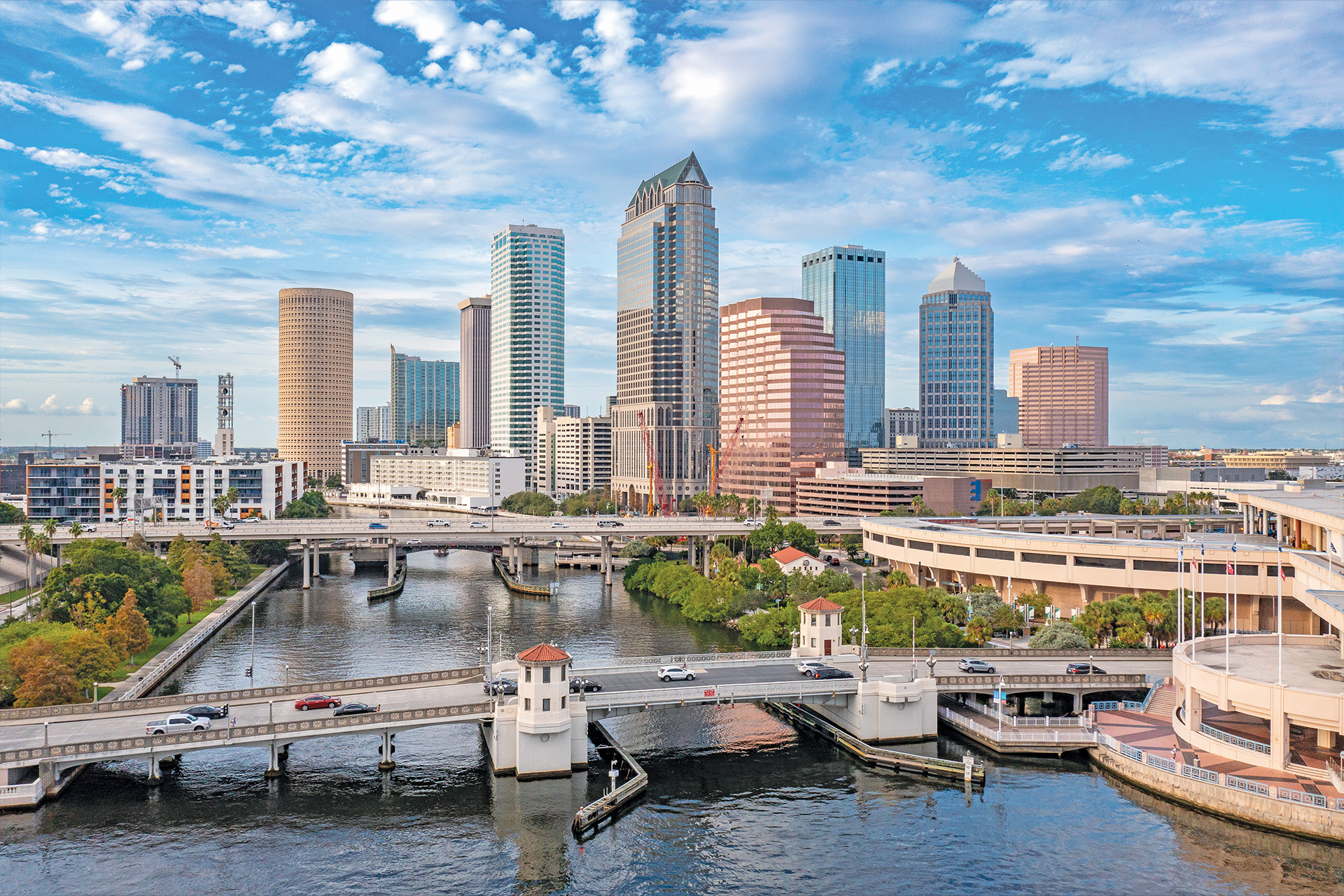
As the dominant urban center in the region, with a metro population of 3.2 million, Tampa and Hillsborough County are home to an array of both natural environmental wonders and man-made features.
Among them is Tampa's Bayshore Boulevard, a 4.5 mile, uninterrupted walkway along Tampa Bay, that was once recognized by the Guinness Book of World Records as the longest continuous sidewalk in the world.
To Tampa's south is Sarasota County, home to the Marie Selby Botanical Gardens and the John and Mable Ringling Museum of Art, the official art museum of the State of Florida. Sarasota was the historic winter home to the Ringling Brothers and Barnum and Bailey Circus that gave Sarasota the nickname of Circus City.
In Citrus County, the Crystal River/Kings Bay water management region is world renowned as a winter refuge for the West Indian manatee. The Crystal River Archaeological State Park, designated a National Historic Landmark, features a complex of ceremonial mounds built by indigenous peoples as early as 500 BCE. Monkey Island, a small, man-made island on the Homosassa River, is home to a family of spider monkeys.
Spanning Citrus, Pasco and Hernando counties is the Nature Coast Aquatic Preserve, one of the largest continuous seagrass meadows in the world and is a critical habitat for manatees, sea and numerous fish species.
In Pinellas County, a distinctive feature is the 47-mile-long paved pedestrian and cyclist trail — converted from a former railroad corridor — that runs the length of the county from Tarpon Springs to St. Petersburg.
Along the coast, the historic Tarpon Springs Sponge Docks are known for its Greek heritage and traditional sponge-diving industry, which continues to this day.
In downtown St. Petersburg, the Gizella Kopsick Arboretum is a 2.5-acre treasure, home to 500 palm trees and 150 cycads from around the world.
Polk County is home to Florida Southern College in Lakeland, which features the world's largest single-site collection of Frank Lloyd Wright architecture in the world, featuring 13 structures designed by the legendary architect.
Economic growth/
Top industries
Of the many metrics that capture the Tampa Bay region's robust economic growth in 2025, one standout figure tells the story best: 71%.
That's the remarkable increase, according to the latest U.S. Census Bureau statistics, in new business applications filed during calendar year 2025 compared with the previous year, a clear indicator of the region's vibrant and expanding economy.
Accompanying this impressive surge in business applications is a strong job market that added 12,700 private-sector jobs during the same 12-month period.
The strongest job growth was seen in the education and health services, manufacturing and construction sectors.
Census Bureau statistics for 2025 also confirm an increase in wages and salaries in the Tampa Bay area, another sign of a healthy job market and economy.
Key projects and developments that led the way in the past year include Tampa International Airport's $584 million expansion, launched in September 2025, which focuses on expanding new ticketing and baggage systems.
The airport also announced the start of a $1.5 billion Airside D project, scheduled to open in 2028.
Another major Tampa Bay area project underway in 2025 is the revitalization of 120-acres along the Hillsborough River. This mixed-use development will extend the existing Riverwalk and replace the former North Boulevard Homes.
Elsewhere in the Tampa metro area, the $80 million Straz Center expansion project, which began in April, will add new educational space and an outdoor venue, boosting the arts and cultural sector.
The Port of Tampa Bay recently approved lease agreements for three companies — AJAX Paving, Redwing Terminals and Pangaea Florida — to expand operations at Port Redwing, a satellite facility that handles bulk commodities and building materials.
Other strategic growth sectors include the region's technology industries, especially in cybersecurity initiatives spearheaded by organizations such as CyberTechIX Accelerator, Tampa Bay Wave and Embarc Collective.
Tourist revenue remains strong, with Hillsborough County on track in 2025 to surpass the record-setting $1.14 billion in taxable hotel revenue generated in 2024.
The Tampa/Hillsborough metro area has also emerged as a notable destination for foreign businesses and capital investment.
Most recently, the Israeli tech company Xtend Reality opened its U.S. headquarters in Tampa in 2025, following the Scottish firm Systal Technology Solutions, which established its Network Operations Center and U.S. headquarters in 2024.
Neighboring St. Petersburg and Pinellas County also saw significant economic growth, key industry expansions and corporate relocations in 2025. Foot Locker Inc., announced plans to move its global headquarters to St. Peterburg. The aerospace supplier Chromalloy expanded its Belac Coatings Center of Excellence manufacturing facility in Oldsmar. The $30 million expansion, completed in August 2025, significantly increased the company's capacity to manufacture turbine engine parts.
Pinellas County's tourism industry continued to drive economic activity, contributing an $11.2 billion economic impact in fiscal year 2024-25, surpassing the previous year's figures.
Other significant economic development projects in the Tampa Bay region include:
The new 45,000 square-foot ARK Innovation Center in St. Petersburg.
Pasco County's Bauducco Foods, a Brazil-based food manufacturer, which recently began construction on a $233 million, 72-acre facility in the Zephyrhills Airport Industrial Park.
Sarasota-Bradenton International Airport's expansion projects that include a new terminal expansion of Concourse A, which opened in January 2025, and a new ground-boarding concourse with additional gates needed to meet increasing passenger demand.
In September 2025, Israeli medical technology company Ossio announced it would open its 30,000-square-foot U.S. headquarters in Manatee County. The facility will manufacture metal-free implants and is expected to create 100 new jobs over five years, with manufacturing beginning in spring 2026.
Access to Capital
Among the eight counties in the Tampa Bay region, Hillsborough — not surprisingly — has the largest number of investment and venture capital sources, particularly across the tech, finance and health care sectors. The area’s investment ecosystem is anchored by established venture capital firms, a growing network of support networks and a strong partnership with the University of South Florida (USF). USF plays a critical role by providing a steady talent pipeline and driving research commercialization, further fueling regional innovation.
Among the more prominent and active venture capital and private equity firms in the Tampa Bay area is Ballast Point Ventures, a growth equity firm that partners with entrepreneurs and targets high-growth companies in the software development, health care and business services sectors.
Notable investors in the region include Weatherford Capital, which invests in technology, financial, business and consumer services. and Florida Funders, a hybrid venture capital fund and angel investor network focused on early-stage Florida companies. Other prominent investors include MacDonald Ventures (tech startups), HealthEdge Investment Partners, Osceola Capital Management, and TampaBay Ventures, all of which target startups and expansion-stage businesses.
Access to venture and investment capital is more challenging for the counties outside the core Tampa-St. Petersburg area with the notable exception of Manatee and Pasco counties, both of which benefit from proximity to the more established investment ecosystems in Tampa. These counties have seen continued activity from firms such as Ballast Point Ventures, Florida Funders and Third Lake Capital.
As a whole, the region benefits from both local investment firms and a network of local and state-funded accelerators and economic development programs that help nurture early-stage startups.
Culture, Personality and Seasonality
The Tampa Bay area is far more than a “melting pot.” Home to over 130 nationalities, its culture is vibrant, diverse, and unmistakably Floridian.
Tampa blends a thriving economy with a growing population of young professionals and families, all enjoying the region’s consistent sunshine.
The city’s energetic personality shines through in its festivals, sports, museums, music and performing arts, entertainment venues, world-class beaches, and acclaimed dining scene.
Over the past decade, Tampa has emerged as a global city and a top destination for international travelers visiting Florida.
Just across the bay, St. Petersburg offers its own distinct charm, defined by a bustling arts scene, waterfront lifestyle, and seasonal buzz that complement Tampa’s urban energy.
Outside of the dominate Tampa Bay metro, Polk County is a balanced blend of old Florida tradition that stems from its agricultural roots that are complemented by a modern economy, diverse population and a central location between the huge urban centers of Tampa and Orlando.
Sarasota offers a relaxed yet sophisticated atmosphere and is widely celebrated for its arts and cultural scene. The city’s seasonal rhythm is shaped by tourism and its semi-tropical climate, that’s particularly appealing in winter and early spring.
Hernando County, located on Florida's Nature Coast, has a culture closely connected to its natural surroundings and a friendly, welcoming personality similar to its neighboring rural, agriculturally based counties.
Similar to Hernando, Citrus County is rooted in agrarian traditions and takes pride in its laid-back, small-town charm and affordable, neighborly lifestyle.