










The St. Petersburg-Tampa Airboat Line, offering $10 round trips, would survive only four months before folding. Yet that first flight served as a herald for a future when airplanes drastically reduce travel times across the country and the world.
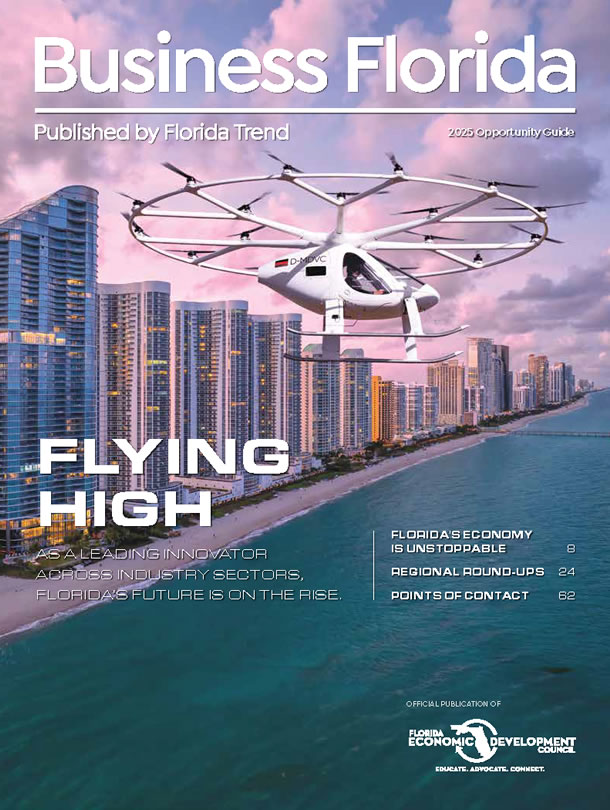
Today, the Sunshine State again finds itself on the leading edge of air travel, serving as ground zero for the promising eVTOL (electric vertical takeoff and landing vehicle) industry. Across the state, well-funded startups are scrambling to build a new future of air travel — one where passengers can use air taxis to quickly travel short distances without the encumbrances of traditional air transportation.
Florida made sense in 1914 and it makes sense now, says Casey Barnes, client services leader for aerospace and defense markets at BRPH and chair of the Florida Economic Development Council.
“We have tremendous flying weather. The regulatory climate is right. Plus, we've got a population that is very robust in multiple areas of the state with networks that are ready to go,” Barnes says. “Florida is extraordinarily well positioned.”
It sounds like something out of science fiction movies, but these companies are working hard to get their vehicles tested, certified and approved for flights. They could begin accepting paying customers before the end of the decade.
The movement has caught the attention of the state’s largest airports, including Orlando International Airport, where efforts are underway to identify potential airfield sites for advanced air mobility (AAM). With more than 11,000 acres, the airport has the flexibility needed to incorporate vertiports.
Florida has long embraced the concept of pilotless/driverless (or autonomous) vehicles. Already autonomous vehicles have been allowed on Florida’s highways for more than a dozen years. Cities across the state are already utilizing driverless shuttles and cars.
The state even has its own $150 million SunTrax Transportation Testing Center, the nation’s first large-scale testing site for autonomous vehicles operating at highway speeds. And in 2025 the state announced plans to expand the site with vertiport facilities to enhance testing and evaluation for autonomous flight.
Traditional Travel
While the future of air travel may capture more headlines, the state still relies on its traditional transportation infrastructure to meet the needs of its businesses.
A robust rail network has evolved to include the nation’s first privately owned intercity passenger railroad, Brightline. The initial route connected Miami to Orlando, but multiple stops have been added, with plans to bring Tampa and other large population centers into the network.
The line offers easy connections between these cities and less downtime for employees who use it, says Bob Swindell, president of the Greater Fort Lauderdale Alliance.
“I usually take it if I have a two- or three-hour meeting in Orlando,” Swindell says. “It just makes a lot more sense to me to be productive, with great access to Wi-Fi.”
With 21 commercial airports, Florida has an infrastructure that connects businesses within the state and the rest of the world. Orlando International Airport, for example, has more than 50 non-stop international destinations, with an emphasis on Central and South America.
The airport is also pushing to expand its cargo operations to create new opportunities to serve international businesses. As one of the nation’s largest airports — by landmass — there is ample space for expansion while also featuring easy access to the state’s highways.
The state also works to make it easier and more efficient for trucks moving about the state’s highways. Among the initiatives is freight signaling technology that extends green lights for trucks; technology to help drivers find parking; and weigh-in motion technology to allow drivers to bypass weigh stations.
Boasting 16 public seaports, Florida is the cruise capital of the world while offering easy access to commercial shipping. Updating these facilities remains a priority. Consider a recent $420 million deepening of the Port of Jacksonville — the state’s largest container port — to better position it to meet the needs of larger cargo ships passing through the Suez and Panama canals. Also, the Port of Miami opened a shore power installation allowing cruise ships to turn off their engines and plug into landside power while docked, significantly reducing noise and emissions.
Historically, Florida has been heavily involved in shipping routes from the Caribbean and Latin America. But there are opportunities to expand beyond those markets, particularly in light of traffic snarls encountered on the West Coast.
“I think all of us on the East Coast and Gulf Coast are pointing out how problematic it is to bring it in through California,” says Mike Rubin, president of the Florida Ports Council. “What are you gaining by sitting off the coast waiting for berth space? And then you have to ship it via rail or truck. It may not end up being cheaper at the end of the day.”
Florida's top assets