



You can look across the state for numerous examples of communities that have reinvented themselves to attract, retain and grow companies in the aerospace, financial services, advanced manufacturing, biotechnology and transportation sectors.
This isn’t a scattershot approach, where local economic leaders throw thousands of darts at the board, hoping for a bullseye. Instead, these are highly targeted efforts designed to maximize local resources and strengths.
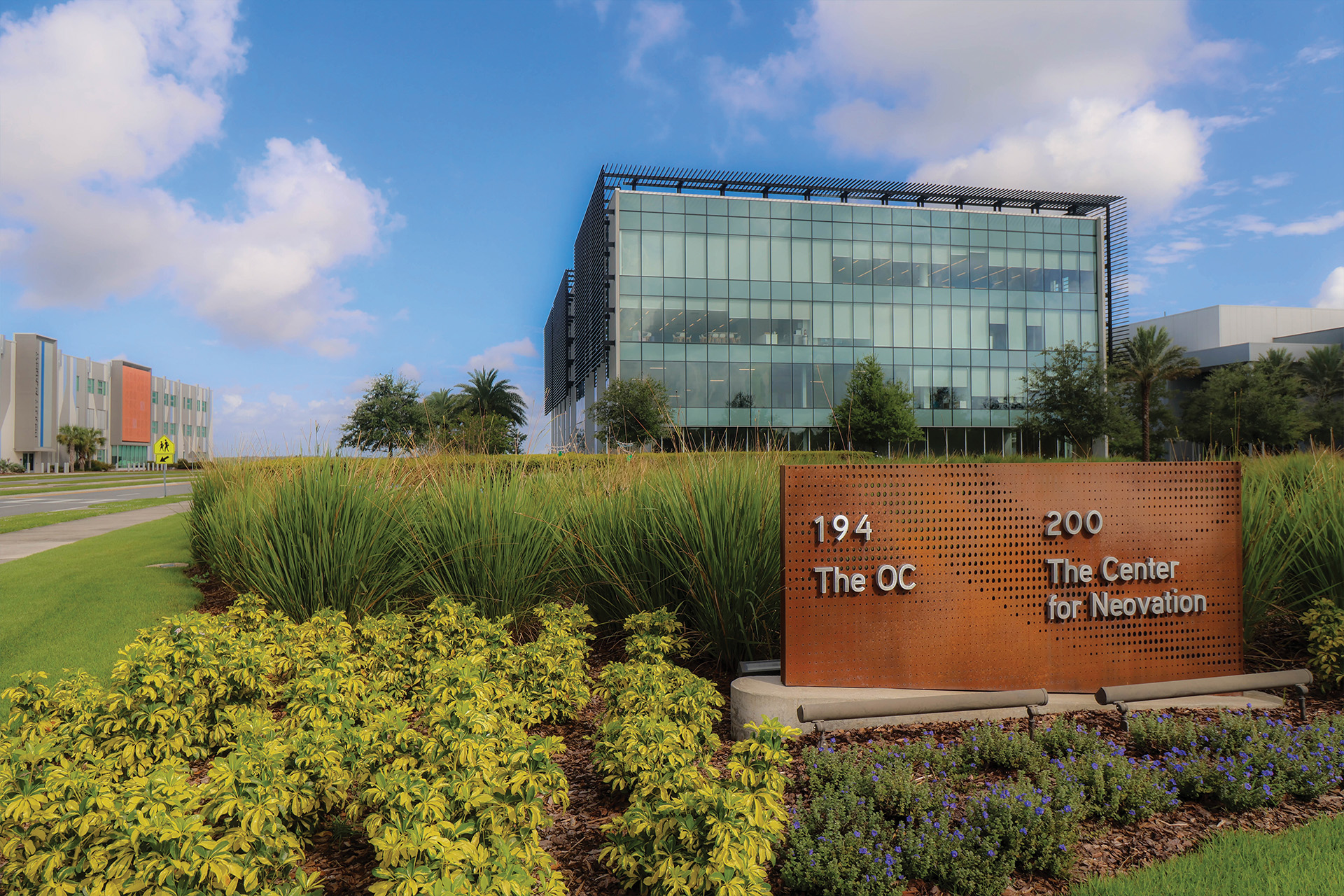
Consider what’s happening in Osceola County, where economic developers have been focused for more than a decade on creating high-wage industry clusters, including advanced manufacturing. To jumpstart the effort, the county acquired and set aside 500 acres for its NeoCity technology campus.
“We own the land with no debt and it's pad ready. That makes it stand out because we can enter into economic development deals that others can't,” says Don Fisher, county manager for Osceola County.
And as an example of Florida’s approach to incentives, the county built its own semiconductor manufacturing facility — rather than offer incentives to build one. The operation — the Center for Neovation — is currently operated by SkyWater Technology, a U.S.-based semiconductor foundry.
Statewide, these efforts have created a diverse economy with each region building on its own strengths. Look to the Panhandle for ship building and defense-based aerospace. Southeast Florida is a global leader in aviation. South Florida is home to fintech. The region around Kennedy Space Center is the Space Coast. Pinellas County, on the west coast, has a thriving medical technology presence. Central Florida has modeling and simulation.
Building Clusters
For every region, the goal is the same: Develop industry clusters that support themselves while serving as a gravitational force to attract related companies.
A great example of this power can be found in and around the Space Coast, which is becoming increasingly difficult to define by traditional geographic lines. What started as a relatively limited orbit around Kennedy Space Center has rapidly spread across the state.
“We're not only recruiting companies in the space industry. We're recruiting entire supply chains, which are leaving California and relocating to our Space Coast,” says Wilson, Florida Chamber president and CEO.
Encouraging that spillover is part of the long-term plan for Volusia County, located just north of the Space Coast’s boundaries. The county’s five-year strategic plan targets numerous industries, including advanced manufacturing, aerospace and life sciences. The county is also nurturing the insurance sector, already serving as home to several major players, including Brown & Brown, one of the nation’s largest private insurance brokerages.
It's not that the county discourages non-targeted firms from relocating there. But the county’s own recruiting resources are allocated with precision, says Keith Norden, president of the Team Volusia Economic Development Corp.
“It’s a better use of our resources to target the industry sectors that make sense for us and that make sense for them,” Norden says.
That’s because there are often significant advantages for the regions and the companies that join a growing cluster, says Hector Sandoval, director of the Economic Analysis Program at the University of Florida’s Bureau of Economic and Business Research.
“They’ll have a ripple effect. You have these high-paying jobs that will actually create additional jobs for other industries,” Sandoval says. “And people keep coming when you develop these clusters. They start to attract each other. It’s not just the industry, but also other industries that supply them.”
Clustering also has workforce benefits, including making it easier to recruit highly specialized workers, who may be more willing to consider a location rich with potential employers. It helps convince local colleges to offer new training programs when the schools know there will be strong demand for the classes, says Suzanne Christman, director of business development for Pinellas County Economic Development.
There are also important networking opportunities. Christman watched that dynamic play out with the birth of the Florida Medical Manufacturers Consortium, which followed the development of the cluster in Pinellas County.
“We brought together those industry professionals because we knew we had quite a few of them here. And they didn't know who was right in their own backyard,” Christman says. “Now I constantly see them working with each other, referring customers and clients to each other.”
Looking to the Future
Through a 15-year initiative, Palm Beach County developed its financial technology and financial services sector, creating its highly successful Wall Street South, home to more than 250 fintech firms.
But that doesn’t mean the region isn’t looking and planning for what comes next. Already, local development has turned its attention to another targeted sector — a combination of artificial intelligence, cybersecurity and quantum computing.
“We believe we have to be forward thinking and understand that technology is going to replace some of the very clusters that we've been focused on for 20 years,” says Kelly Smallridge, president of the Business Development Board of Palm Beach County.
The county is in the midst of a multi-pronged effort, applying for federal grants, establishing a quantum computing fund, planning with local universities and networking with companies by, among other things, hosting a quantum computing conference.
Such efforts only succeed when the entire region is dedicated to making it happen.
“It's as though you have eight tentacles out there,” Smallridge said. “You can't just say, ‘I'm going to do it.’ You’ve got to build your marketing strategy around it.”
Florida's top assets