








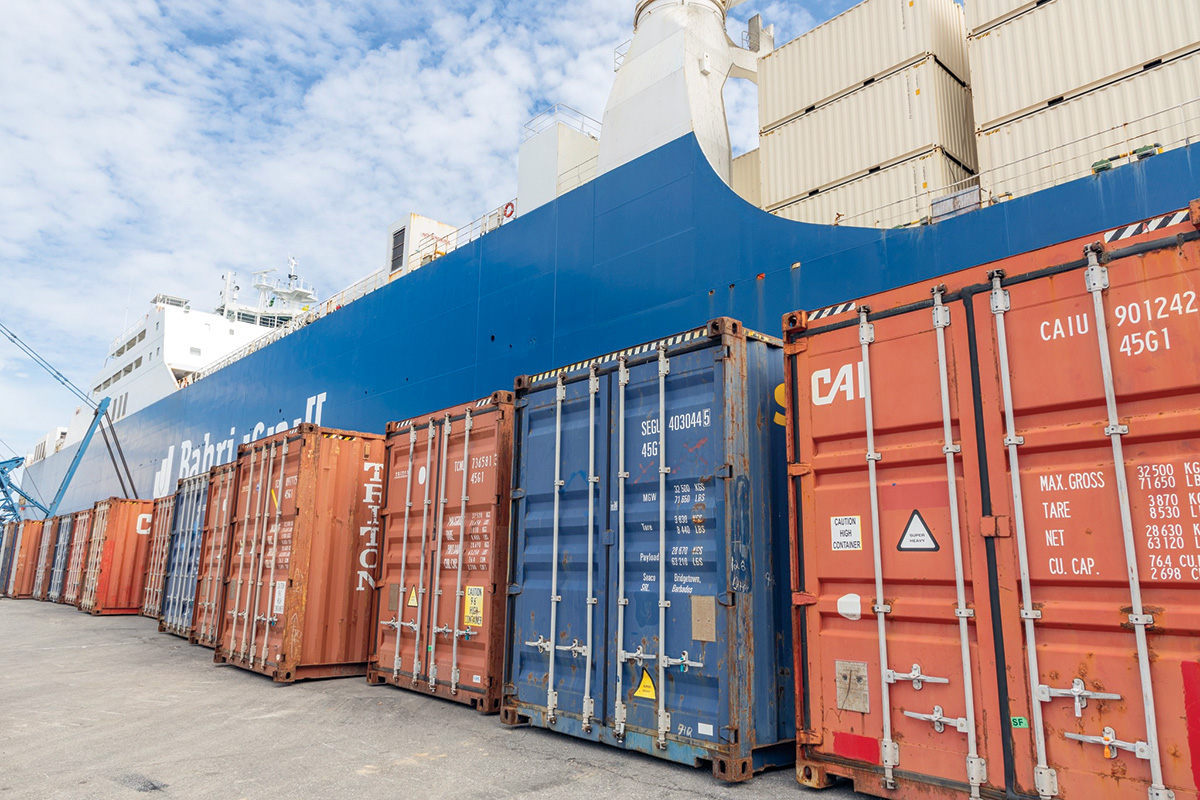
Established nearly a century ago by federal legislation, the Foreign Trade Zones Act remains today a useful and effective economic development tool.
FTZs allow businesses to defer, reduce or eliminate U.S. Customs duties on foreign materials imported, assembled and manufactured on U.S. soil.
The sustained popularity of FTZs is evident by their widespread and active use across all 50 states as well as Puerto Rico.
Texas, California, Louisiana and Florida continue year-over-year to have the highest dollar volume of merchandise processed through their respective FTZs. In 2025, more than $25 billion in imported merchandise flowed through the Sunshine State's 19 active Foreign Trade Zones, two of which are in operation in Panama City (FTZ 65) and Pensacola (FTZ 249).
Panama City's FTZ handled $1.6 billion in 2024 — the latest reporting period available — while Pensacola's FTZ reported $594.2 million for the same year.
Pensacola's FTZ, which covers all of Escambia, Santa Rose and Okaloosa counties, falls under the auspices of the Pensacola-Escambia Development Commission (PEDC) and is administered by the FloridaWest Economic Development Alliance.
FloridaWest CEO Chris Platé and Danita Andrews, director of business retention and expansion, spoke about how FTZs are used in ongoing economic development strategies.
"We're always trying to identify opportunities for companies to have a cost savings, and our FTZ 249 is one of those cost savings. If the right circumstances exist, we can show interested companies that Foreign Trade Zones can be a definite benefit," says Platé.
How FTZs are pitched to prospective companies depends on the company and the type of products they are importing from another country, manipulating that product and, in most cases, exporting that product out for sale in the U.S.
"There are a wide variety of uses in a Foreign Trade Zone. You can handle, process, assemble and package products," says Andrews.
"For example, let's say I'm making an iPhone in the U.S. with its various imported pieces," says Platé. "Each one of those pieces has a duty, or tariff, assigned to it when it enters the U.S. You don't pay the duty until it comes out of the Foreign Trade Zone. If it comes out as a fully assembled iPhone, a lot of the times it's cheaper than if you paid the duty on the individual parts."
And, in some cases, a product assembled in a U.S. Foreign Trade Zone can be exported back out as if it had never been in the U.S.
"So, Foreign Trade Zones are sort of like these little islands," says Platé. — By Carlton Proctor