






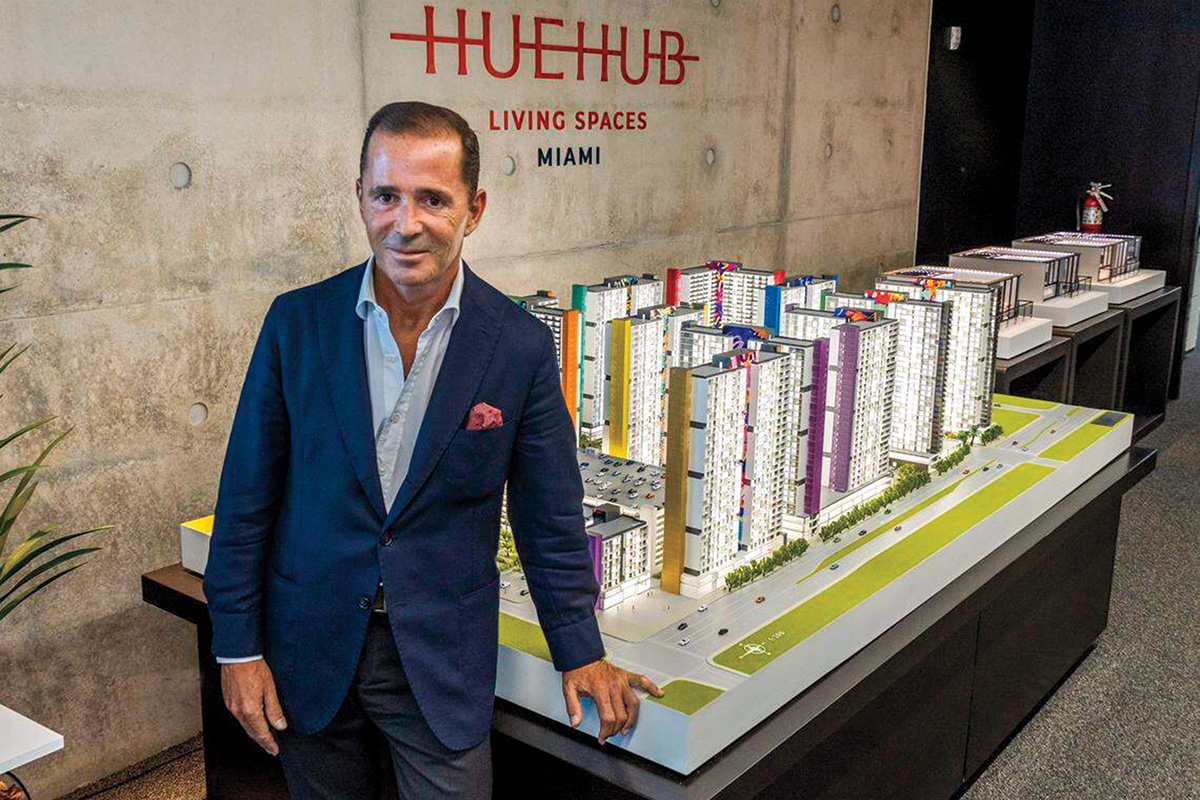
Plenty of developers have taken advantage of Florida's Live Local Act to secure tax breaks, expedited permitting and other benefits in exchange for adding workforce housing units. But no project is as ambitious as Pablo Castro's HueHub, coming late next year to Miami's West Little River neighborhood.
It promises 4,000 furnished apartments in seven 35-story towers with rents starting at $1,300 for a studio and $1,900 for a two-bedroom unit. Those rates are locked in for a decade, with 2% annual caps for inflation. For comparison, a new apartment complex about two miles away lists a one-bedroom at $2,100.
HueHub will be a gated community designed to provide residents a sense of community and belonging, Castro says, including a stocked library, workstations and artist space along with afterschool homework help for kids. It's all included in the rent.
"It makes the project singular and a little bit disruptive," says Castro, a Spaniard who moved permanently to Miami about two years ago. He hired Arquitectonica, "one of the top three firms in the world, to do a nice design" that factored in sustainability in engineering and aimed to minimize traffic and pollution.
Castro is setting aside three-quarters of the units for police, firefighters, teachers and health care workers. There are 5,000 names on a waiting list. "I'm so happy to be involved in that kind of deal with these people because in the end, these are people that serve us."
When his members heard about the project, "Everyone's first reaction actually was skepticism," says William "Billy" McAllister, IV, president of Metro-Dade Firefighters Local 1403. "It seemed to be almost too good to be true, like 'what's the catch?' ... We vetted this. I handed it over to our attorneys. There is no catch."
The local represents 2,400 firefighters, many living as far away as Martin and Orange counties and driving up to four hours twice a week for a 24-hour shift.
"It's disappointing," McAllister says, "that those who swear an oath to protect a community with their life if needed can't afford to live in that community they're willing to give everything for." There's a risk there. If catastrophe struck — a hurricane, building collapse or other crisis — fire departments would call in all hands for search and rescue. Too many would be hours away. "That's scary to me. Keeping public safety local, whether they're off duty or on duty, is probably an underappreciated necessity because you don't call upon it often."
"I've been doing attainable housing for the last 30 years," Castro says. "For me this project is the purpose of my life. It's like reaching a dream that I'm able to do it." — By Michael Fechter