





Not long ago, few good options existed for treating premature babies suffering with patent ductus arteriosus. That’s a congenital heart defect in which a blood vessel between the aorta and pulmonary artery that stays open in the womb fails to close after birth. It can lead to fluid buildup in the lungs and heart failure.
Medicine often proved ineffective and surgery was risky. A minimally invasive procedure inserting a catheter into a leg vein was effective, but the tools often were too big for premature babies.
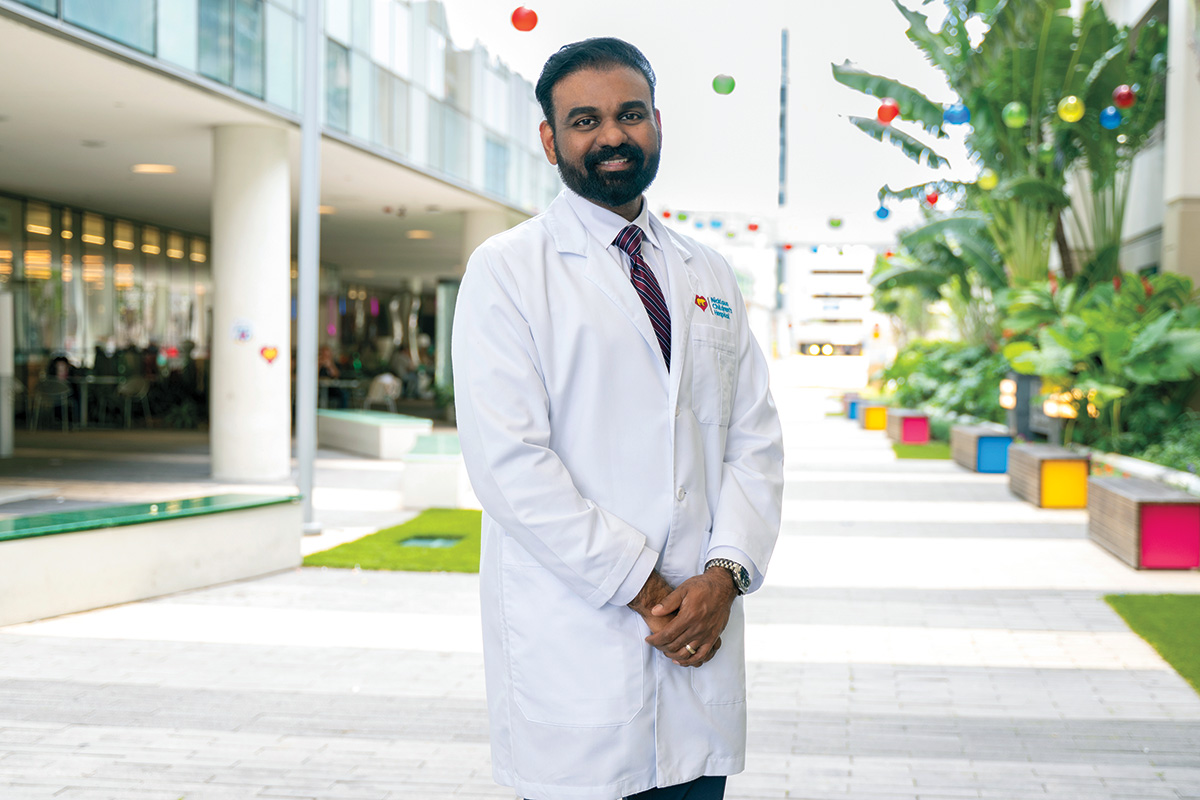
Dr. Shyam Sathanandam helped manufacturers miniaturize them, opening the door to a 10-minute procedure he performs at Miami’s Nicklaus Children’s Hospital without even removing the baby from its incubator. A day before speaking with Florida Trend, Sathanandam successfully closed the vessel in a baby born at 22 weeks — a full pregnancy generally is 40 weeks.
“These are babies that are lighter than a cell phone,” he says, “one-pound babies. They’re not supposed to be born; they’re supposed to be inside the mothers.”
The tiny catheter is a “huge deal because this therapy could make not just a survival benefit for these premature infants but also (for) other outcomes — respiratory outcomes can be better. Neurodevelopmental outcomes can be better.”
The procedure eliminates a number of risks that previous catheter treatments posed to fragile bodies. Transporting the patient increases the chances of head bleeding. Removing them from incubators means exposure to an unheated environment with bacteria. And they need to be disconnected from ventilators, causing their lungs to collapse. “We can reinflate them but that’s not ideal either,” Sathanandam says.
He has taught the procedure throughout the United States and globally. “We made this procedure very reproduceable. This procedure should be so simple everybody should be able to do it.”
Plans are in the works to take the procedure on the road, allowing patients at other hospitals to enjoy the same benefits.
Sathanandam, 48, came to Nicklaus Children’s in March 2025 as chief of cardiovascular medicine, emphasizing his priority of creating “tailored, specialized cardiovascular care” for babies with congenital heart defects. He brought a half dozen other innovations that are in practice or development.
One is an expandable metal mesh stent that can be inserted into blood vessels to keep them from closing. Stents have existed for years, but cannot grow as the child does, meaning repeated operations would be required. Sathanandam helped develop the Minima stent, which is inserted via a balloon-tipped catheter and can be expanded manually over time in a noninvasive procedure.