










Two Northwest Florida hospitals are offering cancer patients highly advanced treatment programs that were once available only in larger cities hundreds of miles away.
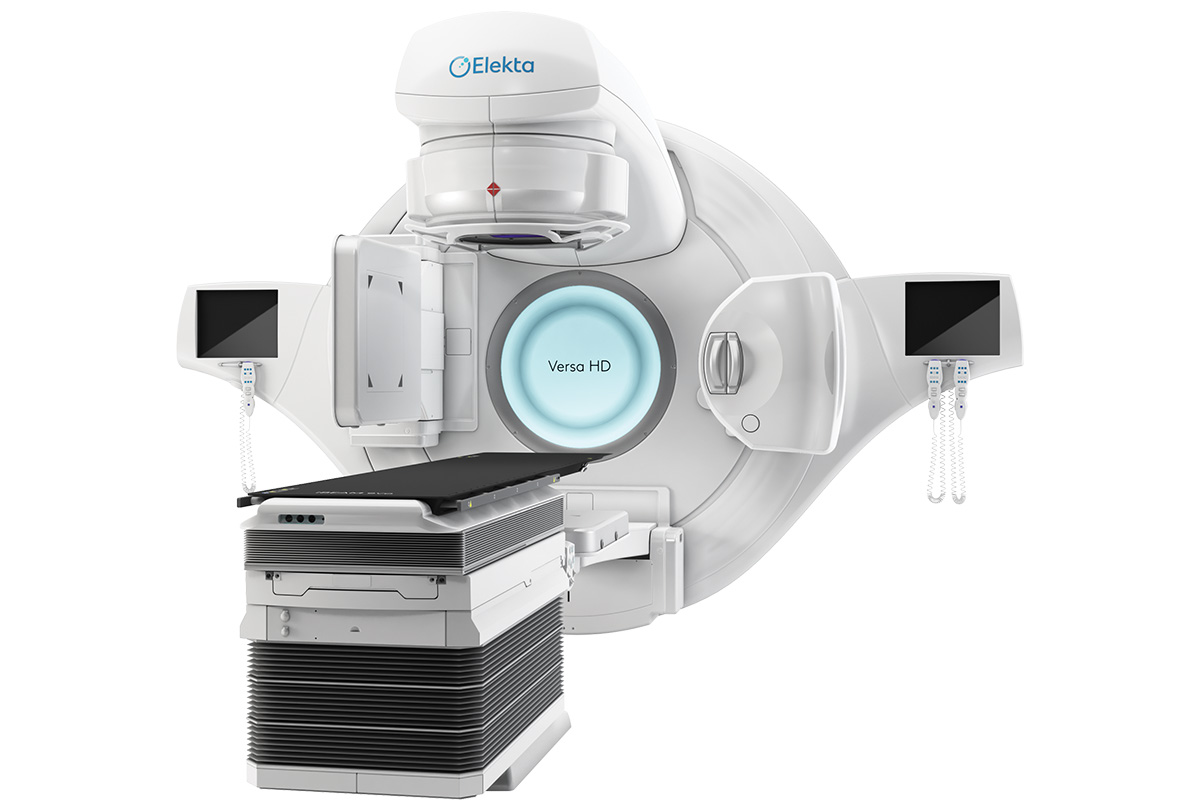
Oncologists at Florida Cancer Affiliates in Panama City now have at their disposal the Versa HD, a device that can position a patient precisely for cancer imaging and radiation beam targeting of tumors.
Although not new to the health care market, the Versa HD, manufactured by the Swedish company Elekta, is a seventh-generation machine that allows doctors to perform a combination of advanced radiation procedures that use external, multiple targeting beams from different angles to converge on a tumor.
It gives oncologists an effective option to treat a cancer patient when surgery would be too risky.
Versa HD is most effective when used on small, well-defined tumors, especially in the brain. The device also reduces destruction of healthy tissue around the tumor as well as the number of times a patient will have to undergo radiation treatment.
“We can deliver higher doses of radiation in fewer sessions, which leads to better tumor control and less normal-tissue toxicity,” says Florida Cancer Affiliates radiation oncologist Dr. Brian Center. “If you can perfectly deliver high doses to the tumor and avoid all normal tissue, then you can eradicate just about any cancer without any side effects. Less toxicity means less side effects from radiation and more hope for the future. That’s the ultimate goal.”
Meanwhile, at HCA Fort Walton-Destin Hospital, physicians are battling cancer through their new Incidental Lung Nodule Program that focuses on early detection, diagnosis and the use of robotic-assisted bronchoscopy procedures.
The program identifies nodules found incidentally on scans, which are then reviewed by a multidisciplinary team of specialists. If a biopsy is needed, physicians will employ a robotic-assisted bronchoscopy, a minimally invasive procedure to biopsy lung nodules, which can be difficult to reach with traditional methods.
Dr. Luke Yuhico, an interventional pulmonologist at HCA Fort Walton-Destin, says the “technology allows for earlier diagnosis and offers peace of mind to patients sooner.”
The procedure has many benefits that allow for increased accuracy and stability in accessing nodules at the outer edges of the lungs that are hard to reach with older technologies.
Dr. Yuhico also notes that the procedure has a lower risk of complications, such as lung collapse, compared to other biopsy methods, and has a confirmed success rate of 90%.
Identified nodules are reviewed in a weekly “nodule conference” with specialists including radiologists, pulmonologists, oncologists and surgeons to determine the best course of action.
The goal is simple: to catch lung cancer at its earliest, most treatable stages by identifying nodules before a patient has symptoms that include persistent cough, shortness of breath and discomfort in the chest.