










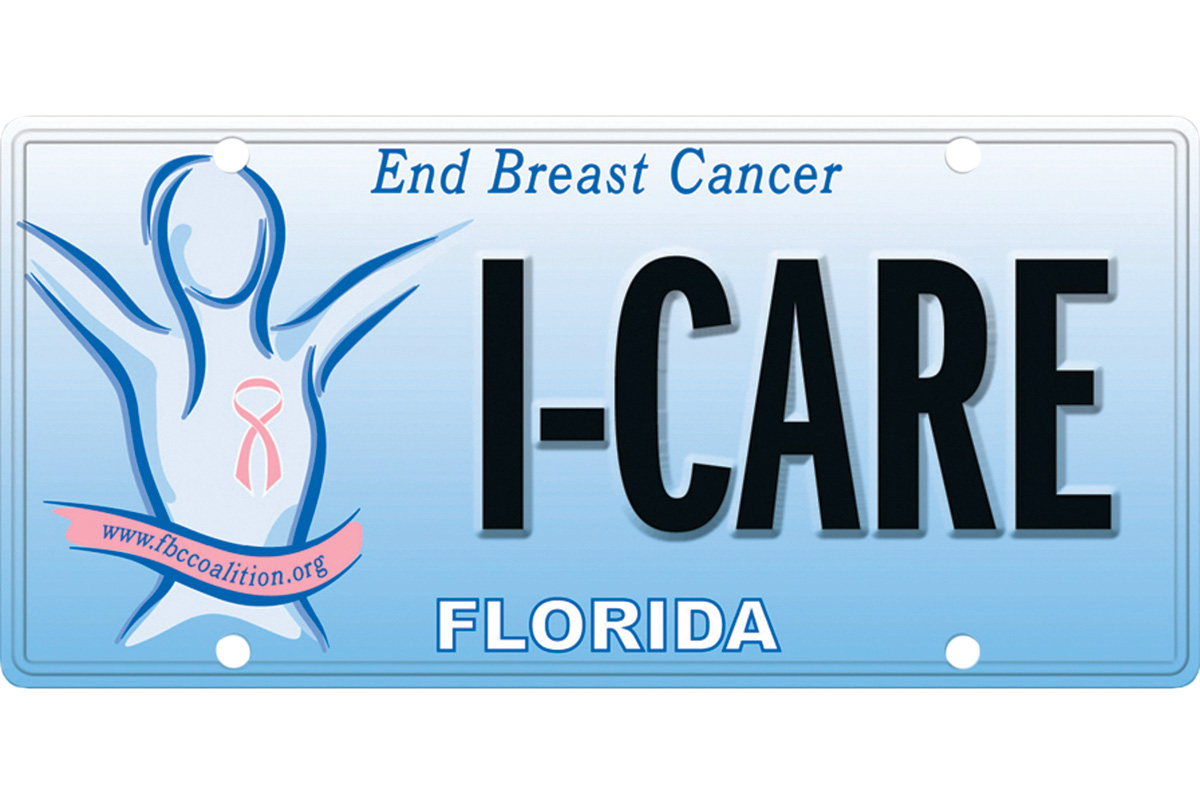
Florida has a huge number of specialty license plates — more than 100 of them. They allow drivers to personalize their vehicles and support various causes, universities or sports teams.
One of them is the “End Breast Cancer” license tag, which was introduced in 2002. Each time a vehicle owner purchases or renews this plate, the nonprofit Florida Breast Cancer Foundation receives $25. The state says there are 16,927 of these plates currently in circulation, and that funnels nearly $425,000 a year to the foundation.
“That number will fluctuate throughout the year depending on new sales and renewals,” says Cathy Cruz, the foundation’s communications director. “That number is about the average, but we’re hoping to grow it.”
So, where does all that license-plate money go? It pays for breast cancer research and education.
Each year, the foundation funds about $100,000 in education grants and $1 million in research grants. The license plate funds a lot of it but not all of it. The foundation also has a longstanding partnership with a donation service, Pickups for Breast Cancer, which donates a portion of its proceeds to the foundation. “We also receive donations from individuals and corporations during Breast Cancer Awareness Month and throughout the year,” Cruz says.
In the interest of transparency, the Breast Cancer Foundation spells out in detail on its website how all the money is spent.
“The education grants we fund support programs that promote breast health education and awareness in underserved communities and among youth, provide guidance on post-treatment survivorship, and aim to reduce late-stage diagnoses in high-risk areas across Florida,” Cruz says. Recent grants have gone to the Rural Women’s Health Project, the Big Bend Rural Health Network, the Community Health Center of West Palm Beach and the Family Health Centers of Southwest Florida, among other organizations.
And the $1 million in research grants? This past year, grants went to Moffitt Cancer Center, the University of Florida, the University of Miami and the University of Central Florida.
“The scientific research grants we fund target several priority areas: basic, clinical or translational research; environmental links; epidemiological studies; psycho-immunologic mechanisms; and innovative awards and idea grants,” Cruz says.
UCF won two of the foundation’s grants this past year. It was the first time that had ever happened. Two UCF cancer researchers, Debbie Altomare and Alicja Copik, each received $100,000 to fund their research.
Altomare has been studying how something called “fibroblast growth factor receptor 4” affects breast cancer cells. She’ll use the funding to examine how the growth factor in specific tumors impact their ability to spread. Her hope is that the research will help create new metastatic breast cancer therapies. “We’re looking at ways the tumor cells can be reprogrammed to better react to therapies and not be so drug-resistant,” she says.
Copik focuses her research on better arming the body’s natural killer cells to wipe out cancer. The foundation’s grant will help her refine her technologies to specifically fight breast cancer.
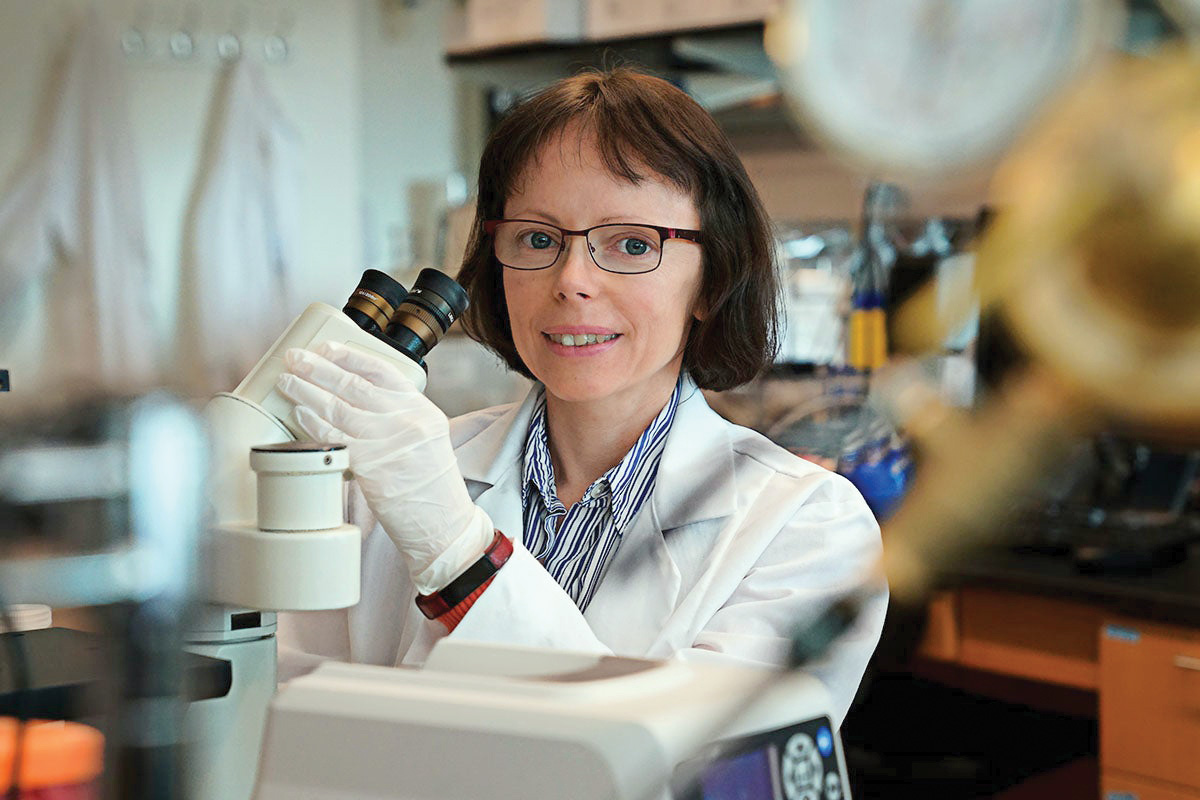
“We know chemo and radiation work, but they have drastic side effects,” Copik says. “We need to harness innovation and innovative thinking to improve care.”