



But icons beget iconoclasts. And some deride Weston as just the sort of development Florida should be discouraging rather than worshiping. Environmentalists, for instance, bemoan Weston's location -- "like a thumb sticking in the eye of the Everglades," says Alan Farago, executive director of the Everglades Defense Council -- and the harm they say it's done to natural water flows in the Glades. Despite their proximity to the Everglades, most residents can't even see the Glades from their homes or from Weston's meticulously landscaped roads.
Weston also affronts advocates of "new urbanism" who say its location away from an urban center, its porchless homes, cul-de-sacs and curvilinear roads trample on the holiest principles of community-building design. It's the type of place, the new urbanists say, that fosters an over-dependence on cars and engenders long commutes, alienation and suicidal teen-agers.
But for all its ubiquitous barrel-tiled roofs and repetitive home designs, Weston has sold like hotcakes to exactly those people who make up the natural audience for the anti-sprawl group: The educated and affluent. Weston may not have faced the challenge of building community among people from a wide range of incomes and races; but it nonetheless has managed, in a classic suburban setting, to achieve the new urbanists' ethos of community-building -- by boosting churches, synagogues, community centers, athletic fields and other places that put people together with their neighbors.
In the process, it has shown the possibilities for the sprawl that defines much of recent Florida development. And in a curious way, it may have validated the goals of the same new urbanists who snipe at its location and design. Weston has been successful "because it sold not just houses. It has social infrastructure," says Hunter.
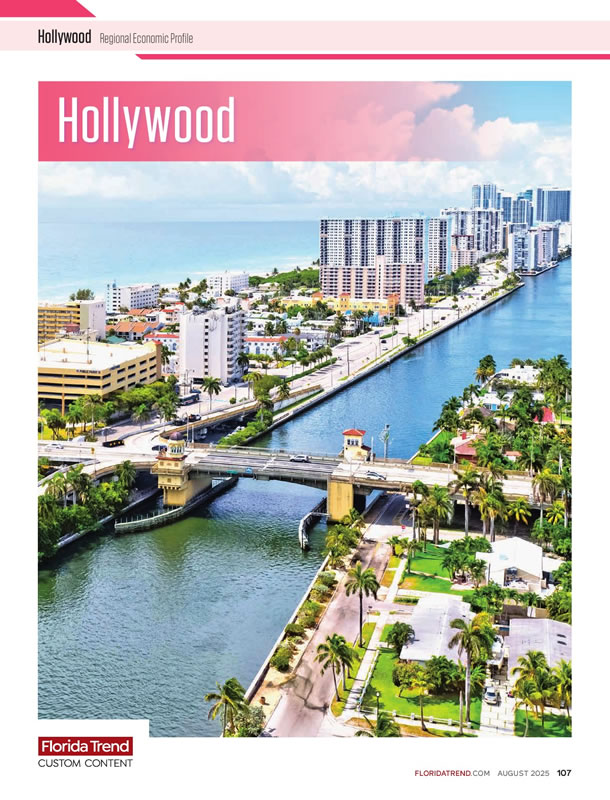
Like much of south Florida, Weston, now home to 49,286 people, was Everglades until it was drained to create agricultural land -- ranchland, in this case. Alcoa Chairman Arthur Vining Davis bought the property in the 1950s. Davis founded Arvida four years before his death in 1962, and the company has since gone on to develop some 60 planned communities with 40,000 homes. Weston always was a centerpiece.
Arvida's biggest decision with Weston was to scale it down. The company originally envisioned the project as a condo-dominated 60,000-unit development for south Florida's traditional snowbird and retiree markets. Believing that the family home market, not condo dwellers, was Weston's future, Arvida eventually plotted out a project with just under 16,000 units, most of them single-family homes.
Marketing prowess met serendipity: The completion of Interstate 75 from Miami to the project's doorstep in 1985 made Weston a viable bedroom community for Miami commuters, and Arvida offered houses at a range of prices appealing to everyone from entry-level buyers to multimillionaires. It hired Miami Dolphins quarterback Dan Marino, then an emerging NFL superstar, as pitchman and moved his young family into Weston. Arvida offered buyers bells and whistles such as a clubhouse in Weston's Savanna subsection with two pools, a water playground and nine-hole miniature golf course.
Hurricane Andrew in 1992 put insurance settlements in the hands of Miami-Dade County parents anxious to move to new homes with new schools in west Broward County. Terror and upheaval in Latin America sent family-oriented Latins swarming to Weston, where they found security behind the development's guard gates.
Today, 30% of Weston residents are Hispanic, the highest percentage of any city in Broward. A third of its population is under 18. That makes for overcrowded schools, but as is true with many overcrowded schools in hot-development areas, they reflect the shared expectations and values of like-minded parents. Most Weston schools score A's in the state's rating system.
Meanwhile, behind its many gates, Weston enjoys a crime rate that is a third that of Broward's and Palm Beach's and is less than a sixth that of Miami-Dade's. "Unbelievably low," says Lt. Mark Murray of the Broward sheriff's office, which acts as Weston's police force.
As it grew, Weston became one of the hottest-selling planned communities in the nation. In 2000, Weston had 1,728 new-home sales totaling $462 million -- the fourth-best performance in the country, according to tracking firm Robert Charles Lesser & Co. of Chevy Chase, Md. In Florida, only senior-targeted The Villages ["The Village People," September 2001] was hotter.
Weston's business districts, sitting just off I-75, became prime commercial locations. Banker-to-the-rich Northern Trust has a branch in Weston. Cleveland Clinic has a hospital. Hershey's has its Caribbean and Southeastern U.S. headquarters here. Weston's "town center" -- largely a specialty retail complex -- is as artificially grown as the rest of the city. It came near the end, rather than the beginning as is the case with traditional town centers.
Parents love Weston. "The kids aren't walking through parks with bottles broken, rims broken, people sleeping in the bushes," says house-hunter Howard Tripp, senior program director at the busy West Broward YMCA, which serves Weston. "The kids are walking through parks that are pristine."
Intangibles
The intangibles, however, are where Arvida distinguished itself and Weston from the mass of plain-vanilla suburbs. The company discounted land prices for temples and churches. It got them. It helped launch youth sport leagues. More than 2,000 kids now play soccer on teams in Weston.
Arvida's thinking was that as Weston homeowners ran into each other at kids' soccer games, an enrichment class or at the synagogue or church, they would feel connected. "Just designing houses with front porches doesn't mean you know your neighbors," points out George Casey, Arvida's south Florida operations president. The social spending created "a value that people call community." And they were willing and able to pay for it. The average home in 2000 sold for nearly $270,000.
Fitting in
Ross and Susan Manella moved to Weston 10 years ago from an older east Hollywood suburb in search of a community with more open space that was "more planned" and safe for kids. They say they do not want for a sense of community in Wes-ton -- or the amenities espoused by the new urbanists. Miles of walking paths allow them to "walk anywhere, jog anywhere." Awful commute? A lawyer, Ross has opened a Weston office. Susan, a doctor, practices medicine nearby for the North Broward Hospital District. Soulless suburb? He's president of B'nai Aviv, a 600-family Conservative synagogue that opened its permanent sanctuary in Weston last year. Weston also has a Reform temple and Orthodox synagogue. "You do feel it's your hometown," he says. "I feel I'm not just a number in the city. I feel the city is important to me and I'm important to the city."
Arvida didn't set out to copy the desired end-results of new urbanism; it just evolved as a goal, Casey says. "To make a community, you need the physical side and the soft side. It just developed. We had to go through the evolutionary process." Casey acknowledges that the project's scale allowed consistency of vision and has had a "huge amount" to do with Weston's success.
So, of course, has the community's economic and racial homogeneity: Compared with the rest of Florida, the community is younger, richer and has fewer African-Americans. There are no homeless, and immigrants are hardly tired, poor, huddled masses. At a recent immigration seminar in Weston hosted by the Americas Community Center, a fledgling interest group, the concerns were predictable -- expired visas and bureaucratic hassles in the naturalization process. The crowd, however, was well-dressed and professional -- Latin American doctors and businesspeople.Their morning conversations included stories of the latest friend-of-a-friend to be murdered back in Colombia. Their special concerns are getting licenses to practice medicine or their professions in Florida.
Weston's Latins are people like Omar Jiménez Cano, whose advertising business in Bogota had $10 million (U.S.) in annual revenues in 1994. Colombia's slide and threats from guerrillas led him and his family to emigrate. "I saw the future," he says. He founded Guia de broward, a Spanish-language magazine based in Weston.
Weston even has environmental defenders. By the time Arvida began pouring concrete home slabs, the land was just a remnant of its former Everglades self. It isn't reasonable to think it could have remained undeveloped, notes Roy Rogers, a longtime Arvida senior vice president in Weston and former vice chairman of the Florida Audubon Society. To get approval to build on 941 acres in its final phase, Weston had to agree to spend millions of dollars to restore and preserve the other 1,559 acres in the phase. Arvida devised what wetlands ecologist Thomas E. Lodge, author of "The Everglades Handbook," calls "if not the largest, it has to be one of the largest" private, single-development mitigation projects in existence.
As construction at Weston winds down, Arvida's new boss, St. Joe Co. of Jacksonville, is drawing on Weston's lessons as it develops its 1 million acres in the Panhandle. Plans for at least some of those projects, unlike Weston, will incorporate many new urbanist-style design features. But like Weston, social infrastructure will be a key, company executives say.
Rogers, the Arvida executive, ticks off the list of things that could have derailed Weston's success: A bad recession, the location nearby of a prison or landfill, an environmental lawsuit, a hurricane, an untoward change in ownership. "We've had this unbelievable success and sustained continuity for over 15 years, and that's rare," Rogers says. "A lot of it had to do with luck and a lot of it had to do with planning."